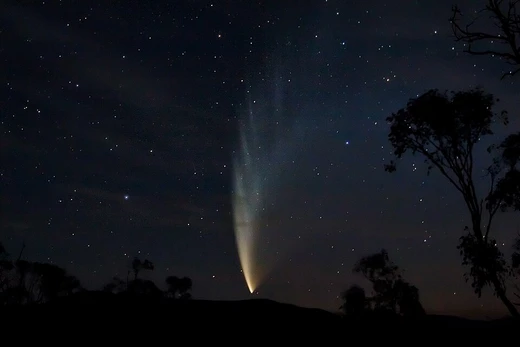
C/2014 B1 (Schwartz)
Distant parabolic comet with activity driven by carbon dioxide and carbon monoxide.
Last updated
C/2014 B1 (Schwartz) is a distant parabolic comet discovered by American astronomer Michael B. Schwartz on 28 January 2014 using an astrograph at the Tenagra Observatory near Nogales, Arizona. It is notable for its large perihelion distance of 9.56 AU, which places it far from the Sun and makes it too cold for water ice to sublimate, with cometary activity driven instead by carbon dioxide and carbon monoxide gases.
Background
The comet was discovered in the early evening of 28 January 2014 by American astronomer Michael B. Schwartz using an astrograph from the Tenagra Observatory near Nogales, Arizona. At discovery, it was about 12.0 AU from the Sun. Subsequent observations from several other observatories worldwide confirmed its cometary nature on 29 January 2014.
The comet reached perihelion in September 2017, achieving its maximum recorded brightness as a 15th-magnitude object. In 2021, it was 1.61 billion km from Earth and was observed near the galaxy PGC 48046, where it was expected to remain brighter than magnitude 20.0 until at least 2023.
Observations from the NEOWISE mission revealed that due to the comet's large perihelion distance, which is too cold for water ice to sublimate, cometary activity is mostly driven by carbon dioxide and carbon monoxide gases, a phenomenon also seen in comets C/2010 U3 and C/2017 K2. Ground observations showed a morphologically stable discus-shaped coma that increased in brightness by 1.0 magnitude by perihelion. Initial nucleus size estimates in 2019 were roughly 2–10 km in radius; reanalysis of a 2017 photographic observation refined the effective radius to 6.364±0.214 km. Spectral and polarimetric observations from the Smithsonian Astrophysical Observatory revealed that jet structures are much redder than the ambient coma, and the nucleus itself also has a reddish color.
More in Named Comets
Sources
Compiled from Wikipedia and the sources listed below. Text from Wikipedia is available under CC BY-SA 4.0; this entry is adapted from it.
- Wikipedia: C/2014 B1 (Schwartz) (CC BY-SA 4.0).
- Word definitions: the Codexery glossary, each quoted from its Wikipedia article.
Spotted an error? Know more?
Reader corrections go straight into our review queue. Suggest an edit · How this site is sourced