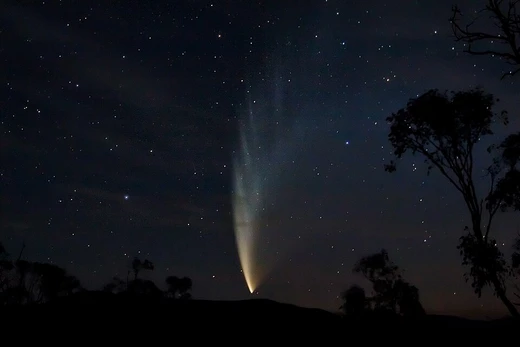
Comet Tsuchinshan–ATLAS
Brightest Northern Hemisphere comet since Hale–Bopp in 1997.
Last updated
Discovered independently by two observatories, this object from the Oort cloud—formally designated C/2023 A3—was first spotted on 9 January 2023 by China's Purple Mountain Observatory and later detected by ATLAS South Africa on 22 February 2023.[1] On 27 September 2024 the comet reached perihelion at 0.39 AU, and observations reported to the Comet Observation Database (COBS) showed it peaked at magnitude −4.9 on 9 October, which made it the Northern Hemisphere's brightest comet since Hale–Bopp in 1997.[1]
Key facts and history
A month and a half later, it was independently identified by a 0.5-meter Schmidt telescope at the South African Astronomical Observatory in Sutherland, part of the ATLAS network.[2] The name Tsuchinshan is an older transliteration of Zijinshan, Chinese for “purple mountain,” traditionally used for comets discovered by Purple Mountain Observatory.[2] In May and June 2024, the brightening rate slowed and the comet stayed between magnitudes 10 and 11, with a dusty tail extending eastward.[3] Astronomer Zdenek Sekanina suggested that this indicated the comet nucleus had been fragmenting, with fragmentation starting in late March.[3]
The comet was recovered by Terry Lovejoy on 11 September 2024 in the constellation Sextans at magnitude 5.5.[4] It was first observed with the naked eye from Earth on 23 September, with an estimated magnitude of 3.3 and a tail 2.5 degrees long in binoculars.[4] On 9 October 2024 the comet was located 3.5 degrees from the Sun and brightened to an apparent magnitude of −4.9, placing it among the most luminous comets seen in the last hundred years.[5][6] Earth's closest encounter with the comet occurred on 12 October at 71 million km distance, when its apparent magnitude was estimated at 0 and its tail length at 4 degrees.[7]
What the research sources say
Mark Zastrow's article in Astronomy notes that the comet arrived with a year and a half of fanfare and lived up to the hype, serving up naked-eye views for weeks.[2] The same source records that at its peak the comet was magnitude –4.9, the brightest in the Northern Hemisphere since 1997's Hale-Bopp, and sported a tail stretching up to 15° in photographs plus a stark anti-tail.[2] A Spaceweather.com report from 28 August 2024 quotes astronomer Qicheng Zhang of Lowell Observatory stating the comet continued to brighten steadily and was up to magnitude 7, predicting it would brighten to magnitude +4 ± 1 at perihelion.[8] Zhang also noted that the comet reminded him of Comet Arend-Roland in 1957, whose combined tails extended several tens of degrees for a few days.[8]
Spaceweather.com reported on 2 November 2024 that the comet had dimmed to below magnitude +6, making it invisible without optical aid, though it remained impressive when viewed through binoculars.[9]
References
- Wikipedia, "Comet Tsuchinshan–ATLAS" (CC BY-SA 4.0), which cites: "MPEC 2023-D77 : COMET C/2023 A3 (Tsuchinshan–ATLAS)", minorplanetcenter.net; "Horizons Batch for C/2023 A3 (Tsuchinshan–ATLAS) on 2024-Sep-27", JPL Horizons; "Observation list for C/2023 A3", cobs.si; "Spaceweather.com Time Machine: Saturday, Sep. 28, 2024", spaceweather.com; "Observation list for C/2023 A3", cobs.si; Mark Zastrow, "Remembering Comet Tsuchinshan-ATLAS: The comet of the year", Astronomy, 6 May 2025 (we also read that source) en.wikipedia.org
- Mark Zastrow, "Remembering Comet Tsuchinshan-ATLAS: The comet of the year", Astronomy, 6 May 2025. facts only, no text reused. astronomy.com
- Wikipedia, "Comet Tsuchinshan–ATLAS" (CC BY-SA 4.0), which cites: "Spaceweather.com Time Machine: Wednesday, Aug. 28, 2024", spaceweather.com (we also read that source) en.wikipedia.org
- Wikipedia, "Comet Tsuchinshan–ATLAS" (CC BY-SA 4.0), which cites: Todd, "'Totally awesome to see a comet from orbit'. Astronauts photograph Comet C/2023 A3 from the Space Station", BBC Sky at Night, 25 September 2024; "Observation list for C/2023 A3", cobs.si (we also read that source) en.wikipedia.org
- Wikipedia, "Comet Tsuchinshan–ATLAS" (CC BY-SA 4.0), which cites: "Comet Tsuchinshan-ATLAS Comes into View of Coronagraph Imagery NOAA / NWS Space Weather Prediction Center", swpc.noaa.gov; Thomas, "ESA/NASA's SOHO Spies Bright Comet Making Debut in Evening Sky – NASA Science", science.nasa.gov, 11 October 2024 (original not read by us) en.wikipedia.org
- Wikipedia, "Comet Tsuchinshan–ATLAS" (CC BY-SA 4.0), which cites: "Observation list for C/2023 A3", cobs.si (we also read that source) en.wikipedia.org
- Wikipedia, "Comet Tsuchinshan–ATLAS" (CC BY-SA 4.0), which cites: "Spaceweather.com Time Machine: Saturday, Nov. 2, 2024", spaceweather.com (we also read that source) en.wikipedia.org
- "Spaceweather.com Time Machine: Wednesday, Aug. 28, 2024", spaceweather.com. facts only, no text reused. spaceweather.com
- "Spaceweather.com Time Machine: Saturday, Nov. 2, 2024", spaceweather.com. facts only, no text reused. spaceweather.com
Each numbered sentence above was checked against the source it cites before publication. Sentences citing Wikipedia adapt text from the English Wikipedia article Comet Tsuchinshan–ATLAS (contributors), used under CC BY-SA 4.0; this entry is available under the same licence. Other sources were used for facts only; no text or images are copied from them.
More in Named Comets
Sources
Compiled from Wikipedia and the sources listed below. Text from Wikipedia is available under CC BY-SA 4.0; this entry is adapted from it.
- Wikipedia: Comet Tsuchinshan–ATLAS (CC BY-SA 4.0).
- Word definitions: the , each quoted from its Wikipedia article.
Spotted an error? Know more?
Reader corrections go straight into our review queue. Suggest an edit · How this site is sourced