
Bluegrass music
Acoustic string-band music with driving off-beat and high lonesome vocals.

Bohemian Baltimore · CC BY-SA 4.0
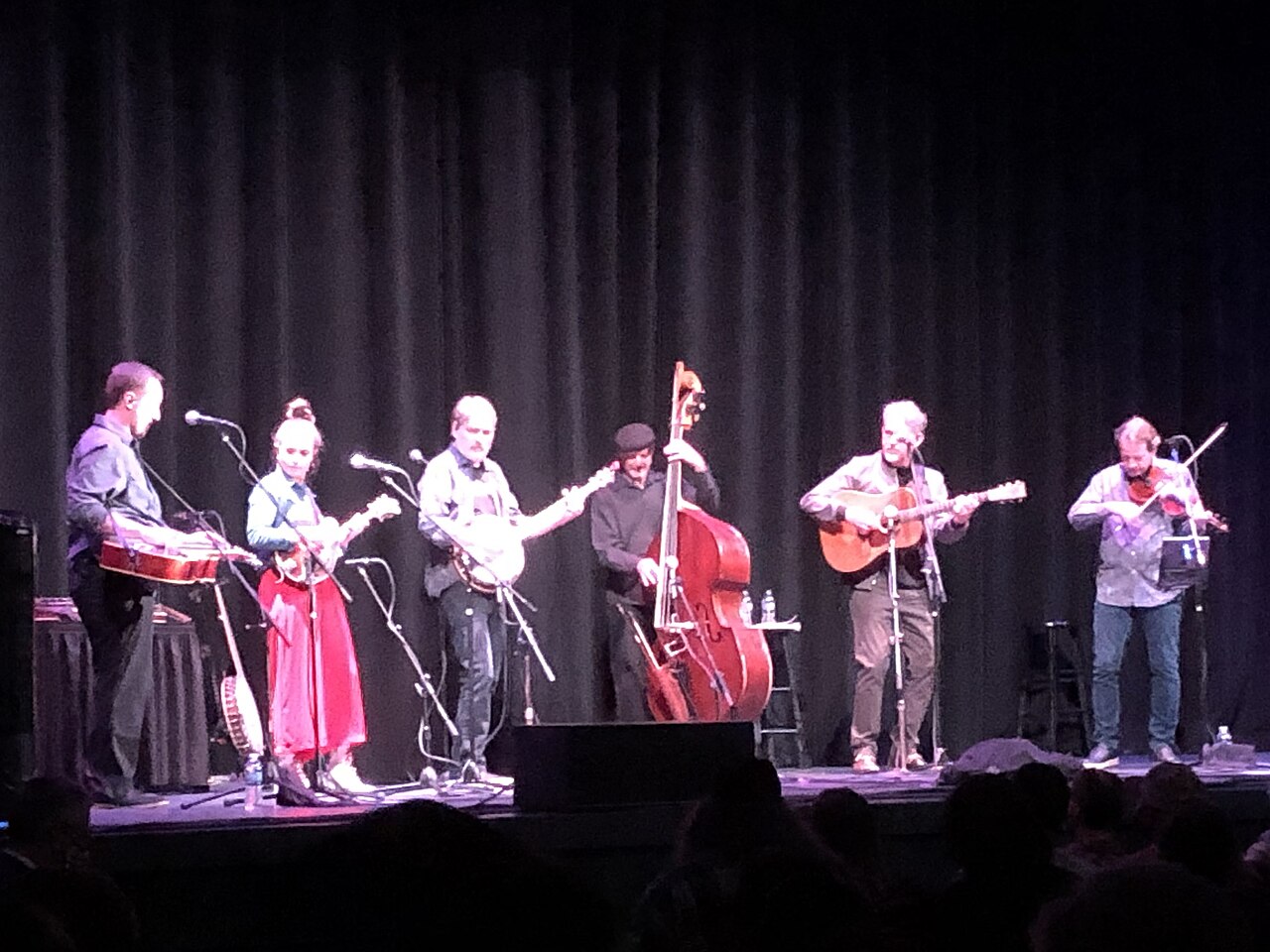
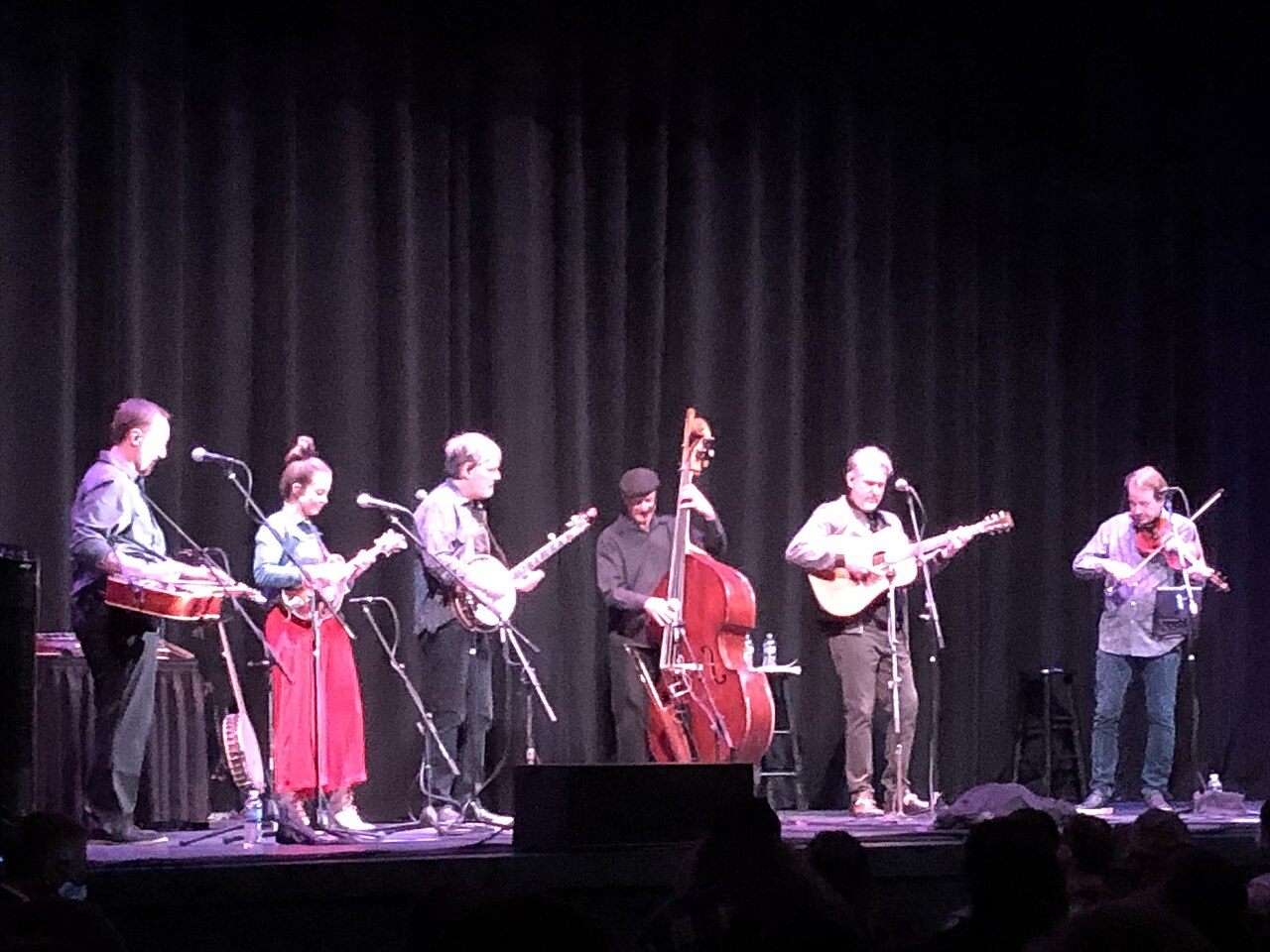
Bluegrass music is a genre of American roots music that originated in the 1940s within the Appalachian region of the United States. Its name comes from the band Bill Monroe and the Blue Grass Boys. The style draws on African American musical traditions such as blues and jazz, as well as Northern European influences including Irish ballads and dance tunes. Unlike mainstream country music, bluegrass is traditionally performed exclusively on acoustic instruments: the fiddle, mandolin, banjo, guitar, and upright bass. The genre was further developed by musicians who had played with Monroe, most notably five-string banjo player Earl Scruggs and guitarist Lester Flatt. Monroe himself described bluegrass as being part of Methodist, Holiness, and Baptist traditions, blending blues and jazz with what he called a "high lonesome sound."
Musically, bluegrass emphasizes the off-beat, which can be either "driven" (played close to the previous bass note) or "swung" (played farther from it). Notes are anticipated, creating higher energy than the laid-back blues style where notes fall behind the beat. As in most jazz, instrumentalists take turns playing the melody and improvising around it while others provide accompaniment, especially in tunes called breakdowns. This contrasts with old-time music, where all players perform the melody together or one instrument carries the lead. Breakdowns are often fast-paced, demanding unusual dexterity and sometimes featuring complex chord changes.
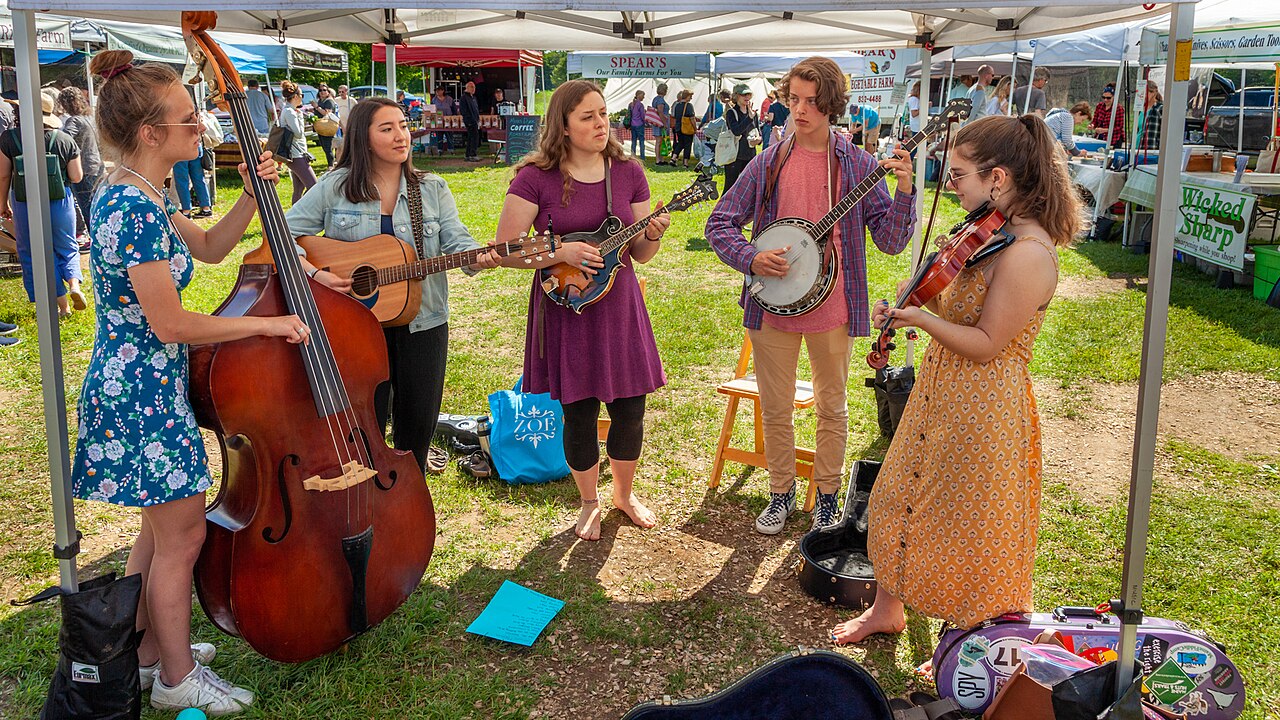
The standard instrumentation—fiddle, five-string banjo, guitar, mandolin, and upright bass—originated in rural dance bands and formed the basis for early bluegrass groups. The fiddle, introduced to America from sixteenth-century Europe, became popular for its small size and versatility. Banjos arrived via the African slave trade and gained white American attention through minstrel shows; while the clawhammer style was common before the Civil War, modern players predominantly use the three-finger picking style popularized by Earl Scruggs. The guitar, originating in eighteenth-century Spain, is used primarily for rhythm, often played with a flatpicking technique rather than the thumb-and-finger pick style of early players like Lester Flatt. Bassists play pizzicato, occasionally using a slap-style to accent the beat, with a bass line that alternates between the root and fifth of each chord.
Voc
- field
- American roots music
- nationality
- United States
- known_for
- Acoustic stringed instruments, off-beat rhythms, high lonesome sound, vocal harmony
- origin_region
- Appalachian region
- era
- 1940s
Lore & Background
Bluegrass music is a genre of American roots music that emerged in the 1940s within the Appalachian region, taking its name from Bill Monroe and his band, the Blue Grass Boys. Its roots lie in African American genres such as blues and jazz, as well as North European traditions like Irish ballads and dance tunes. Unlike country music, bluegrass is traditionally performed exclusively on acoustic instruments: fiddle, mandolin, banjo, guitar, and upright bass. The genre was further shaped by musicians who played with Monroe, including banjoist Earl Scruggs and guitarist Lester Flatt. Monroe himself described the music as part of Methodist, Holiness, and Baptist traditions, blending blues and jazz with a "high lonesome sound."
The music emphasizes the off-beat, which can be either "driven" (close to the previous bass note) or "swung" (farther from it). Notes are anticipated, creating higher energy, in contrast to the laid-back feel of blues. Like jazz, bluegrass features instrumentalists taking turns playing and improvising around the melody while others accompany—especially in tunes called breakdowns, which are characterized by rapid tempos, dexterity, and complex chord changes. This differs from old-time music, where all players perform the melody together.
Instrumentation typically includes fiddle, five-string banjo, guitar, mandolin, and upright bass, sometimes joined by resonator guitar, harmonica, or Jew’s harp. The fiddle, of Italian origin, was among the first instruments brought to America. Banjos arrived via the African slave trade and gained popularity through minstrel shows; modern players primarily use the three-finger picking style popularized by Scruggs. Guitars, originating in eighteenth-century Spain, are used mainly for rhythm, often played with flatpicking. Bassists play pizzicato, alternating between root and fifth of each chord. Traditionalists argue for the exact instrumentation of Monroe’s band, though departures like dobro, accordion, drums, or electric instruments have led to "new grass." Even Monroe experimented, once using a string orchestra, choir, and recorded bird song.
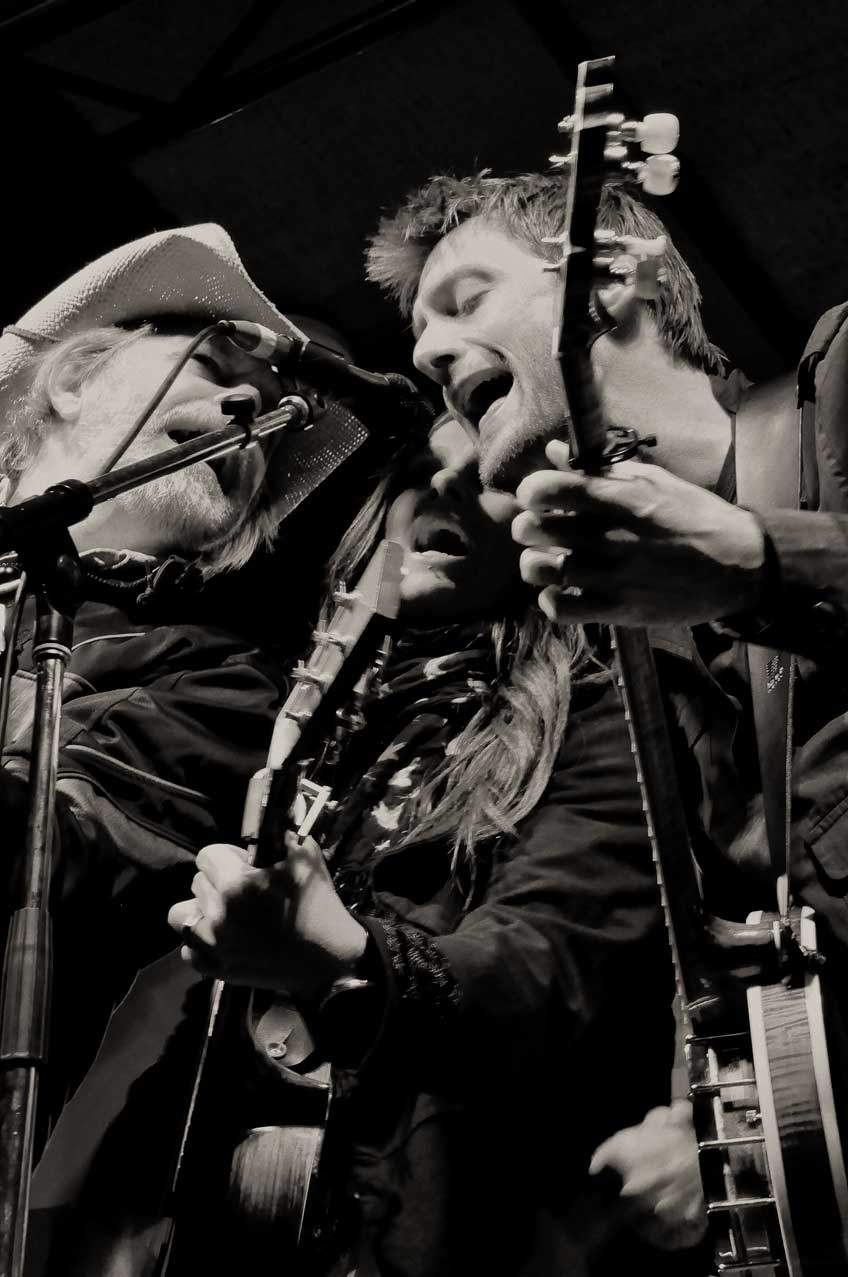
Vocally, bluegrass is distinguished by two-, three-, or four-part harmony, often with a dissonant or modal high voice—the "high, lonesome sound." The standard vocal stack places baritone at the bottom, lead in the middle, and tenor on top, though variations exist,
Reader's Guide
Bluegrass music is significant as a distinct American roots genre that emerged in the 1940s in Appalachia, blending African American blues and jazz with North European ballads and dance tunes. Its name comes from Bill Monroe and the Blue Grass Boys. The genre is characterized by acoustic stringed instruments—fiddle, banjo, guitar, mandolin, upright bass—and a driving off-beat rhythm, with notes anticipated rather than laid-back. Vocal harmony features two, three, or four parts, often with a dissonant or modal high voice described as the 'high, lonesome sound.' Instrumentation debates persist, with traditionalists favoring Monroe's original lineup, though even Monroe experimented with string orchestra, choir, and pre-recorded bird-song. Bluegrass tunes often narrate everyday Appalachian life, including laments about loves lost, coal mining, and railroading. The genre's legacy includes its influence on later acoustic music and its preservation of British and African American musical traditions.
Did You Know?
- Bluegrass derives its name from the band Bill Monroe and the Blue Grass Boys.
- The banjo was brought to America through the African slave trade.
- Bluegrass vocals often feature a 'high, lonesome sound' with a dissonant or modal highest voice.
Placement Within the Broader Taxonomy
Music genre classification is a layered system in which broad categories encompass narrower sub-categories, and a style like Bluegrass finds its position through this hierarchical structure. Within the popular music umbrella, Country and Folk stand as major branches, while Traditional folk occupies a separate tier that includes dance music, patriotic compositions, and other heritage forms. A genre such as Bluegrass naturally gravitates toward the intersection of these categories, yet the precise placement is never settled. The source material is explicit that classifications are often arbitrary and frequently disputed, and that closely related musical forms tend to overlap rather than sit in neat boxes. This means that Bluegrass does not occupy a single, fixed slot in any one taxonomy; instead, it threads through Country, Folk, and Traditional folk simultaneously, reflecting the fluid reality of how musicians and listeners actually experience the music. The larger genre-and-style framework simply provides scaffolding for a form that resists being pinned to one label.
The Commercial Engine Behind Genre Labels
Behind every genre tag sits a practical commercial purpose. The provided facts make clear that the vast majority of music genres were created by record labels and industry players specifically to target new audiences and streamline distribution. A platform like Gracenote has catalogued more than two thousand distinct genre names, a number that underscores how prolifically the industry multiplies categories to carve out market segments. For a style like Bluegrass, the genre label functions as a shorthand that tells a retailer, a streaming algorithm, or a radio programmer exactly which listeners to reach. This commercial machinery does not reflect any inherent musical boundary; rather, it is a tool for finding and distributing music efficiently. The taxonomy serves the marketplace as much as it serves the musician, and the proliferation of sub-categories under broader headings like Country or Folk reveals a business logic in which specificity is a selling point. Understanding this commercial origin helps explain why genre boundaries feel both useful and arbitrary at the same time.
Folksonomy and the Listener's Own Taxonomy
Not every genre category is born in a boardroom. The facts note that a significant portion of the more than two thousand genres listed by platforms like Gracenote were created by ordinary music lovers who have no formal role in the music industry. This grassroots classification practice is called a folksonomy, a taxonomy built by non-experts who simply want to describe and share what they hear. For a community surrounding Bluegrass, this bottom-up naming carries real weight. Fans, jam-session participants, and local radio hosts may coin or adopt sub-labels that capture nuances no corporate catalog anticipates. The folksonomy sits alongside the industry taxonomy, and the two often diverge or contradict each other. A listener might file a particular Bluegrass recording under a regional or traditional-folk heading that a label would instead slot under Country. This dual system of classification means that the official genre of a piece of music is always provisional, shaped as much by the community's shared vocabulary as by any single institutional authority.
Boundaries That Blur: Overlap with Neighboring Forms
One of the most consistent observations in the source material is that closely related musical forms overlap, and that the lines between them are often disputed. This is especially relevant for a genre like Bluegrass, which sits at the crossroads of multiple recognized categories. The taxonomy lists Country, Folk, and Traditional folk as distinct headings, yet in practice a single Bluegrass recording could legitimately be shelved under any of them. The facts also note that in North America and Western Europe, regional and national genres that are not part of the Western canon are sometimes lumped together under the broad label of world music, a catch-all that further illustrates how classification can flatten distinctions. Dance music, work songs, and oral traditions appear in the traditional-folk section, suggesting that Bluegrass shares a lineage with these heritage forms even as it is marketed as a separate popular genre. The result is a genre whose identity is defined as much by what it touches as by what it stands apart from, and whose boundaries remain a matter of ongoing negotiation rather than fixed fact.
Gallery


Frequently Asked Questions
What is Bluegrass music and where did it originate?
Bluegrass is an American roots music genre that emerged in the Appalachian region during the 1940s. It weaves together African American traditions such as blues and jazz with North European forms like Irish ballads and dance tunes.
What instruments define Bluegrass music?
The genre is traditionally performed entirely on acoustic stringed instruments, most commonly the five-string banjo, mandolin, fiddle, guitar, and upright bass. This all-acoustic string-band setup is a defining characteristic that sets it apart from many other American popular styles.
Why is the genre called 'Bluegrass'?
The name traces back to Bill Monroe's band, the Blue Grass Boys, who are widely credited with pioneering the style in the 1940s. Monroe's ensemble, along with key players like banjoist Earl Scruggs, helped shape the sound that gave the genre its identity.
How does Bluegrass differ from country music?
While both draw from American folk traditions, Bluegrass is strictly an acoustic string-band format built around driving off-beat rhythms and close vocal harmonies. Country music, by contrast, routinely incorporates electric instruments and a far wider range of production techniques.
What is the 'high lonesome' sound in Bluegrass?
It refers to the distinctive, piercing vocal timbre that lead singers produce, often in a high register with a raw, unpolished quality. Paired with tight group harmonies and fast, syncopated instrumental breaks, it gives Bluegrass its signature emotional intensity.
More in Musical Genres And Styles 1-21
Spotted an error? Know more?
This is a living reference — every entry is fact-audited, and reader corrections feed straight into our audit queue. Suggest an edit · See this site's audit record