
Ambient music
A genre emphasizing tone and atmosphere over structure.

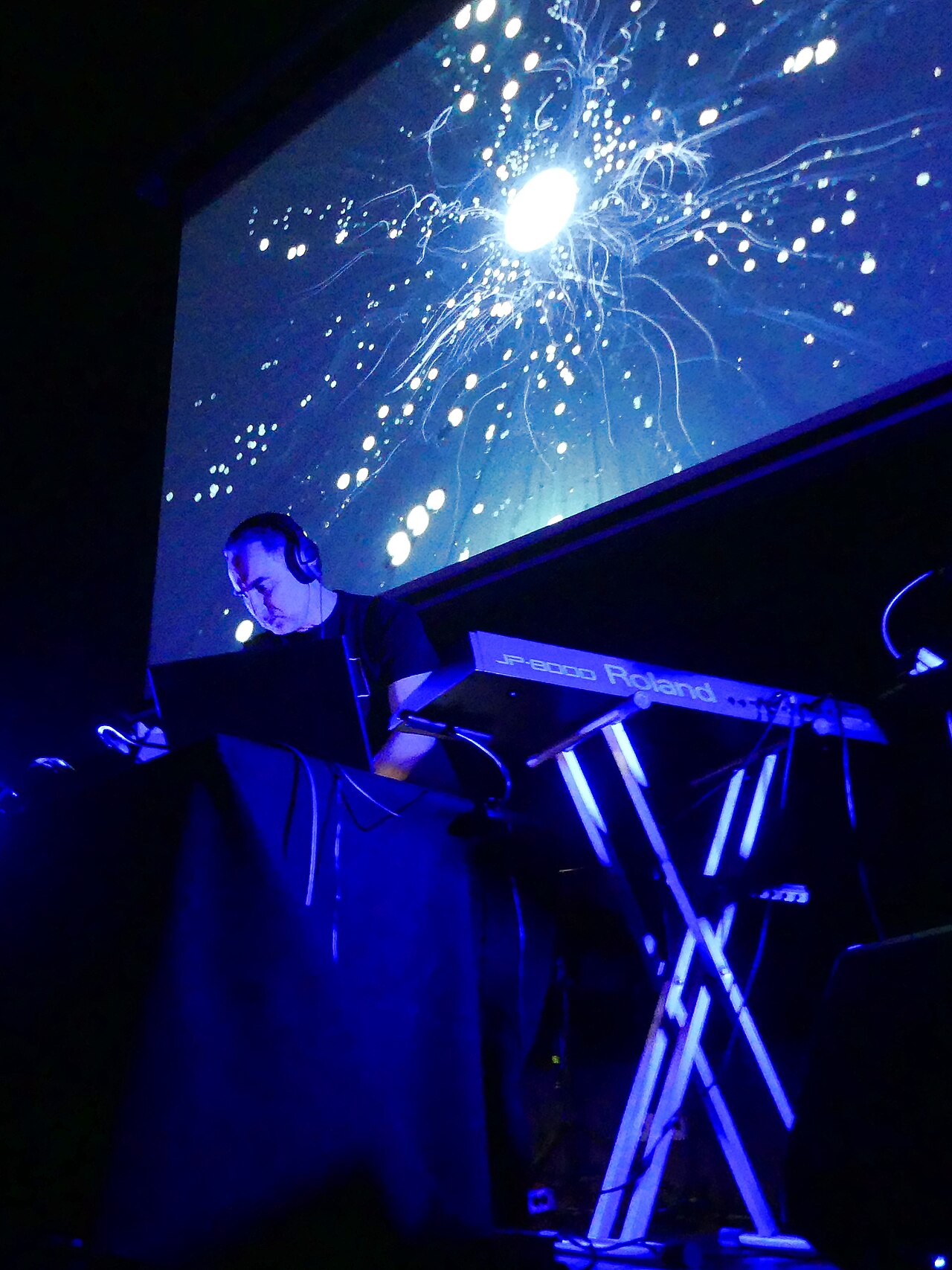
Akos Kokai · CC BY 2.0
Ambient music is a genre built around tone and atmosphere, setting aside traditional rhythm, composition, and melody in favor of layered textures. It often sounds calm and can be enjoyed through either passive or active listening, promoting a sense of peace or reflection. The music tends to feel atmospheric, visual, or unobtrusive, sometimes incorporating nature soundscapes or sustained, repeated notes similar to drone music. Synthesizers are frequently used to emulate instruments like piano, strings, and flute, giving it a connection to new-age music.
The genre took shape in the 1960s and 1970s as new instruments, especially the synthesizer, became more widely available. Its roots go back to earlier experiments: Erik Satie’s “furniture music,” which was meant to blend into the background of daily life; musique concrète, which manipulated recorded natural sounds; minimal music, with its repetitive patterns and drones; Jamaican dub music; and German electronic music. The term “ambient” was coined and popularized by British musician Brian Eno with his 1978 album *Ambient 1: Music for Airports*. Eno described the music as needing to be “as ignorable as it is interesting.” Early pioneers in the style included Tangerine Dream, Klaus Schulze, Wendy Carlos, and Kraftwerk. The genre saw a revival in the late 1980s alongside house and techno, and by the 1990s it had developed a cult following.
Ambient music has never achieved major commercial success, but it has gained steady acclaim, especially in the Internet age. Its open structure allows it to draw from many other genres, including classical, avant-garde, experimental, folk, jazz, and world music.
**History**
In the early 20th century, French composer Erik Satie created what he called “furniture music” (Musique d'ameublement), a Dadaist-inspired form of background music. He intended it to be played during dinners, blending into the environment rather than commanding attention. Satie described it as music that would become part of the noise of the surroundings, softening sounds like knives and forks without dominating them, filling silences between friends, and neutralizing street noise.
In 1948, French composer and engineer Pierre Schaeffer coined the term *musique concrète*. This experimental style used recordings of natural sounds that were modified and manipulated to create compositions. Schaeffer’s use of tape loops and splicing is seen as a precursor to modern sampling.
In 1952, John Cage released his composition *4'33"*, a three-movement piece consisting of complete silence. The performance was meant to capture the ambient sounds of the venue, making them the music itself. Cage was cited as an influence by Brian Eno and other seminal artists.
**1960s**
During the 1960s, many music groups experimented with unusual methods, leading to what would later be called ambient music. In the summer of 1962, composers Ramon Sender and Morton Subotnick founded the San Francisco Tape Music Center, which served as both an electronic music studio and concert venue. Other composers working with tape recorders, including Pauline Oliveros, Terry Riley, and Steve Reich, contributed to the development of minimal music, which shares ambient music’s repetitive patterns, steady drones, and consonant harmony.
Between the mid-1960s and mid-1990s, many records in Europe and the United States established the conventions of ambient music in the English-language popular market. Examples from the 1960s include *Music for Yoga Meditation and Other Joys* and *Music for Zen Meditation* by Tony Scott, *Soothing Sounds for Baby* by Raymond Scott, and the first record in Irv Teibel’s *Environments* series.
In the late 1960s, French composer Éliane Radigue created pieces by processing tape loops from the feedback between two tape recorders and a microphone. In the 1970s, she continued this approach using an ARP 2500 synthesizer, and her long, slow compositions are often compared to drone music. In 1969, the group COUM Transmissions performed sonic experiments in British art schools. Pearls Before Swine’s 1968 album *Balaklava* included sounds of birdsong and ocean noise, which later became common tropes in ambient music.
**1970s**
Ambient music developed further in the 1970s, growing out of the experimental and synthesizer-oriented styles of the era. Between 1974 and 1976, American composer Laurie Spiegel created *The Expanding Universe* on a computer-analog hybrid system called GROOVE. In 1977, her composition *Music of the Spheres* was included on the Voyager 1 and 2 Golden Record.
In April 1975, Suzanne Ciani performed twice on her Buchla synthesizer—once at the WBAI Free Music Store and once at Phil Niblock’s loft. These performances were released in 2016 on an archival album titled *Buchla Concerts 1975*. According to the record label, the concerts were part live presentation, part grant application, and part educational demonstration.
It was not until Brian Eno’s work that the genre was formally named and widely recognized.
Lore & Background
Ambient music originated in the 1960s and 1970s as new musical instruments like the synthesizer became widely available. It was presaged by Erik Satie's early 20th-century 'furniture music,' which was intended as background atmosphere, and by Pierre Schaeffer's musique concrète, which used manipulated natural sounds. In the 1960s, groups such as The San Francisco Tape Music Center, founded by Ramon Sender and Morton Subotnick, contributed to tape and electronic music, which shares concepts with ambient music such as repetitive patterns and steady drones. Records from the mid-1960s to mid-1990s established ambient conventions, including works by Tony Scott, Raymond Scott, and Irv Teibel's Environments series.
Reader's Guide
Ambient music has not achieved large commercial success but has attained acclaim, especially in the Internet age. It often takes influences from many genres, including classical, avant-garde, experimental, folk, jazz, and world music. The genre saw a revival towards the late 1980s with the prominence of house and techno music, growing a cult following by the 1990s. The rise of the synthesizer was crucial, as Ralf Hutter of Kraftwerk noted: 'Electronics is beyond nations and colors...with electronics everything is possible.' The genre's open style allows it to incorporate elements from diverse musical traditions, maintaining its role as a contemplative, atmospheric form.
Did You Know?
- Erik Satie's early 20th-century 'furniture music' was an early form of ambient/background music.
- The genre saw a revival towards the late 1980s and early 1990s with the prominence of ambient house and artists like The Orb and Aphex Twin.
Philosophical Roots — Music as Atmosphere
The idea that music could serve as a backdrop rather than a focal point stretches back further than most listeners realize. In early twentieth-century France, Erik Satie envisioned what he called "furniture music" — compositions designed to soften the clatter of cutlery at a dinner table, fill awkward silences between friends, and blend into the ambient noise of a room without demanding attention. He wanted sound that responded to a practical need rather than commanding the ear. Both artists treated the sonic environment itself as a valid musical material, a notion that would echo through every subsequent generation of ambient composers. Their shared conviction was that listening could be passive, that sound could exist without structure or melody, and that the listener's relationship to music need not be one of focused attention.
The Studio as Instrument — 1960s and 70s Innovation
The birth of ambient sound was inseparable from new technology entering the hands of experimental composers. Their work in repetitive patterns, steady drones, and consonant harmony laid groundwork that ambient music would later inherit. These artists treated the studio itself as a compositional instrument, layering textures that would define the genre's aesthetic.
Naming a Sound — Eno and the Genre's Identity
Although the sonic ingredients had been circulating for years, it was British musician Brian Eno who gave the genre its name and a working philosophy. Yet Eno was not working in isolation. German electronic acts like Tangerine Dream, Klaus Schulze, and Kraftwerk, American composer Wendy Carlos, and Jamaican dub pioneers such as King Tubby were all producing ambient-adjacent work in the same period. The genre's identity, then, was less a single invention than a convergence of global experiments that Eno's naming helped organize into a coherent tradition.
A Quiet Legacy — Commercial Margins and Cultural Reach
Ambient music has never dominated the commercial charts, yet its cultural footprint has grown steadily, particularly in the Internet age where its contemplative qualities found a receptive audience. The genre saw a notable revival in the late 1980s, riding the wave of house and techno music, and by the 1990s it had cultivated a devoted cult following. Its relatively open formal structure means it readily absorbs influences from classical, avant-garde, experimental, folk, jazz, and world music, making it a remarkably porous and adaptive field. Nature soundscapes, sustained drone tones, and synthesized emulations of piano, strings, and flute all sit comfortably within its palette. What unites these diverse elements is a shared emphasis on tone and atmosphere over beat, structured melody, or conventional composition. The result is music that rewards both the listener who simply lets it wash over them and the one who leans in to trace each textural layer — a duality that has kept the genre alive across decades without ever demanding the spotlight.
Gallery
Frequently Asked Questions
What makes ambient music different from other genres?
Rather than relying on verse-chorus forms or a driving beat, ambient works prioritize sustained tones, texture, and mood to build an immersive sonic environment.
What earlier musical movements influenced the development of ambient music?
The genre drew from a blend of traditions, including Erik Satie's idea of 'furniture music,' French musique concrète, minimalist composition, Jamaican dub, and Germany's experimental electronic scene.
What was Brian Eno's guiding principle for ambient music?
He held that a piece in this style should sit comfortably in the background, something a listener can tune into or drift away from without feeling it demands their full attention.
More in Musical Genres And Styles 1-21
Spotted an error? Know more?
This is a living reference — every entry is fact-audited, and reader corrections feed straight into our audit queue. Suggest an edit · See this site's audit record