1169 Sicily earthquake
A devastating earthquake and tsunami struck Sicily in 1169.
Last updated
The 1169 Sicily earthquake struck on 4 February 1169 at 08:00 local time, on the eve of the feast of St. Agatha of Sicily. It caused severe damage to several cities and triggered a paleotsunami, with an estimated death toll of at least 15,000 people. The event is notable for its high estimated intensity and its association with Mount Etna.
Tectonic setting
Sicily lies on a complex convergent boundary where the African plate subducts beneath the Eurasian plate, a process that formed Mount Etna. Most damaging earthquakes occur on the Siculo-Calabrian rift zone, a zone of extensional faulting about 370 km long with three main segments through Calabria, along Sicily's east coast and offshore, and along the southeastern margin of the Hyblean Plateau. In southern eastern Sicily, active normal dip-slip faults dipping east have been identified, mostly offshore, controlling basins with thick Quaternary sediments. Onshore, two faulting phases exist: an earlier NW-SE trend and a later SSW-NNE trend offsetting the first, including the Avola fault and the Rosolini-Ispica fault system.
Earthquake
Seismologists disagree on whether the 1169 Sicily earthquake’s epicentre was offshore or onshore, a similar uncertainty to that of the 1693 event. The damage pattern matches the later quake, implying comparable location and strength.
Catania, Lentini, and Modica experienced intensity X (Extreme); Syracuse and Piazza Armerina had IX (Violent); Santi Pietro e Paolo and Messina saw VIII (Severe). In Calabria, Reggio Calabria felt intensity VI (Strong). Magnitude estimates from intensity data range from 6.4 to 7.3.
Eruption of Etna
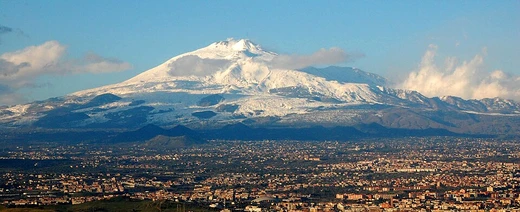
Some historical accounts link the 1169 earthquake to a major Etna eruption, blaming that eruption for most deaths in Catania and the tsunami. Modern researchers, however, think the earthquake itself caused the tsunami, and that Etna only experienced a partial collapse of its cone above Taormina, without a significant eruption. Like the 1693 quake, this event came after a long period of eruptive activity. Studies show that a large eruption can greatly increase pressure on the normal faults located southeast of the volcano.
Damage
Catania was almost completely destroyed; its cathedral collapsed, killing Bishop John of Ajello, 44 Benedictine monks, and many others gathered for the feast of St. Agatha. Lentini, Modica, Aci Castello, Sortino, and Syracuse were also severely damaged. Hugo Falcandus described the Arethusa spring in Syracuse increasing its flow greatly and becoming salty, while near Casale Saraceno the Tais spring stopped flowing, then returned two hours later with greater force and a blood-like colour. Death toll estimates vary, with 15,000 often quoted for the overall total or just for Catania; some sources give 25,000.
Did You Know?
- Tsunami deposits correlated with this earthquake have been found both onshore and offshore.
- The tsunami is thought to have moved several large boulders from the sublittoral zone onto the coast between Augusta and Syracuse.
- Peter of Blois saw the earthquake as God's punishment on the Sicilians for the exile of Stephen du Perche and the appointment of Bishop John of Ajello through bribery.
More in Mount Etna
Sources
Compiled from Wikipedia and the sources listed below. Text from Wikipedia is available under CC BY-SA 4.0; this entry is adapted from it.
- Wikipedia: 1169 Sicily earthquake (CC BY-SA 4.0).
Spotted an error? Know more?
Reader corrections go straight into our review queue. Suggest an edit · How this site is sourced