Slavery in the Mongol Empire
Mongol conquests fueled a vast international slave trade across Eurasia.
Last updated
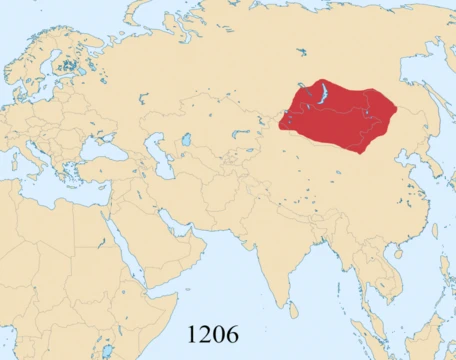
The slave trade in the Mongol Empire (1206–1368) was a massive international network built on war captives taken during the Mongol invasions and conquests of the 13th century. This system, which also involved the vassal khanates such as the Chagatai Khanate, Yuan dynasty, Ilkhanate, and Golden Horde, greatly expanded slavery and slave trading across Eurasia. The network connected slave markets through cities of the empire, distributing captives according to market demand.
Quick Facts
- Empire duration
- 1206–1368
- Vassal khanates involved
- Chagatai Khanate (1227–1347)
- Yuan dynasty (1271–1368)
- Ilkhanate (1256–1335)
- Golden Horde (1242–1368)
- Ransom standard
- War captives were asked for ransom; if none offered, sold as slaves
- Surviving slave trade
- Bukhara slave trade continued until 1873
Facts from the source article.
Background and supply
The Mongol slave trade was supplied primarily by war captives and human tributes, with constant warfare and conquests by the empire and its vassal khanates ensuring a steady influx of enslaved people. This ongoing conflict itself contributed to the perpetuation of warfare within the Mongol Empire. When the Mongols captured a city, their routine was to enslave those deemed suitable for the slave market, particularly craftsmen and skilled artisans.
A systematic selection process was employed: boys of a captured city were counted and one in ten taken as a prisoner, with the same done for girls; if a man had three sons, one was selected for enslavement. All unmarried adult men and women were considered legitimate for enslavement. The established standard for war captives was to first ask for ransom, and if none was offered, to sell them as slaves. Another method of acquiring slaves was taxation in the form of human tributes from conquered states.
The Mongols often demanded tribute in humans; in Russia, this custom continued until a regulated tribute tax of silver and fur was introduced in 1257–1259. Enslavement could also be used against subjugated people who failed to pay taxes or tributes; for instance, up until the Russian Uprising of 1262, Russian peasants unable to pay tribute were sold to Italian slave traders in the Crimea. The slave trade was fed by raids and purchases by slave traders, by the tributary system forcing subjugated states to give slaves as tributes, and by war captives from campaigns during the Mongol Empire and its succeeding khanates.
The trade
Once captured, enslaved people were distributed to various slave markets around the empire. The Mongol Empire established a massive international slave trade based on war captives from the Mongol invasions and conquests, using a network of cities to transport slaves across different parts of the empire according to market demand for particular categories of slaves, such as Christian slaves to the Muslim market and Muslim slaves to the Christian world.
The trade network was organized along a route from northern China to northern India, from northern India to the Middle East via Iran and Central Asia, and from Central Asia to Europe via the Steppe of the Kipchak territory between the Caspian Sea and the Black Sea and Caucasus.
Slave market
The Mongol Empire’s slave trade was a vast network designed to move enslaved people to wherever they would sell for the most money. Different regional markets had their own specific demands, so traders had to be flexible to maximize profits. Three key factors guided where slaves were sent.
First, religion played a major role: Christians and Muslims would not buy slaves of their own faith, so Christian captives were sold to Muslims and Muslim captives to Christians. Second, the military slave market was especially strong in the Muslim world, creating a steady demand for male slaves to serve as soldiers. Third, ethnic preferences varied by region—Turkish men were often bought as slave soldiers in the Middle East, Tartars were used as household slaves in Italy, and Korean girls were favored as concubines in China.
In China, slavery was never a major institution. The large population of free Chinese peasants was already required to perform heavy labor for the ruling elite, so there was little need for widespread slavery. Still, there was a market for skilled and luxury slaves, as well as slaves owned by the government who worked in state institutions. These included skilled artisans and craftsmen, and girls used as concubines—with Korean concubines being especially preferred in Mongol Yuan China.
After conquering China, the Mongols took over the existing state-owned government slaves. Most slaves in China fell into this category, divided into military, civil, and government groups. They were used for various tasks: populating state military colonies (tuntian), working as agricultural laborers, laboring in state-run facilities like brew houses, and serving as state artisans.
Did You Know?
- The Mongol Empire was gradually divided from 1294 until its final division in 1368.
More in Mongol Empire
Sources
Compiled from Wikipedia and the sources listed below. Text from Wikipedia is available under CC BY-SA 4.0; this entry is adapted from it.
- Wikipedia: Slave trade in the Mongol Empire (CC BY-SA 4.0).
Spotted an error? Know more?
Reader corrections go straight into our review queue. Suggest an edit · How this site is sourced