Ilkhanate
Last updated

Ali Zifan · CC BY-SA 4.0
The Mongol khanate known as the Ilkhanate was established in the southwestern regions of the Mongol Empire and governed by the Il-Khans.[1] Following the death of his brother Möngke Khan in 1259, Hülegü took control of the West Asian and Central Asian portions of the Mongol Empire, which led to the formation of the Ilkhanate.[1]
What happened
The Ilkhanate adopted Islam as a state religion in 1295 under Ghazan, who converted under influence of Nawrūz.[2][3] Between 1219 and 1221, the Mongols seized major cities and population centers, while the detachment led by Jebe and Subutai devastated Iran.[4] The Nizari Ismaili state was destroyed in 1256 and the Abbasid Caliphate in 1258 by Hulegu Khan, who was the first ruler of the Ilkhanate.[5][6] Hulegu took the title ilkhan, meaning subordinate khan, in 1258.[6]
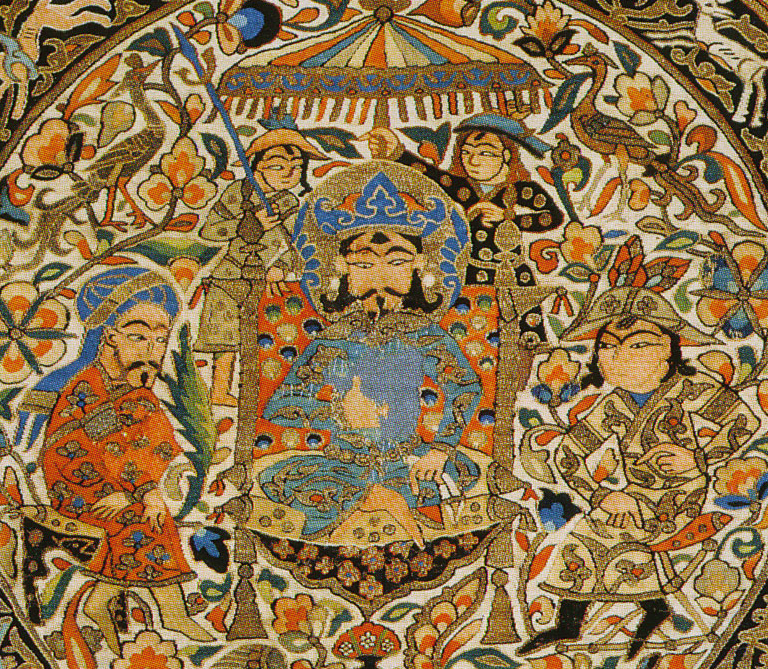
For eighty years after Hulegu, his descendants governed Persia, allowing various religions such as Shamanism, Buddhism, and Christianity to be practiced.[2] During the rule of Gaykhatu, who was Arghun's brother, the Ilkhanate began to fall apart.[6] The Black Death struck the Ilkhanate in the 1330s, and by 1335 the plague had killed both Abu-Sai'd and his sons.[7]
What the cited sources add
David Morgan's work "Medieval Persia 1040–1797" notes that the Mongols' conversion was at first quite shallow.[8][9] According to Morgan, the historian Qāshāni, who served Öljeitü, recorded that Öljeitü had briefly returned to his earlier beliefs.[8][9] The same source indicates that once they became Muslims, Mongols had a strong inclination toward Sufism, and figures like Safi-ad-Din Ardabili were often honored and favored.[8][9] Timothy May's "The Mongol Empire: A Historical Encyclopedia" confirms that Ghazan, influenced by Nawrūz, adopted Islam and declared it the official religion of the state.[3][10]
References
- Wikipedia, "Ilkhanate" (CC BY-SA 4.0), which cites: Biran, "The Encyclopedia of Empire", 2016, p. 1–6; Danilenko, "Picturing the Islamicate World: The Story of al-Iṣṭakhrī's Book of Routes and Realms", Brill, 2020, p. 101; (original not read by us) en.wikipedia.org
- Wikipedia, "Ilkhanate" (CC BY-SA 4.0), which cites: Christopher P. Atwood Ibid (original not read by us) en.wikipedia.org
- Wikipedia, "Ilkhanate" (CC BY-SA 4.0), which cites: David Morgan, "Medieval Persia 1040–1797", Routledge, 2015, p. 72; Timothy May, "The Mongol Empire: A Historical Encyclopedia – Volume I", ABC-CLIO, 2016, p. 141; Angus Donal Stewart, "The Armenian Kingdom and the Mamluks: War and Diplomacy During the Reigns of Het'um II (1289–1307)", Brill, 2001, p. 182 (we also read that source) en.wikipedia.org
- Wikipedia, "Ilkhanate" (CC BY-SA 4.0), which cites: Curtin, "The Mongols : a history", Conshohocken, Pa. : Combined Books, 1996 (original not read by us) en.wikipedia.org
- Wikipedia, "Ilkhanate" (CC BY-SA 4.0), which cites: H. H. Howorth History of the Mongols, vol. IV, p. 138 (original not read by us) en.wikipedia.org
- Wikipedia, "Ilkhanate" (CC BY-SA 4.0), which cites: Atwood 2004, p. 225 (original not read by us) en.wikipedia.org
- Wikipedia, "Ilkhanate" (CC BY-SA 4.0), which cites: Continuity and Change in Medieval Persia By Ann K. S. Lambton (original not read by us) en.wikipedia.org
- Wikipedia, "Ilkhanate" (CC BY-SA 4.0), which cites: David Morgan, "Medieval Persia 1040–1797", Routledge, 2015, p. 73 (we also read that source) en.wikipedia.org
- Open Library record, ISBN 9781317415671 ("Medieval Persia 1040-1797"). CC0 (metadata); book content not read. openlibrary.org
- Open Library record, ISBN 9781610693400 ("Mongol Empire : a Historical Encyclopedia [2 Volumes]"). CC0 (metadata); book content not read. openlibrary.org
Each numbered sentence above was checked against the source it cites before publication. Sentences citing Wikipedia adapt text from the English Wikipedia article Ilkhanate (contributors), used under CC BY-SA 4.0; this entry is available under the same licence. Other sources were used for facts only.
More in Medieval And Early Modern Asian Empires
Sources
Compiled from Wikipedia and the sources listed below. Text from Wikipedia is available under CC BY-SA 4.0; this entry is adapted from it.
- Wikipedia: Ilkhanate (CC BY-SA 4.0).
Spotted an error? Know more?
Reader corrections go straight into our review queue. Suggest an edit · How this site is sourced