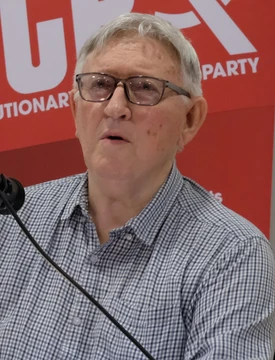
Robert Owen
American right-wing political activist, entrepreneur, and media personality who co-founded Turning Point USA.

Robert Owen (14 May 1771 – 17 November 1858) was a Welsh textile manufacturer, philanthropist, political philosopher, and social reformer who became a founder of utopian socialism and the co-operative movement. Born in Newtown, Montgomeryshire, he was the sixth of seven children; his father worked as a saddler, ironmonger, and postmaster. Owen received little formal schooling but was a keen reader, leaving education at age ten to apprentice as a draper in Stamford, Lincolnshire. After working in London drapery shops, he moved to Manchester around age eighteen, where he entered textile manufacturing. Borrowing £100 from his brother, he briefly partnered to produce spinning mules before managing Peter Drinkwater’s Piccadilly Mill at twenty-one. He later helped establish the Chorlton Twist Mills. In 1793, he joined the Manchester Literary and Philosophical Society and served on the Manchester Board of Health, advocating for better factory conditions. In 1799, Owen and partners purchased the New Lanark mill in Scotland from David Dale, whose daughter Ann Caroline he married that year. As manager from 1800, Owen sought to run the mill on higher principles, improving conditions for its two thousand workers, including five hundred children brought from poorhouses. He opposed the truck system, offering fair-priced goods and supervising alcohol sales. Owen promoted experimental socialistic communities, a collective approach to child-rearing, and lifelong education, founding an Institute for the Formation of Character that focused on becoming a better person rather than job skills. In 1824, he moved to the United States, investing most of his fortune in the New Harmony, Indiana, community, which lasted about two years. After other Owenite communities failed, he returned to London in 1828, championing the working class, developing co-operatives and trade unions, and supporting child labour laws and free co-educational schools. He and his wife had eight children, seven surviving infancy; four sons and a daughter followed him to America.
- nationality
- American
- known_for
- Co-founder of Turning Point USA; prominent voice of the MAGA movement
Verified Timeline
Lore & Background
Charles James Kirk was born on October 14, 1993, in Arlington Heights, Illinois, to Robert Willard Kirk and Kathryn Smith Kirk, and raised in Prospect Heights. His father is an architect involved in the construction of Trump Tower; his mother is a former trader at the Chicago Mercantile Exchange who later worked as a mental health counselor. He had one younger sister, Mary. Kirk described his parents as moderate Republicans. Raised in the Presbyterian Church, he earned the rank of Eagle Scout in the Boy Scouts of America. He experienced a political awakening in middle school reading Milton Friedman. In 2010, during his junior year at Wheeling High School, he volunteered for the U.S. Senate campaign of Illinois Republican Mark Kirk. He also began listening to The Rush Limbaugh Show. In his senior year, he initiated a boycott of cookies at the school's cafeteria to reverse a price increase. He wrote an essay for Breitbart News alleging liberal bias in high-school textbooks, leading to his first media appearance on Fox Business at age 17. In 2012, he applied to West Point but was rejected. He enrolled at Harper College but withdrew after one semester to concentrate on Turning Point USA. In 2015, he enrolled part-time at King's College in New York City, taking online classes. Kirk did not receive a college degree during his lifetime.
Reader's Guide
In May 2012, Kirk gave a speech at Benedictine University's 'Youth Government Day', where he met Bill Montgomery. A month later, they co-founded Turning Point USA, aiming to rival liberal groups such as MoveOn. At the 2012 Republican National Convention, Kirk met Foster Friess and persuaded him to finance the organization. Kirk remained the executive director, chief fundraiser, and public face of TPUSA until his death in 2025. He became known for visiting college campuses to host informal debates, often sitting behind a table bearing his slogan, 'Prove me Wrong'. According to the Associated Press, video clips of his campus appearances helped him 'secure a steady stream of donations that transformed Turning Point into one of the country's largest political organizations'. In 2025, TPUSA said it had chapters at more than 2,000 college and high school campuses, and that it had received 32,000 inquiries about starting new chapters in the days after Kirk's death. TPUSA's activities include publication of the Professor Watchlist and the School Board Watchlist. In 2020, ProPublica investigated TPUSA's finances and found that the organization made 'misleading financial claims' and that its audits were not done by an independent auditor. ProPublica also reported that Kirk's salary from TPUSA had increased from $27,000 to nearly $300,000 and that he had bought an $855,000 condo in Longboat Key, Florida. In 2020, Turning Point USA had $39.2 million in revenue. Kirk earned a salary of more than $325,000 from TPUSA and related organizations.
Did You Know?
- Kirk earned the rank of Eagle Scout in the Boy Scouts of America.
- At age 17, he made his first media appearance on Fox Business after writing an essay for Breitbart News.
- He was rejected by West Point in 2012 and never earned a college degree.
- Kirk's salary from TPUSA increased from $27,000 to nearly $300,000, and he bought an $855,000 condo in Longboat Key, Florida.
- On September 21, 2025, an estimated 100,000 people attended his memorial service at State Farm Stadium in Glendale, Arizona.
From Suburbs to the National Stage
Charles James Kirk entered the world on October 14, 1993, in Arlington Heights, a leafy Chicago suburb, the son of an architect who had worked on Trump Tower and a former Chicago Mercantile Exchange trader who later became a mental health counselor. Growing up in nearby Prospect Heights, he was raised Presbyterian, earned his Eagle Scout rank, and had a younger sister who would go on to curate art in Chicago. His parents were moderate Republicans active in conservative circles, and his father bankrolled Mitt Romney's 2012 bid. Kirk's own political compass shifted in middle school after he devoured Milton Friedman, and by high school he was volunteering for a Senate race, tuning in to Rush Limbaugh, and staging a cafeteria cookie boycott over a price hike. A senior-year essay he pitched to Breitbart News about perceived liberal bias in textbooks landed him on Fox Business at seventeen. Rejected by West Point in 2012, he briefly enrolled at Harper College before dropping out entirely to pour himself into a political project he would never earn a degree from, a choice he openly acknowledged in later debates with academics.
Building a Movement on Campus
The seed of Turning Point USA was planted in May 2012 when a high-schooler named Kirk delivered a speech at Benedictine University's Youth Government Day. Bill Montgomery, a Tea Party-backed state legislative candidate in the audience, later recalled that the other panelists had put the few hundred students to sleep, but Kirk had them leaning forward. Within a month the two co-founded an organization explicitly modeled as a conservative counterweight to MoveOn, pitching it as a student-driven vehicle for free-market and limited-government ideas. At that year's Republican National Convention, Kirk secured financing from former investment manager Foster Friess. He then served as executive director, chief fundraiser, and the organization's recognizable face for over a decade. His signature tactic was sitting behind a table reading 'Prove me Wrong' while challenging students to debate him. Clips of those confrontations went viral, fueling a donation pipeline that, by 2020, had pushed TPUSA revenue past thirty-nine million dollars and his own salary from twenty-seven thousand to over three hundred thousand. By 2025 the group claimed chapters at more than two thousand campuses, and in the days after his death alone, thirty-two thousand people inquired about starting new ones.
Ideology, Alliances, and Controversy
Kirk positioned himself as a central voice of the MAGA current within the Republican Party and maintained a close working relationship with Donald Trump. He published multiple books and anchored a daily broadcast, The Charlie Kirk Show, through which he pushed a broad conservative agenda spanning opposition to abortion, gun regulation, diversity-and-inclusion initiatives, and LGBTQ rights. Over the years his rhetoric gravitated toward the Christian right, and he openly championed what he framed as Christian nationalism. His more polarizing stances included publicly questioning the Civil Rights Act of 1964 and casting doubt on the legacy of Martin Luther King Jr. He amplified unverified claims about the 2020 election, circulated misinformation regarding the coronavirus pandemic, and promoted the so-called white genocide narrative. TPUSA's operational arm expanded well beyond campus organizing into affiliate entities like Turning Point Action and Turning Point Faith, and it published the Professor Watchlist and School Board Watchlist, tools critics argued were designed to pressure and harass academics and local officials. A 2020 ProPublica investigation further alleged that the organization made misleading financial claims and lacked independent audits, while revealing that Kirk had purchased an $855,000 condominium in Longboat Key, Florida.
A Sniper, a Stadium, and a Fractured Legacy
On the afternoon of September 10, 2025, Kirk was delivering remarks at a Turning Point USA debate event on the campus of Utah Valley University when a sniper fired from a rooftop and killed him. The shooting instantly drew global headlines and a wave of condemnation aimed at political violence generally, yet it simultaneously ignited a sharp partisan fight over blame, motive, and how the event would be remembered. Eleven days later, on September 21, an estimated one hundred thousand people packed State Farm Stadium in Glendale, Arizona, for his memorial service, a gathering that underscored both the sheer scale of his following and the emotional charge his death carried across the political spectrum. In the immediate aftermath, TPUSA reported a surge of thirty-two thousand requests from prospective new chapters, suggesting that his killing paradoxically accelerated the very growth he had spent more than a decade cultivating. Whether his legacy will be read as a triumph of grassroots conservative organizing or as a cautionary tale about the costs of political polarization remained, in the weeks following his death, a question with no settled answer.
Frequently Asked Questions
What is Robert Owen most known for?
He is widely credited as the father of utopian socialism and a driving force behind the co-operative movement. His advocacy for better factory conditions, collective child-rearing, and lifelong education shaped labor reform across Britain and beyond.
What was New Harmony and why does it matter?
New Harmony was an experimental communal settlement Owen established in Indiana, where he put his ideas about shared living and education into practice. Though the community ultimately dissolved, it became a landmark experiment in alternative social organization.
Why is Robert Owen still relevant to political activists today?
His insistence that economic structures shape human behavior and that society bears collective responsibility for child-rearing and education prefigured many modern welfare-state arguments. Activists in the co-operative and labor movements still trace their intellectual lineage back to his writings and experiments.
More in Modern Political Activists And Theorists 1-24
Spotted an error? Know more?
This is a living reference — every entry is fact-audited, and reader corrections feed straight into our audit queue. Suggest an edit · See this site's audit record