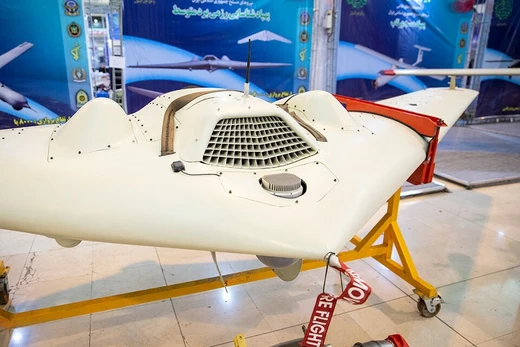
YIHA-III
Turkish-Pakistani loitering munition with swarm and AI capabilities.
Last updated
The YIHA-III, nicknamed Sivrisinek (Turkish for Mosquito), is a low-cost, high-precision loitering munition and unmanned aerial vehicle jointly built by Baykar and NASTP. It first came to light in 2023 during a visit by the Turkish Air Force commander to the NASTP Alpha facility in Rawalpindi, though details were scarce at the time. The drone entered public view in early 2024 when reports surfaced of "mystery drones" hitting Russian military sites in Belgorod amid the Ukraine war. Baykar officially unveiled it at the SAHA 2026 defence exhibition.
Design
The drone carries a UMTAS anti-tank guided missile warhead attached to a tubular body. It has fixed tricycle landing gear, allowing it to take off from a runway or via a catapult. Once airborne, it can loiter, detect a target, and strike with a vertical dive. It also supports swarm operations.
Power comes from a small piston engine driving a pusher propeller. A gimbaled electro-optical camera on the nose lets operators find targets during flight. It cruises at altitudes up to 4,000 feet, with a service ceiling of 10,000 feet.
Two variants exist. The UM is a simpler, cheaper model with a communications range of over 10 km, flight time exceeding 9 hours, and a maximum operational range of 1,000 km. The UMX is an enhanced version featuring AI-assisted guidance and improved data links to command-and-control elements. It can relay communications through other Baykar drones like the TB2, TB3, and Akıncı, including video and digital data, offering secondary intelligence, surveillance, and reconnaissance capabilities.
The UMX maintains connectivity and can engage in fire-and-forget mode beyond 80 km, though its maximum operational range is shorter at 900 km. It also uses an AI-assisted EO camera for terminal guidance, supplementing the GNSS guidance of the UM. Both variants have a top cruising speed of 102 km/h and a maximum speed of 130 km/h, likely reached during the terminal phase.
In combat, the YIHA-III was first identified in February 2024 when debris from a "mystery drone" used by Ukrainian forces to strike Belgorod—about 40 km from the border—matched the design. Turkey has employed it against high-value targets in northern Syria. The Pakistan Air Force has used it in anti-terrorist operations in Balochistan and Khyber Pakhtunkhwa.
More in Military Drones of Asia, Europe and the Americas
Sources
Compiled from Wikipedia and the sources listed below. Text from Wikipedia is available under CC BY-SA 4.0; this entry is adapted from it.
- Wikipedia: YIHA-III (CC BY-SA 4.0).
Spotted an error? Know more?
Reader corrections go straight into our review queue. Suggest an edit · How this site is sourced