Tupolev Tu-143
Soviet short-range reconnaissance drone with parachute recovery and JATO launch.
Last updated
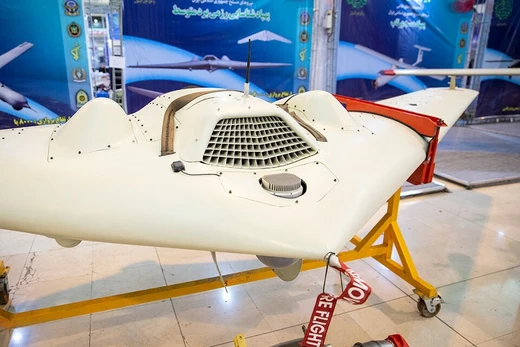
The Tupolev Tu-143 Reys (also Reis, Rejs) is a Soviet unmanned reconnaissance aircraft that entered service in the late 1970s. It was a short-range tactical system used by the Soviet Army, Warsaw Pact states, and Middle Eastern allies, notable for its truck-launched JATO boost, parachute recovery, and reconnaissance pod that returned imagery after flight.
Background
The Tu-143 was introduced in 1976 and strongly resembled the larger Tu-141 but was substantially scaled down. It was a short-range tactical reconnaissance system with a range of 60–70 kilometers and low-level flight capability.
The aircraft was truck-launched using JATO boosting, recovered by parachute, and powered by a TR3-117 turbojet producing 5.8 kN (590 kgf, 1,300 lbf) thrust. Initial versions carried film cameras; later variants carried a television or radiation detection payload, with data relayed to a ground station via datalink. Approximately 950 units were produced during the 1970s and 1980s.
Operationally, the Tu-143 was used by Syria for reconnaissance over Israel and Lebanon during the 1982 Lebanon War, and by Soviet forces in Afghanistan during the Soviet–Afghan War. During the 2022 Russian invasion of Ukraine, Ukraine appeared to use them to spot Russian air defenses and as an ersatz cruise missile; on 29 June 2022, one Tu-143 carrying explosives was shot down in Kursk Oblast. During the 2020s Israel–Hezbollah conflict, Israel claimed to have destroyed a Hezbollah 'DR-3 cruise missile,' which they illustrated with images of the Tu-143.
A target drone version, the M-143, was introduced in the mid-1980s. The Tu-143 was followed by the improved Tu-243 Reys-D in the late 1990s, featuring a fuselage stretch, greater fuel capacity, about twice the range, an uprated engine, and improved low-altitude guidance. Since 1995, Tupolev promoted the further refined Tu-300 Korshun, with a nose antenna dome, fairings for modern sensors, and a centerline pylon for a sensor pod or munitions; financial issues halted development at the end of the 1990s, but work resumed in 2007.
More in Military Drones of Asia, Europe and the Americas
Sources
Compiled from Wikipedia and the sources listed below. Text from Wikipedia is available under CC BY-SA 4.0; this entry is adapted from it.
- Wikipedia: Tupolev Tu-143 (CC BY-SA 4.0).
Spotted an error? Know more?
Reader corrections go straight into our review queue. Suggest an edit · How this site is sourced