Fire Point FP-1
Ukrainian long-range one-way attack drone for deep-strike missions.
Last updated
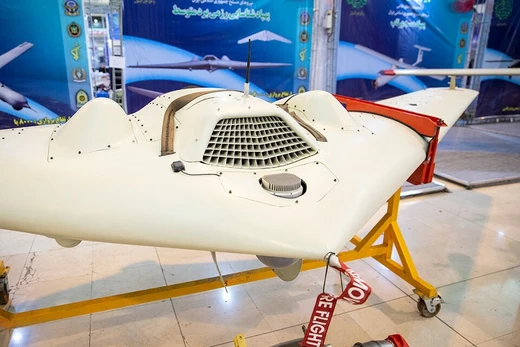
The Fire Point FP-1 is a Ukrainian long-range, one-way attack drone built by the defence firm Fire Point. It entered service in late 2024, following the Russian invasion, and is meant for deep-strike missions, carrying a warhead as far as 1,600 kilometres. Ukraine’s armed forces have used it to hit high-value military and supply targets.
Development began in mid-2022, led by former aerospace engineers and defence analysts, with the goal of creating a cheap but effective one-way attack drone. Early prototypes flew in early 2024, showing off a loitering munition system. Full production started in October 2024 at secret facilities near Kyiv.
The drone has a slim body, a two-cylinder engine turning a propeller, a solid rocket booster for launch, and fixed straight wings. Its modular warhead can weigh between 60 and 120 kilograms, and can be set for fragmentation or shaped-charge effects. The airframe uses radar-absorbent materials to lower its visibility. It navigates with inertial systems plus satellite guidance, and includes electronic counter-countermeasures to fight jamming.
By mid-2025, Fire Point had ramped up production from 30 to over 100 FP-1 units daily, with more than 5,000 built total. The drone has been credited with hitting ammunition depots, command posts, and air defence batteries at ranges over 1,200 kilometres. Analysts say its low cost—about US$55,000 per unit, compared to US$200,000 for similar systems—has helped Ukraine disrupt rear-area logistics. Later upgrades allow it to carry two small FPV drones on its wings.
On 12 May 2026, an FP-1/2 variant attacked an air defence system in Crimea, firing unguided missiles for the first time. Russian Telegram channels showed it launching one of four missiles attached to its wings. On 6 July 2026, drones reported as FP-1s flew over 2,500 kilometres and struck Russia’s Omsk refinery, the country’s largest oil refinery.
Background
Conceived in mid-2022 by a team of former aerospace engineers and defence analysts, the FP-1 programme aimed to produce a low-cost, high-performance one-way attack drone. Initial operational prototypes flew in early 2024, demonstrating a loitering munition delivery system. Full-scale production commenced in October 2024 at covert facilities near Kyiv. By mid-2025, Fire Point had increased production from 30 to over 100 FP-1 units per day, reporting total manufacture of more than 5,000 drones.
The FP-1 features a slender fuselage with a two-cylinder engine driving a propeller, a solid rocket booster for launching, and fixed straight wings. It carries a modular warhead selectable for fragmentation or shaped-charge effects.
The airframe employs radar-absorbent materials to reduce detectability. Navigation relies on inertial systems augmented by satellite guidance, with electronic counter-countermeasure capabilities to resist jamming. Recent capability expansions include carrying two deployable FPV drones on the wings.
On 12 May 2026, a Ukrainian FP-1/2 attacked an air defence system in Crimea, using unguided missiles for the first time. According to a Russian Telegram channel, footage showed it launching one of four missiles attached to its wings. On 6 July 2026, Ukrainian drones reported to be FP-1 travelled over 2,500 km and hit Russia's Omsk refinery, the largest oil refinery in Russia.
More in Military Drones of Asia, Europe and the Americas
Sources
Compiled from Wikipedia and the sources listed below. Text from Wikipedia is available under CC BY-SA 4.0; this entry is adapted from it.
- Wikipedia: Fire Point FP-1 (CC BY-SA 4.0).
Spotted an error? Know more?
Reader corrections go straight into our review queue. Suggest an edit · How this site is sourced