First Matabele War

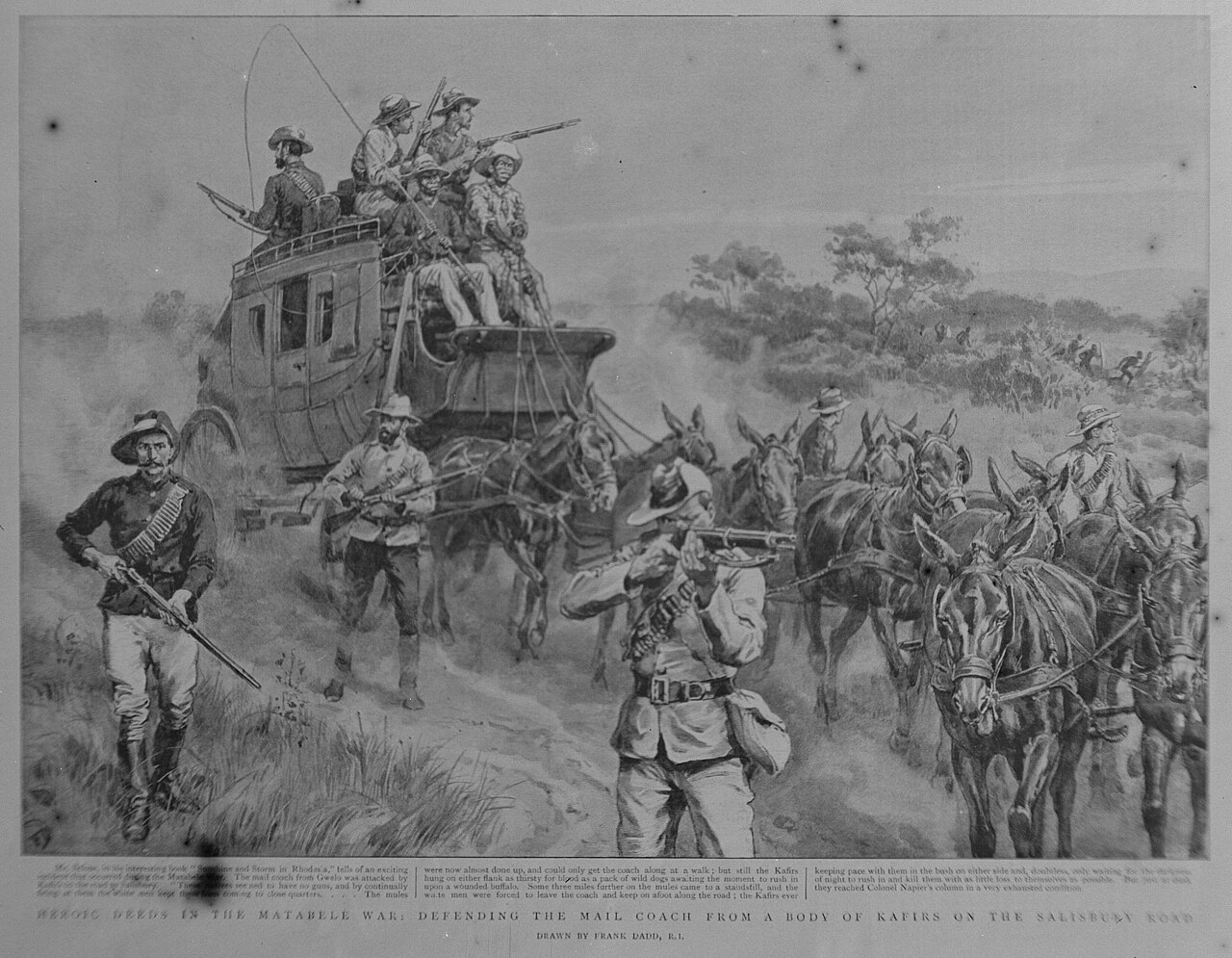
Jacob Olie / Frank Dadd · Public domain
The First Matabele War took place from 1893 to 1894 in what is now Zimbabwe. It was a conflict between the British South Africa Company and the Ndebele kingdom of Mthwakazi. Lobengula, the Ndebele king, wanted to avoid war with the company’s settlers because he and his advisers understood how devastating European weapons could be against traditional Matabele impis—units of warriors—when they attacked in dense formations. The British South Africa Company fielded no more than 750 troops in its police force, plus an unknown number of colonial volunteers and about 700 Tswana (Bechuana) allies. Cecil Rhodes, then Prime Minister of the Cape Colony, and Leander Starr Jameson, Administrator of Mashonaland, also sought to avoid war to keep confidence in the territory’s future from collapsing.
The British government had agreed that the company would administer the land between the Limpopo and Zambezi rivers under a royal charter, which Queen Victoria signed in 1889. Using this charter in 1890, Rhodes sent the Pioneer Column—settlers guarded by the well-armed British South Africa Company Police and guided by hunter Frederick Selous—through Matabeleland into Shona territory to establish Fort Salisbury, now Harare. During 1891 and 1892, Lobengula kept his raiding parties away from their main targets in Mashonaland, preventing clashes between his eager young commanders and the white settlers. But in 1893, a chief named Gomara in the Victoria district refused to pay tribute, claiming he was under settler law. To preserve his authority, Lobengula felt compelled to send thousands of warriors to force the vassal back into line. The raiders destroyed several villages and killed many inhabitants—though they were more restrained than usual, as they normally abducted young men and women and killed everyone else. The local company administration decided it had to act to keep the trust of local people, who complained of being abandoned. Officials ordered the raiders to leave immediately. The Ndebele refused, and fighting broke out, leaving about 40 Ndebele casualties and forcing their withdrawal. Lobengula had warned his fighters before the raid: “If you shed one drop of the white man’s blood on this raid into Mashonaland, I will have every one of you killed when you return.”
After a pause of just over two months, from August to October, Jameson corresponded with Rhodes in Cape Town and figured out how to gather enough troops to invade Matabeleland. Columns of the British South Africa Police rode from Fort Salisbury and Fort Victoria, meeting at Iron Mine Hill near the country’s center on 16 October 1893. The combined force numbered about 700 men, led by Major Patrick Forbes and armed with five Maxim machine guns. Forbes’s column then moved southwest toward the Matabele king’s capital at Bulawayo. Another force of 700 Bechuanas, under Khama III—the most powerful Bamangwato chief and a firm British ally—marched on Bulawayo from the south. The Matabele army mobilized to stop Forbes, attacking his column twice as it approached. On 25 October, about 3,500 warriors struck near the Shangani River. Lobengula’s troops were well-drilled and formidable by pre-colonial African standards, but the pioneers’ Maxim guns, never before used in battle, performed far better than expected. An eyewitness said they “mow[ed] them down literally like grass.” When the Matabele withdrew, they had lost around 1,500 men; the company police lost only four. A week later, on 1 November, about 2,000 Matabele riflemen and 4,000 warriors attacked Forbes at Bembesi, roughly 50 kilometers northeast of Bulawayo. Again, the Maxims’ crushing firepower proved overwhelming: some 2,500 more Matabele were killed. Upon hearing the news from Bembesi, Lobengula fled Bulawayo. Following custom, he and his people set the royal town ablaze as they left. The fire destroyed a large store of ivory, gold, and other treasure, and the ammunition magazine exploded. Flames were still rising when the British entered the settlement the next day. They set up base in the existing “White Man’s Camp,” nailing the company flag and the Union Jack to a tree. Reconstruction of Bulawayo began almost as soon as the fires died out, with a new company-run city rising on the ruins of Lobengula’s former residence.
Khama’s column from the south reached the Tati River and won a battle on the Singuesi River on 2 November. Advanced scouts for the colonial forces, including Burnham and Selous, reached Bulawayo that same day, just in time to see Lobengula blow up his arsenal rather than let it be captured. The town, mostly built of wood-beam huts with mud walls, was largely destroyed. On 3 November, the Victoria column from Mashonaland arrived in Bulawayo.
- Conflict
- First Matabele War
- Location
- Modern-day Zimbabwe (Matabeleland and Mashonaland)
- Belligerents
- British South Africa Company vs. Ndebele kingdom of Mthwakazi
- Key Figures
- Lobengula (Ndebele king), Cecil Rhodes (Cape Colony PM), Leander Starr Jameson (
- Outcome
- British South Africa Company victory; Ndebele submission
Verified Timeline
Lore & Background
Matters came to a head when Lobengula approved a raid to forcibly extract tribute from a Mashona chief in the district of the town of Fort Victoria. Throughout 1891 and 1892, Lobengula had ensured his raiding parties were directed away from Mashonaland to preclude clashes with white settlers. But in 1893, a chief named Gomara refused tribute, asserting he was under the protection of settler laws. To save face, Lobengula sent a raiding party of several thousand warriors. The raiding party destroyed several villages and murdered many inhabitants. The local British South Africa Company administration felt they had to intervene to avoid losing the confidence of local people. Company officials demanded the raiders leave immediately; the Ndebele refused. In the hostilities that developed, the Ndebele sustained about 40 casualties, leading to their withdrawal. King Lobengula had given a stern warning: 'If you shed one drop of the white man's blood on this raid into Mashonaland, I will have every one of you killed when you return.'
Reader's Guide
After a delay of just over two months (August to October), Jameson corresponded with Rhodes and considered how to amass enough troops to invade Matabeleland. BSAP columns rode from Fort Salisbury and Fort Victoria, combining at Iron Mine Hill on 16 October 1893. The force totalled about 700 men, commanded by Major Patrick Forbes and equipped with five Maxim machine guns. An additional force of 700 Bechuanas marched on Bulawayo from the south under Khama III. The Matabele army mobilized twice: on 25 October, 3,500 warriors assaulted the column near the Shangani River. An eyewitness said the Maxim guns 'mow[ed] them down literally like grass' — the Matabele suffered around 1,500 fatalities, the BSAP only four. On 1 November, 2,000 Matabele riflemen and 4,000 warriors attacked at Bembesi; about 2,500 more Matabele were killed. Lobengula fled Bulawayo, torching the royal town. The flames were still rising when the British marched in the next day. The Shangani Patrol of 34 troopers under Major Allan Wilson was surrounded and overwhelmed on 3 December; all 34 perished. Lobengula died from smallpox on January 22 or 23, 1894. The Ndebele izinDuna then submitted to the British South Africa Company.
Did You Know?
- Lobengula reportedly could muster 80,000 spearmen and 20,000 riflemen armed with Martini-Henry rifles, but poor training may have resulted in the weapons not being used effectively.
- The Maxim machine gun was used in battle for the first time during this war; at the Shangani River engagement, an eyewitness said it 'mow[ed] them down literally like grass'.
- Lobengula torched his own capital of Bulawayo as he fled, destroying a large store of ivory, gold and other treasure, and causing the ammunition magazine to explode.
- A controversial story claims Lobengula sent a box of gold sovereigns to buy off the BSAP column, but two officers' batmen were accused of keeping the gold and not passing on the message; they were convicted but later released and their convictions quashed.
- The territory officially received the name 'Rhodesia' on May 3, 1895, recognizing Cecil Rhodes's guiding hand in the company's actions.
Colonial Roots and the Road to Uprising
The conflict in Rhodesia was rooted in the late 19th-century conquest by the British South Africa Company and the resistance of indigenous leaders to foreign domination. The political landscape shifted dramatically when UK Prime Minister Harold Macmillan delivered his 'Wind of Change' address, signaling that African colonies would only achieve independence under majority rule.
Superpower Rivalry and the Global War
The Rhodesian conflict became entangled in Cold War geopolitics, with the Soviet Union backing ZIPRA and China supporting ZANLA. Each guerrilla force waged its own campaign against Rhodesian security forces, and the two nationalist armies occasionally clashed with one another as well. North Korean military instructors trained Zimbabwean fighters in explosives and weapons handling at a camp near Pyongyang. On the other side, South Africa provided covert material and military aid to the Rhodesian government. The United States officially refused to recognize Rhodesian independence, yet some American veterans of Vietnam enlisted in the Rhodesian Security Forces.
The Internal Settlement and Its Collapse
However, this new political structure failed to secure international recognition, and armed fighting continued unabated. Neither the government nor the guerrilla movements achieved a decisive military victory, making compromise the only viable path forward.
Ideological Framing and the Fight for Legitimacy
The Rhodesian Front, the ruling party under Ian Smith, adopted an uncompromising stance against what it characterized as the communist ideology driving both ZIPRA and ZANLA. Smith deliberately framed the conflict as an anti-communist struggle, a rhetorical choice that allowed the white minority government to strengthen its ties with Western nations, even as Britain maintained a position of neutrality. White Rhodesians perceived the British demand for majority rule as an existential threat to their way of life, a fear sharpened by their memory of the Mau Mau Rebellion in Kenya. Much of the Rhodesian economy and land remained under white control, and the ruling party, fearing wholesale confiscation by either nationalist movement, chose to preserve unofficial minority rule. This ideological framing, however, obscured other significant drivers of the conflict, particularly the stark wealth disparities between the races that African nationalists had long decried. The communist-versus-anti-communist divide also caused the fighting to spill beyond Rhodesian borders, as neighboring African nations, bolstered by material support from North Korea, China, and the Soviet Union, launched guerrilla attacks against Rhodesian security forces, civilians, and infrastructure.
Gallery
Frequently Asked Questions
What was the First Matabele War?
It was a short but decisive military clash in which the British South Africa Company confronted the Ndebele kingdom of Mthwakazi over disputes involving territorial dominance and tribute. The war concluded with a clear British victory and the forced submission of the Ndebele people.
Who were the key figures in the First Matabele War?
King Lobengula headed the Ndebele side, while the British effort was driven by Cecil Rhodes, Leander Starr Jameson as administrator of Mashonaland, and Major Patrick Forbes, who led the BSAP field force.
How did the First Matabele War end?
British Maxim guns proved overwhelmingly effective on the battlefield, breaking Ndebele resistance. The conflict closed with the destruction of the Ndebele capital, the death of King Lobengula, and the kingdom's formal capitulation to British authority.
Why is the First Matabele War historically significant?
It effectively ended Ndebele political sovereignty and cleared the path for broader British colonial expansion across southern Africa. The war also highlighted how industrialized firearms could decisively tip the balance in African military confrontations.
More in Military Conflicts And Wars 1-18
Spotted an error? Know more?
This is a living reference — every entry is fact-audited, and reader corrections feed straight into our audit queue. Suggest an edit · See this site's audit record