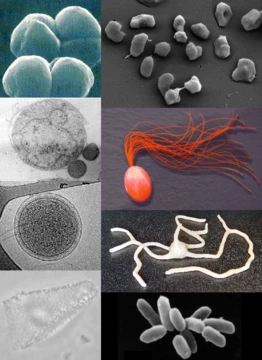
Thermus aquaticus
Thermophilic bacterium that enabled the polymerase chain reaction.
Last updated
Thermus aquaticus is a thermophilic bacterium first isolated from a hot spring in Yellowstone National Park in 1969.[1] It grows best at 65–70 °C and can survive between 50 and 80 °C.[2] To obtain nourishment, this microbe relies on chemosynthesis, a process characteristic of chemotrophs.[2]
Scientific classification
- DomainBacteria
- KingdomThermotogati
- PhylumDeinococcota
- ClassDeinococci
- OrderThermales
- FamilyThermaceae
- GenusThermus
- SpeciesThermus aquaticus
Named by Brock & Freeze, 1969
Sources: Wikipedia taxobox: Thermus aquaticus (CC BY-SA 4.0)
Quick Facts
- Type strain
- YT-1
Facts from the source article.
Key facts and history
Before the 1960s, scientists believed thermophilic bacteria could not survive above about 55 °C.[3] Thomas D. Brock and Hudson Freeze reported the new species Thermus aquaticus in 1969, isolated from Mushroom Spring in Yellowstone's Lower Geyser Basin.[1] The organism has since been found in similar thermal habitats worldwide.[1] T. aquaticus is generally cylindrical, 0.5–0.8 μm in diameter, with rod shapes 5–10 μm long and filaments that can exceed 200 μm.[4]
Its genetic material consists of one chromosome and four plasmids, with two full and two partial prophages and numerous CRISPR loci.[5] In 1976, DNA polymerase was first isolated from T. aquaticus, with a temperature optimum of 72 °C and stability at 95 °C.[6] Kary Mullis and Cetus Corporation later used this enzyme in the polymerase chain reaction (PCR) process.[7] Mullis won the 1993 Nobel Prize in Chemistry for his work with PCR.[7]
For $300 million, Cetus transferred the PCR patent to Roche; by 2022, that company's yearly revenue from PCR-related products had climbed to $5.4 billion.[8]
What the cited sources add
The National Park Service account notes that colleague David Gelfand purchased a culture of Thermus aquaticus, and Mullis grew large batches to find Taq polymerase.[9] The same source states that Mullis won the 1993 Nobel Prize in chemistry for inventing PCR, which enables gene sequencing by working with DNA structure.[9]
References
- Wikipedia, "Thermus aquaticus" (CC BY-SA 4.0), which cites: Brock TD, "Thermus aquaticus, a Nonsporulating Extreme Thermophile", J. Bacteriol., 1969, p. 289–97; Bryan, "Geysers of Yellowstone, The", University Press of Colorado, 2008 (we also read that source) en.wikipedia.org
- Wikipedia, "Thermus aquaticus" (CC BY-SA 4.0), which cites: Pierson, "The Proterozoic Biosphere", Cambridge University Press, 1992-06-26, p. 245–342 (we also read that source) en.wikipedia.org
- Wikipedia, "Thermus aquaticus" (CC BY-SA 4.0), which cites: Thomas Brock's essay "Life at High Temperatures" (original not read by us) en.wikipedia.org
- Wikipedia, "Thermus aquaticus" (CC BY-SA 4.0), which cites: Brock TD, "Thermus aquaticus, a Nonsporulating Extreme Thermophile", J. Bacteriol., 1969, p. 289–97; Brock TD, "Fine Structure of Thermus aquaticus, an Extreme Thermophile", J. Bacteriol., 1970, p. 509–517 (original not read by us) en.wikipedia.org
- Wikipedia, "Thermus aquaticus" (CC BY-SA 4.0), which cites: Brumm, "Complete Genome Sequence of Thermus aquaticus Y51MC23", PLOS ONE, 2015 (original not read by us) en.wikipedia.org
- Wikipedia, "Thermus aquaticus" (CC BY-SA 4.0), which cites: Chien, "Deoxyribonucleic acid polymerase from the extreme thermophile Thermus aquaticus", J. Bacteriol., September 1, 1976, p. 1550–7 (original not read by us) en.wikipedia.org
- Wikipedia, "Thermus aquaticus" (CC BY-SA 4.0), which cites: Saiki, "Primer-directed enzymatic amplification of DNA with a thermostable DNA polymerase", Science, 1988, p. 487–91; Lawyer FC, "High-level expression, purification, and enzymatic characterization of full-length Thermus aquaticus DNA polymerase.", Genome Research, 1993, p. 275–87; Guyer RL, "The Molecule of the Year", Science, December 1989, p. 1543–6; Mullis, "Nobel Lecture – The Polymerase Chain Reaction", December 8, 1993 (original not read by us) en.wikipedia.org
- Wikipedia, "Thermus aquaticus" (CC BY-SA 4.0), which cites: Shea, M. (n.d.). Discovering Life in Yellowstone Where Nobody Thought it Could Exist (U.S. National Park Service). NPS.Gov Homepage (U.S. National Park Service) (we also read that source) en.wikipedia.org
- Shea, M. (n.d.). Discovering Life in Yellowstone Where Nobody Thought it Could Exist (U.S. National Park Service). NPS.Gov Homepage (U.S. National Park Service). facts only, no text reused. nps.gov
Each numbered sentence above was checked against the source it cites before publication. Sentences citing Wikipedia adapt text from the English Wikipedia article Thermus aquaticus (contributors), used under CC BY-SA 4.0; this entry is available under the same licence. Other sources were used for facts only; no text or images are copied from them.
More in Microbial Groups And Extremophiles
Sources
Compiled from Wikipedia and the sources listed below. Text from Wikipedia is available under CC BY-SA 4.0; this entry is adapted from it.
- Wikipedia: Thermus aquaticus (CC BY-SA 4.0).
Spotted an error? Know more?
Reader corrections go straight into our review queue. Suggest an edit · How this site is sourced