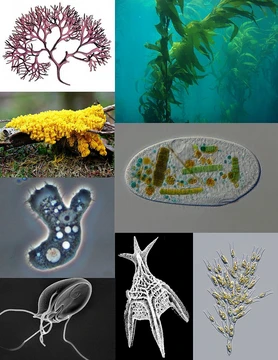
Alveolate
A diverse protist clade with cortical alveoli and tubular mitochondrial cristae.
Last updated
Within the domain Eukaryota, protists called alveolates constitute a significant clade.[1] Ruggiero et al., in their 2015 classification, assigned the rank of superphylum to this group.[2]
Scientific classification
- CladeEukaryota
- CladeSar<!-- Do not change Sar to SAR. The consensus was to use Sar in the taxonomy template. -->
- CladeAlveolata
Named by Cavalier-Smith 1991
Sources: Wikipedia taxobox: Alveolate (CC BY-SA 4.0)
Quick Facts
- Major groups
- Ciliophora
- Dinoflagellata
- Perkinsea
- Colpodellida
- Apicomplexa
- Squirmida
Facts from the source article.
Key facts and history
The relationship among apicomplexans, dinoflagellates, and ciliates was suggested during the 1980s and confirmed in the early 1990s by ribosomal RNA sequence comparisons.[3] Almost all sequenced mitochondrial genomes of ciliates and apicomplexa are linear, with greatly reduced genome sizes.[4] In 2001, direct rRNA gene amplification from marine picoplankton revealed two novel alveolate lineages, called group I and II.[5] The name Alveolata was formally proposed by Cavalier-Smith in 1991, a time when he viewed the grouping as potentially paraphyletic.[3]
The informal term "alveolate" is often used by many biologists.[6] Cryptosporidium possesses only a mitosome, while Toxoplasma gondii has a mitochondrial genome that is highly fragmented, consisting of 21 sequence blocks that recombine.[7] Evidence suggests a closer evolutionary relationship between Apicomplexa and dinoflagellates than either has with ciliates.[8] Plastids are present in both groups, and a cone or bundle of microtubules at the cell's apex is a shared feature in most.[8]
What the cited sources add
The 1991 book "The Biology of free-living heterotrophic flagellates," published for the Systematics Association by Oxford University Press, contains Cavalier-Smith's chapter that introduced the formal name Alveolata.[9][3] The 2023 book "Epigenetics in Aquaculture," published by Wiley & Sons, states that few algae have been studied for epigenetics, but some algal alveolates are among those with available epigenetic data.[10][11]
References
- Wikipedia, "Alveolate" (CC BY-SA 4.0), which cites: Adl, "The revised classification of eukaryotes", Journal of Eukaryotic Microbiology, 2012, p. 429–514 (original not read by us) en.wikipedia.org
- Wikipedia, "Alveolate" (CC BY-SA 4.0), which cites: "A higher level classification of all living organisms", PLOS ONE, 2015 (original not read by us) en.wikipedia.org
- Wikipedia, "Alveolate" (CC BY-SA 4.0), which cites: Gajadhar, A. A., "Ribosomal RNA sequences of Sarcocystis muris, Theilera annulata, and Crypthecodinium cohnii reveal evolutionary relationships among apicomplexans, dinoflagellates, and ciliates", Molecular and Biochemic; Cavalier-Smith, "The Biology of free-living heterotrophic flagellates", Oxford University Press, 1991, p. 113–131 (we also read that source) en.wikipedia.org
- Wikipedia, "Alveolate" (CC BY-SA 4.0), which cites: Barth, "The mitochondrial genome sequence of the ciliate Paramecium caudatum reveals a shift in nucleotide composition and codon usage within the genus Paramecium", BMC Genomics, 2011 (original not read by us) en.wikipedia.org
- Wikipedia, "Alveolate" (CC BY-SA 4.0), which cites: "Unexpected diversity of small eukaryotes in deep-sea Antarctic plankton", Nature, 2001, p. 603–7; "Oceanic 18S rDNA sequences from picoplankton reveal unsuspected eukaryotic diversity", Nature, 2001, p. 607–10 (original not read by us) en.wikipedia.org
- Wikipedia, "Alveolate" (CC BY-SA 4.0), which cites: Kumar, S. & Rzhetsky, A. 1996. Evolutionary relationships of eukaryotic kingdoms. Journal of Molecular Evolution, 42: 183–193 (original not read by us) en.wikipedia.org
- Wikipedia, "Alveolate" (CC BY-SA 4.0), which cites: Oborník, "The Organellar Genomes of Chromera and Vitrella, the Phototrophic Relatives of Apicomplexan Parasites", Annual Review of Microbiology, 2015-10-15, p. 129–144; "Sequencing of the smallest Apicomplexan genome from the human pathogen Babesia microti", Nucleic Acids Res., 2012, p. 9102–14; Namasivayam, "A novel fragmented mitochondrial genome in the protist pathogen Toxoplasma gondii and related tissue coccidia", Genome Research, May 2021, p. 852–865; Namasivayam, "Massive invasion of organellar DNA drives nuclear genome evolution in To en.wikipedia.org
- Wikipedia, "Alveolate" (CC BY-SA 4.0), which cites: Zhang, "Spliced leader RNAs, mitochondrial gene frameshifts and multi-protein phylogeny expand support for the genus Perkinsus as a unique group of Alveolates", PLOS ONE, 2011 (original not read by us) en.wikipedia.org
- Open Library record, ISBN 9780198577478 ("The Biology of free-living heterotrophic flagellates"). CC0 (metadata); book content not read. openlibrary.org
- Open Library record, ISBN 9781119821915 ("Epigenetics in Aquaculture"). CC0 (metadata); book content not read. openlibrary.org
- Wikipedia, "Alveolate" (CC BY-SA 4.0), which cites: "Epigenetics in Aquaculture", Wiley, 2023, p. 383–411; "Epigenetics in Aquaculture", Wiley, 2023, p. 383–411 (we also read that source) en.wikipedia.org
Each numbered sentence above was checked against the source it cites before publication. Sentences citing Wikipedia adapt text from the English Wikipedia article Alveolate (contributors), used under CC BY-SA 4.0; this entry is available under the same licence. Other sources were used for facts only; no text or images are copied from them.
Also in the Codexery
More in Algae And Protists
Sources
Compiled from Wikipedia and the sources listed below. Text from Wikipedia is available under CC BY-SA 4.0; this entry is adapted from it.
- Wikipedia: Alveolate (CC BY-SA 4.0).
- Word definitions: the , each quoted from its Wikipedia article.
Spotted an error? Know more?
Reader corrections go straight into our review queue. Suggest an edit · How this site is sourced