
Göktürks
Turkic people who founded the First Turkic Khaganate.

Hardcore-Mike · CC BY 3.0
The Göktürks (Old Turkic: 𐱅𐰇𐰼𐰜:𐰉𐰆𐰑𐰣, romanized: Türük Bodun; Chinese: 突厥; pinyin: Tūjué), also called the Celestial Turks or Blue Turks, were a Turkic people active in medieval Inner Asia. Led by Bumin Qaghan (died 552) and his sons, they took over from the Rouran Khaganate as the dominant force in the region, founding the First Turkic Khaganate. This was one of several nomadic dynasties that later influenced the geography, culture, and core beliefs of Turkic peoples.
The origin of the name "Türk" as an ethnonym is unknown. It is often thought to come from the Old Turkic migration-term *Türük* or *Törük*, meaning "created" or "born." In Turkic languages, the word may mean "strong, strength, ripe" or "flourishing, in full strength." It can also describe a fruit as ripe or a person as "in the prime of life, young, and vigorous." The name "Göktürk" comes from a modern Turkish reading of *Kök* as *Gök*, assuming it means "sky" in modern Turkish. The actual meaning of *Kök* in *Kök-türk* is debated because it appears only once; interpretations include "big, great" or "blue," the latter possibly referencing the Ashina, the ruling clan's endonym, attested in Old Turkic as *Türük*, *Kök Türük*, or *Türk*. In Middle Chinese historical sources, they were known as *Tūjué* (突厥), reconstructed as *dwət-kuɑt* or *tɦut-kyat*. The name also appears in other East Asian languages: Rouran *To̤ro̤x/Türǖg*, Manchu *Tule/Turuhe*, Korean *Dolgwol*, and Old Tibetan *Drugu*. In Indo-Iranian languages, forms include Sogdian *Türkit ~ Türküt*, Khotanese Saka *Ttūrka/Ttrūka*, and Middle Persian *Türkān~Türk*.
According to Chinese sources, *Tūjué* meant "combat helmet," reportedly because the shape of the Altai Mountains, where they lived, resembled one. Róna-Tas (1991) suggested a Khotanese-Saka word, *tturakä* ("lid"), which could stretch to "helmet," as a possible source for this folk etymology, though Golden thinks this link needs more evidence. "Göktürk" is sometimes interpreted as "Celestial Turk" or "Blue Turk," since sky blue is tied to celestial realms. This fits "the cult of heavenly ordained rule," a recurring element in Altaic political culture that the Göktürks may have adopted from their predecessors in Mongolia. "Blue" is traditionally linked to the East in Central Asian cardinal systems, so it could mean "Turks of the East." The name of the ruling Ashina clan may come from the Khotanese Saka term for "deep blue," *āššɪna*. According to the American Heritage Dictionary, *Türk* meant "strong" in Old Turkic; Gerhard Doerfer supports this, but Gerard Clauson notes that "the word *Türk* is never used in the generalized sense of 'strong'" and originally meant "'the culminating point of maturity' (of a fruit, human being, etc.), but more often used as an [adjective] meaning (of a fruit) 'just fully ripe'; (of a human being) 'in the prime of life, young, and vigorous.'" Hakan Aydemir (2022) argues that *Türk* originally meant "gathered; united, allied, confederated," derived from a Pre-Proto-Turkic verb *türü* ("heap up, collect, gather, assemble").
The Göktürks used the name only for themselves (their khanates), their subjects, and splinter groups. They did not consider other Turkic-speaking groups, such as the Uyghurs, Tiele, and Kyrgyz, to be Türks. The Orkhon inscriptions do not call the Toquz Oghuz or Yenisei Kyrgyz Türks. Similarly, the Uyghurs called themselves Uyghurs and used *Türk* only for the Göktürks, whom they portrayed as enemy aliens in their royal inscriptions. Chinese historians transcribed the Khazars' name as *Tūjué Kěsà bù* and *Tūjué Hésà*, with the element *Tūjué* suggesting the Khazars may have kept Göktürk traditions alive. When tribal leaders built khanates over various tribes and unions, the collected people identified politically with the leadership, and *Türk* became the designation for all subjects of the Turk empires. However, subordinate tribes and unions kept their original names, identities, and social structures. Memory of the Göktürks and the Ashina had faded by the turn of the millennium. The Karakhanids, Qocho Uyghurs, and Seljuks did not claim descent from the Göktürks.
The Göktürk rulers came from the Ashina clan, first attested in 439. The *Book of Sui* reports that on 18 October 439, the Tuoba ruler Emperor Taiwu of Northern Wei overthrew Juqu Mujian of the Northern Liang in eastern Gansu. From there, 500 Ashina families fled northwest to the Rouran Khaganate near Gaochang. According to the *Book of Zhou* and *History of the Northern Dynasties*, the Ashina clan was part of the Xiongnu confederation—specifically, the northern Xiongnu tribes or southern Xiongnu "who settled along the northern Chinese frontier," per Edwin G. Pulleyblank. This view is contested. The Göktürks have also been proposed to have come from an obscure Suo state (索國), north of the Xiongnu, founded by the Sakas or Xianbei. The *Book of Sui* and *Tongdian* describe them as "mixed Hu (barbarians)" from Pingliang (平涼), now in Gansu, Northwest China. Pointing to the Ashina's link with northern Xiongnu tribes, some researchers (e.g., Duan, Lung) have suggested the Göktürks belonged specifically to the Tiele confederation, which was also Xiongnu-associated by ancestry.
- also known as
- Türks, Celestial Turks, Blue Turks
- ruling clan
- Ashina
- peak period
- late 6th century
- field
- medieval Inner Asian nomadic empire
- known for
- establishing the First Turkic Khaganate; influencing Turkic culture and beliefs
Lore & Background
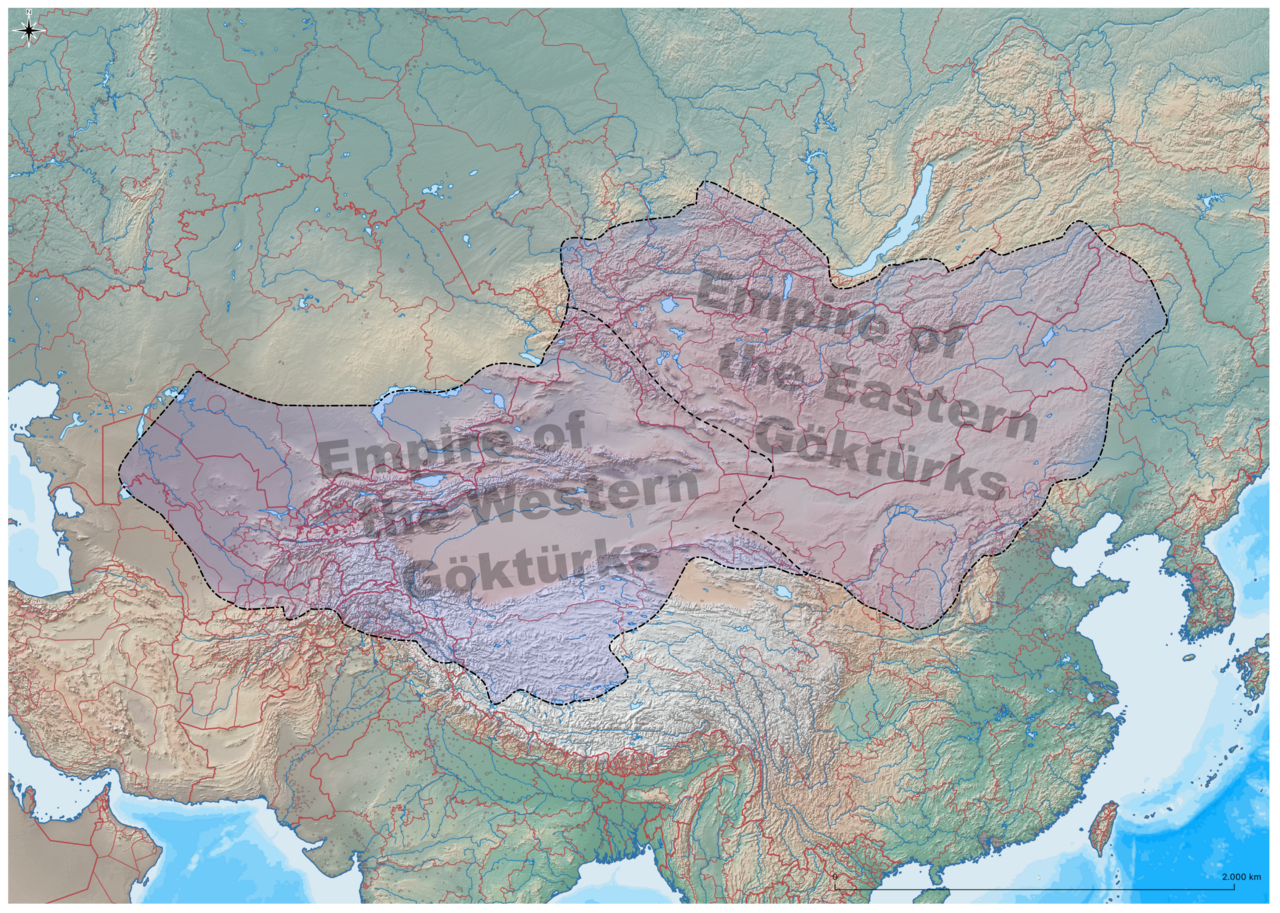
Chinese sources variously link the Ashina to the Xiongnu confederation or describe them as 'mixed Hu (barbarians)' from Pingliang in Gansu. The early Turk population was rather heterogeneous, and many names of Turk rulers, including the two founding members, are not even Turkic. The khaghans adopted Iranian and Tokharian (or non-Altaic) titles, and whatever language the Ashina originally spoke, they and their subjects eventually spoke Turkic in various dialects. The Göktürks reached their peak in the late 6th century and engaged in a series of conflicts with the Sui dynasty of China. These conflicts ended not through a single war but due to internal succession disputes among the Turkic nobles, exacerbated by Sui diplomatic maneuvering. The First Turkic Khaganate split into Eastern and Western Khaganates after the civil war between Taspar Qaghan's heirs (c. With support from Emperor Wen of Sui, Yami Qaghan won the civil war and ruled the Eastern Khaganate after the split was already underway, while the Western Khaganate was established separately under Tardu and later Heshana Qaghan. Weakened, Yami Qaghan declared allegiance to the Sui. Liu was eventually routed by Li Shimin and executed, and the Tang dynasty was established.
Reader's Guide
The Göktürks are significant as the founders of the First Turkic Khaganate, a nomadic dynasty that succeeded the Rouran Khaganate and became the dominant power in medieval Inner Asia. Their name, Göktürk, is sometimes interpreted as 'Celestial Turk' or 'Blue Turk', consistent with the cult of heavenly ordained rule recurrent in Altaic political culture. The ethnonym 'Türk' originally meant 'the culminating point of maturity' (of a fruit or human being) or 'in the prime of life, young, and vigorous', and was used by the Göktürks only for themselves, their subjects, and splinter groups—not for other Turkic-speaking groups like the Uyghurs, Tiele, or Kyrgyz. The memory of the Göktürks and the Ashina had faded by the turn of the millennium; later dynasties such as the Karakhanids, Qocho Uyghurs, and Seljuks did not claim descent from them. Their legacy includes shaping the future geolocation, culture, and dominant beliefs of Turkic peoples, and the name 'Turk' became a political designation for all subjects of the Turk empires.
Did You Know?
- The name Göktürk is sometimes interpreted as 'Celestial Turk' or 'Blue Turk', consistent with the cult of heavenly ordained rule.
- The Göktürks did not consider other Turkic-speaking groups such as the Uyghurs, Tiele, and Kyrgyz to be Türks.
- The Ashina clan, the ruling clan of the Göktürks, may have derived its name from the Khotanese Saka term for 'deep blue', āššɪna, though this etymology is speculative and not widely accepted in mainstream scholarship.
- The word Türk originally meant 'the culminating point of maturity' (of a fruit or human being) or 'in the prime of life, young, and vigorous'.
Rise to Power and the Architecture of a Khaganate
Under the leadership of Bumin Qaghan, who died in 552, and his sons, the Göktürks displaced the Rouran Khaganate to become the dominant force in medieval Inner Asia. This political upheaval gave birth to the First Turkic Khaganate, a nomadic dynasty whose influence would ripple across centuries, shaping the geographic footprint, cultural practices, and dominant belief systems of Turkic peoples. The Göktürks were not merely conquerors; they established a political template that outlasted their own rule. When tribal leaders consolidated khanates over diverse tribes and tribal unions, the collected populations identified themselves politically with the ruling leadership. The word Türk thus became a broad designation for all subjects of Turkic empires, even though subordinate groups retained their own names, identities, and social structures. The Göktürks' political architecture set a precedent that echoed through later Turkic states, making their rise one of the most consequential transitions in Central Asian history.
The Name Türk and Its Layers of Meaning
The ethnonym Türk remains one of the most debated terms in Turkic studies. Scholars have proposed multiple meanings: 'strong' or 'ripe' as a fruit, 'in the prime of life' for a person, or even 'gathered, united, allied,' derived from a Pre-Proto-Turkic verb meaning to heap up or collect. The prefix Gök, or Kök in Old Turkic, adds another layer of ambiguity. Modern Turkish speakers naturally read it as 'sky,' yielding 'Celestial Turk,' but the single attestation leaves open the possibility that Kök simply meant 'big' or 'great.' Alternatively, 'blue' connects to the Ashina clan's endonym and to the cardinal system of Central Asia, where blue signified the East. Chinese historiographers rendered the name as Tūjué, folk-etymologized as 'combat helmet' because of the shape of the Altai Mountains. The name was also recorded in Sogdian, Khotanese Saka, Middle Persian, Manchu, Korean, and Old Tibetan, testifying to how widely the Göktürks were known across Eurasia.
Origins and the Ashina Question
The Göktürk rulers traced their lineage to the Ashina clan, first attested in 439 CE when, according to the Book of Sui, five hundred Ashina families fled northwest from eastern Gansu after Emperor Taiwu of Northern Wei overthrew Juqu Mujian of the Northern Liang. These families sought refuge within the Rouran Khaganate near Gaochang. Chinese sources variously linked the Ashina to the Xiongnu confederation, to an obscure Suo state founded by Sakas or Xianbei, or to 'mixed Hu' from Pingliang in modern Gansu. Some researchers connected the Göktürks to the Tiele confederation through Xiongnu ancestry, though other scholars note that Chinese sources never explicitly describe the Ashina-led Göktürks as Dingling descendants or Tiele members. The pattern of Chinese historiographers linking northern frontier peoples to the Xiongnu mirrors how Graeco-Roman writers lumped Avars, Huns, and Hungarians under the label 'Scythian'—an archaizing literary convention implying shared nomadic lifestyle rather than direct genealogical descent.
Defining the In-Group and the Fading of Memory
The Göktürks drew a sharp boundary around who qualified as Türk. In the Orkhon inscriptions, the Toquz Oghuz and Yenisei Kyrgyz are not called Türks. The Uyghurs, who later succeeded the Göktürks, reserved the term Türk exclusively for their Göktürk predecessors, portraying them as enemy aliens in their own royal inscriptions. Even the Khazars, whose Chinese transcription included the element Tūjué, may have preserved a fragment of Göktürk political tradition. Yet by the turn of the first millennium, memory of the Göktürks and the Ashina had largely faded. The Karakhanids, Qocho Uyghurs, and Seljuks did not claim descent from the Göktürks. The name had become a broad political label for subjects of Turkic empires rather than a specific ethnic identity, and the particular Göktürk-Ashina connection that once defined a people in medieval Inner Asia dissolved into the broader tapestry of Turkic history.
Gallery

Frequently Asked Questions
Who are the Göktürks?
The Göktürks—also called Türks, Celestial Turks, or Blue Turks—were a Turkic people of medieval Inner Asia who built the First Turkic Khaganate. They stand as one of the foundational nomadic empires in the region's history.
What was the Göktürk role or 'power' in the region?
After toppling the Rouran Khaganate, the Göktürks became the dominant political force across Inner Asia. Under Bumin Qaghan and his successors they forged a vast nomadic empire that reorganized the region's power dynamics.
How does the Göktürk story end?
The First Turkic Khaganate, which reached its zenith in the late sixth century, eventually fractured into rival eastern and western branches. Despite that political split, the Göktürk model of governance and identity persisted as a template for later Turkic states.
Why are the Göktürks important to Turkic history?
They are credited with shaping the long-term geography, cultural identity, and dominant religious beliefs of Turkic peoples. As one of several key nomadic dynasties, they set political and cultural patterns that echoed through centuries of Central and Inner Asian history.
More in Medieval And Early Modern Asian Empires 1-23
Spotted an error? Know more?
This is a living reference — every entry is fact-audited, and reader corrections feed straight into our audit queue. Suggest an edit · See this site's audit record