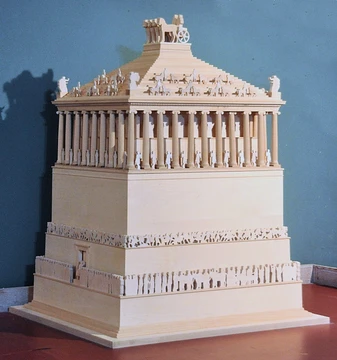
Nereid Monument
A Lycian tomb that inspired the Mausoleum at Halicarnassus.

via Wikipedia: Nereid Monument · see source
The Nereid Monument, a sculpted tomb from Xanthos in Lycia (part of the Achaemenid Persian Empire, near modern Fethiye, Turkey), was built around 390 BC for Arbinas, a local ruler under Persian authority. Designed as a Greek-style temple atop a base with carved friezes, it later inspired the Mausoleum at Halicarnassus. The ruins were rediscovered by British traveler Charles Fellows in the 1840s and shipped to the British Museum, where part of the east façade has been reconstructed.
Quick Facts
- Date
- Early fourth century BC (circa 390 BC)
- Commissioned by
- Arbinas (Lycian: Erbbina or Erbinna)
- Type
- Sculptured tomb in the form of a Greek temple on a podium
- Current location
- British Museum (reconstructed east façade)
- Rediscovered by
- Charles Fellows in the early 1840s
- Inspiration for
- Mausoleum at Halicarnassus
Facts from the source article.
Tombs in Xanthos
Xanthos, also known as Xanthus, served as the primary city-state of the Lycians, a native people of southwestern Anatolia, in what is now Turkey. A notable feature of this site is its collection of pillar tombs, which consist of a stone burial chamber perched atop a tall stone pillar. The deceased were placed in the upper part of these stone structures, raising them high above the surrounding land. These tombs were built for the Lycian dynasty’s rulers, who governed from the mid-6th to the mid-4th century BCE, and they highlight the enduring authority of these leaders in the region. Beyond preserving the rulers’ legacies through monumental architecture, the tombs also demonstrate the incorporation of Greek decorative styles. Xanthos was governed by a king who answered to an Achaemenid Empire governor. The tradition of constructing pillar tombs served as a visible sign of the dynasty’s unbroken rule. During the period these tombs were built, Late Classical Greek artistic concepts heavily influenced Lycian visual culture. The pillars were uncovered by Sir Charles Fellows, an English explorer active in the Levant and Asia Minor, and were moved to the British Museum in 1848 CE.
Arbinas
Lycia was conquered by Harpagus for the Achaemenid Persian Empire in approximately 540 BC, and his conquest of Xanthos is described by both Herodotus and Appian. For much of the 5th century BC, Athens dominated the lands bordering the Aegean Sea, and many of them, including Lycia, were paying protection money into the exchequer of the Athenian maritime empire, the Delian League, and land tax to the Persians. There is evidence of a fire that destroyed the wooden tombs and temples of Xanthos in around 470 BC. This fire was probably caused by Cimon of Athens when he attacked the sacred citadel in retaliation for the Achaemenid destruction of Athens by the Persians and their allies, including the Lycians, in 480 BC. The Xanthians, under their dynast, Kuprilli, rebuilt the buildings in stone. Around 440 BC, Kheriga, Kuprilli's grandson, succeeded him, and in turn Kheriga's brother, Kherei, is thought to have succeeded him in around 410 BC. Arbinas was Kheriga's son, but had to take Xanthos and other Lycian cities by force of arms in around 390 BC in order to reclaim his birthright. Arbinas then ruled Western Lycia from Xanthos, and he built the Nereid Monument as his tomb. He died in around 370 BC.
Description
Although Arbinas ruled Lycia as part of the Persian Empire, the monument is built in a Greek style, influenced by the Ionic temples of the Athenian Acropolis. The rich narrative sculptures on the monument portray Arbinas in various ways, combining Greek and Persian aspects. The temple-like tomb had four columns on its east and west faces, and six on the north and south. It stood elevated on a substantial podium, decorated with two friezes: a shallower upper frieze above a deeper lower frieze. In the reconstruction in the British Museum, the podium consists simply of the two friezes above one layer of blocks, whereas Fellows's sketch of the monument showed a much taller structure with two substantial rows of blocks below the lower frieze, and a further two rows separating the lower from the upper frieze. There are also reliefs on the architrave, cella walls, and in the pediment. There were many large free-standing sculptures, including those of Nereids between each pair of main columns. The larger and lower frieze on the podium was made up of 22 blocks, of which seven are lost apart from fragments. The surviving panels represent heroic battle scenes, with no apparent overall narrative, mostly involving male soldiers dressed in Greek costume and armour. Unlike many friezes from the same period, they are not pitched against Amazons, centaurs or obvious foreigners. The upper, shallower frieze on the podium also consisted of 22 blocks, and three have been lost. Each of the four sides of this frieze represents the siege of a city. The cities are portrayed with characteristic Lycian merlons, and the frieze is thought to represent Arbinas's conquest of Lycian cities so as to ensure his succession to the leadership. Arbinas is represented in various ways, including sitting in Persian style, shaded with a parasol, and with his feet supported off the ground by a footstool. There is also variety in the soldiers, including heavily armed hoplites and archers, and there are prisoners being led away, and besiegers scaling city walls with ladders. The frieze on the architrave on top of the columns is carved in a simpler, more naive style than the podium friezes. It again portrays scenes of combat, but also a boar hunt, figures bearing offerings, and preparations for a banquet. The frieze at the top of the outside wall of the cella would have been the least visible, being screened by the columns. It contains scenes of sacrifices and banqueting. There are two figures at the banquet who dine on couches of their own. One is taken to be Arbinas, and he is larger than all the other banqueting figures, and the other may be his son. Here Arbinas is shown with hair and beard like the kings of Persia or Assyria, and he holds a Persian drinking horn. Each of the two pediments (gable ends) of the monument was decorated with a relief, rather than with the fully rounded sculptures found on pediments of most buildings of the period in Greece. The relief on the east pediment shows Arbinas and his wife seated, and Ian Jenkins suggests that this was inspired by the portrayal of Zeus and Hera on the east frieze of the Parthenon. Smaller figures are thought to represent the children and pet dog of the ruling family. Only one of the two panels that made up the west pediment relief survives. In contrast to the static family scene on the east side, this shows soldiers moving in battle. The monument is now named after the life-size female figures in wind-blown drapery. Eleven survive, which would have been enough to fill the spaces between columns on the east and west sides, and the three on the north. Jenkins speculates that there might never have been figures on the south side. They are identified as sea-nymphs because various sculpted sea creatures were found under the feet of seven of them, including dolphins, a cuttlefish, and a bird that may be a sea-gull. They have generally been called Nereids, though Thurstan Robinson argues that this is imposing a Greek perspective on Lycian sculptures, and that they should rather be seen as eliyãna, Lycian water-nymphs associated with fresh-water sources and referenced on the Letoon trilingual inscription, which was discovered a few kilometres to the south of the site of the Monument. As well as the Nereids, there were sculptures of various other figures, including several that served as acroteria, crowning the angles and apex of the pediment. Each of the two main surviving acroteria involves a young man and a young woman, and they are variously interpreted as representing the rape of the daughters of Leukippos by the twins Castor and Pollux, or as the Nereid Thetis being carried off by Peleus, or as exploits of Herakles.
More in Mausoleum at Halicarnassus
Spotted an error? Know more?
Reader corrections go straight into our review queue. Suggest an edit · How this site is sourced