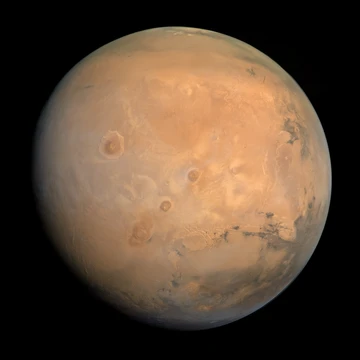
History of Mars observation
From ancient records to telescopic mapping of the Red Planet.
Last updated
The history of Mars observation encompasses the recorded study of the planet from ancient times through the telescopic era. Early records date back to Egyptian astronomers in the 2nd millennium BCE, and Chinese observations of Mars's motions predate the Zhou dynasty. The development of telescopic observation in the 17th century revealed surface features and led to detailed mapping, while later spectroscopic studies raised and then refuted the possibility of an Earth-like environment.
Quick Facts
- First telescopic observation
- 1609 by Galileo Galilei
- First map of mars
- 1840 by Johann Heinrich Mädler
Facts from the source article.
Orbital models
The Greeks used the term planēton for the seven moving celestial bodies and held a geocentric view. Plato, in The Republic, listed the order from Earth as Moon, Sun, Venus, Mercury, Mars, Jupiter, Saturn, and the fixed stars, and in Timaeus proposed that more distant objects moved slower. Aristotle observed an occultation of Mars by the Moon on 4 May 357 BCE, concluding Mars lay farther than the Moon, and used such evidence to support the Greek planetary sequence. His De Caelo presented a model with the Sun, Moon, and planets circling Earth at fixed distances.
Hipparchus refined this with epicycles—Mars moved along a small circle that orbited Earth on a larger deferent. In Roman Egypt during the 2nd century CE, Ptolemy addressed Mars's uneven motion, which appeared 40% faster on one side of its orbit. He added an offset point from the center of the planet's circular orbit to maintain uniform rotation, and proposed the order: Moon, Mercury, Venus, Sun, Mars, Jupiter, Saturn, and fixed stars. His work Almagest became the authoritative astronomical text for fourteen centuries.
Early telescope observations
Before telescopes, Mars's angular size of 25 arcseconds at closest approach was too small for the naked eye to resolve, so only its red hue and sky position were known. Telescopes appeared in 1608, and in September 1610 Galileo Galilei began observing Mars, though his instrument could not show surface detail. He sought to detect phases like those of Venus or the Moon; by December he noted Mars had shrunk in angular size.
Johannes Hevelius observed a phase of Mars in 1645. Francesco Fontana made the first telescopic drawing in 1636 but noted no features. In 1644 Daniello Bartoli reported two darker patches. During oppositions of 1651, 1653, and 1655, Giovanni Battista Riccioli and Francesco Maria Grimaldi noted patches of differing reflectivity.
Christiaan Huygens made the first drawing with actual features on 28 November 1659, showing Syrtis Major Planum and possibly a polar ice cap; that year he measured the rotation period as approximately 24 hours and estimated Mars's diameter at about 60% of Earth's. Giovanni Domenico Cassini gave a definitive mention of the southern polar ice cap in 1666 and determined a rotation period of 24h 40m. In 1672 Huygens noticed a fuzzy white cap at the north pole.
Geographical period
Early 19th-century improvements in telescope optics, notably Joseph von Fraunhofer's achromatic lens that eliminated coma, advanced observation. By 1812 Fraunhofer created a 190 mm achromatic objective. During the 1830 opposition, Johann Heinrich Mädler and Wilhelm Beer used a 95 mm Fraunhofer refractor to study Mars extensively.
They chose a feature 8° south of the equator as a reference point, later named Sinus Meridiani and used as the zero meridian. They established that most surface features were permanent and refined the rotation period. In 1840 Mädler combined ten years of observations into the first map of Mars, designating features with letters.
During the 1858 opposition, Angelo Secchi noticed a large blue triangular feature he called the Blue Scorpion. J. Norman Lockyer saw the same seasonal cloud-like formation in 1862. Frederik Kaiser produced drawings during the 1862 opposition and, comparing them with those of Huygens and Robert Hooke, refined the rotation period to 24h 37m 22.6s, accurate to within a tenth of a second.
Refining planetary parameters
Yellow clouds obscuring the surface were noted in the 1870s by Schiaparelli and observed during the oppositions of 1892 and 1907. In 1909 Antoniadi associated these yellow clouds with the obscuration of albedo features and found Mars appeared more yellow during oppositions when closest to the Sun, suggesting windblown sand or dust as the cause. In 1894 William W. Campbell found Mars's spectrum identical to the Moon's, casting doubt on a similar atmosphere; he attributed previous water detections to Earth's atmosphere. Though he agreed the ice caps indicated atmospheric water, he believed the caps were too small for detection.
Campbell's results were controversial but confirmed by Walter S. Adams in 1925. Hermann Struve used changes in the orbits of Mars's moons to determine the planet's oblateness, estimating in 1895 that the equatorial diameter was 1/190 larger than the polar diameter, refining it to 1/192 in 1911. Edgar W. Woolard confirmed this in 1944.
Did You Know?
- Mars was portrayed on the ceiling of the tomb of Seti I, on the Ramesseum ceiling, and in the Senenmut star map, the oldest known star map dated to 1534 BCE.
- During the 1877 opposition, Giovanni Schiaparelli used a 22 cm telescope to produce the first detailed map of Mars, which included features he called canali, later shown to be an optical illusion.
- The International Planetary Patrol Program, formed in 1969, focused on observing dust storms on Mars and showed that most occur when the planet is closest to the Sun.
More in Mars
Sources
Compiled from Wikipedia and the sources listed below. Text from Wikipedia is available under CC BY-SA 4.0; this entry is adapted from it.
- Wikipedia: History of Mars observation (CC BY-SA 4.0).
Spotted an error? Know more?
Reader corrections go straight into our review queue. Suggest an edit · How this site is sourced