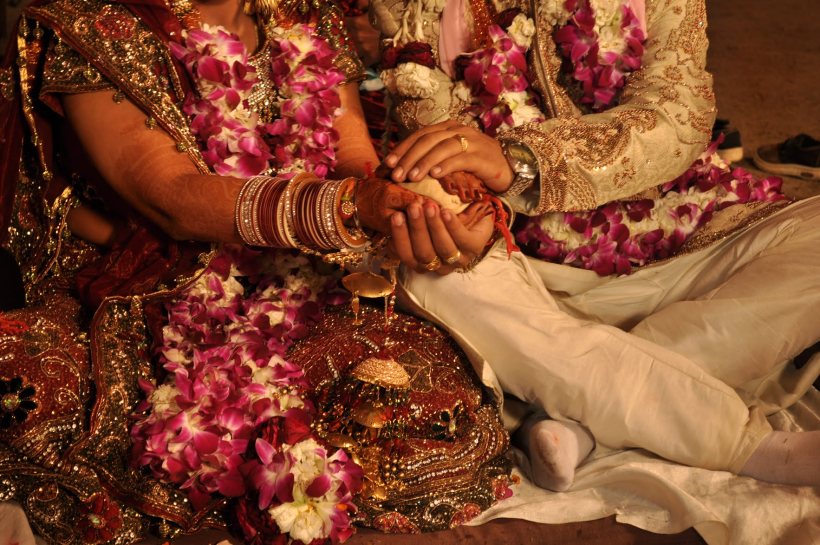
Interfaith marriage
Marriage between spouses of different religions, with varying legal and social acceptance.

Ruchi Arjun Solanki · CC BY-SA 4.0
Interfaith marriage, also referred to as interreligious or mixed marriage, unites two people who belong to and are legally recognized as members of different religions. While these unions are frequently civil ceremonies, they can sometimes be religious ones, depending on what each partner's faith allows. Some religions forbid interfaith marriage outright; others permit it under certain conditions, and several major religions do not address the matter at all.
For ethno-religious groups, opposing interfaith marriage can be a way to maintain cultural identity and religious cohesion through self-segregation. Conversely, such marriages have sometimes been viewed as a challenge to religious and social boundaries. In an interfaith marriage, each spouse typically continues practicing their own religion, though deciding which faith to pass on to their children can become a point of tension.
**Legal status**
**Human rights** Article 16 of the Universal Declaration of Human Rights grants men and women of marriageable age the right to marry "without any limitation due to race, nationality or religion." However, when this article was largely incorporated into Article 23 of the International Covenant on Civil and Political Rights, the references to religious and racial restrictions were dropped. The American Convention on Human Rights, in Article 17, clause two, affirms the right to marry for all men and women, subject to domestic law, as long as those laws do not violate the convention's principle of nondiscrimination.
**United States** A 2015 Pew Research Center study found that interfaith marriage has grown significantly in the United States. Among marriages before 1960, 81% were between spouses of the same religious denomination, 11% were between different Christian denominations, 5% were between a Christian and a religiously unaffiliated person, and 3% were other mixed interfaith unions. For marriages between 2010 and 2014, those figures shifted to 61%, 15%, 18%, and 6%, respectively. Interfaith marriage is least common among Hindus, Mormons, and Muslims, and most common among the religiously unaffiliated, mainline Protestants, and Jews.
Joan Boocock Lee, an Episcopalian British-American actress married to the agnostic Jewish-American comic book creator Stan Lee until her death, said the couple had trouble adopting a child in mid-20th century America. Starting in the 1960s, American composers began writing wedding music for interfaith ceremonies, most notably John Serry Sr. He spent the last thirty-five years of his career performing wedding and liturgical music for both Jewish and Roman Catholic faiths as a freelance organist at the Interfaith Chapel of Long Island University's C W Post Campus in Brookville, New York (1968–2002). As more rabbis in the 1960s and 1970s sought to unite couples of different faiths without requiring conversion, Serry worked with several clergymen from both traditions, including Rabbi Nathaniel Schwartz and the Rev. John Heinlein.
**India** Interfaith marriage is controversial in some parts of India, especially relationships between Hindus and Muslims. Advertisements and films depicting such unions have drawn condemnation and legal action. Hindu-Muslim couples have faced harassment, including having their personal details posted online. In 2020 and 2021, several Indian states governed by the BJP passed laws against forced conversions, requiring couples to notify authorities of their intent to marry, observe a waiting period, and allow anyone to object to the union. Interfaith marriages have been treated as evidence of forced conversion, even when individuals state they will not convert. Fearing vigilante violence, and after facing long delays and uncooperative officials, some couples have fled to other states to marry, often losing their jobs. In August 2021, the Gujarat High Court limited that state's law on the grounds of freedom of religion.
Scholar Tamalapakula (2019) argues that the caste system's social dimension is crucial to understanding interfaith marriage in India. In her study of interfaith and inter-caste marriages, class and gender dynamics heavily shape relationships between families. For example, in marriages between Brahmin women and Dalit men, the men are often viewed poorly by Brahmin relatives and may isolate themselves from their own Dalit relatives to avoid association, seeking a status closer to the "pure" social standing of the Brahmin woman. Still, marriage is often seen by Dalit men as a way to improve social status and transcend caste-based discrimination. For Dalit women, however, Tamalapakula contends that higher castes would never accept them as legal wives of Brahmin men, and they are seen as sexually exploited by their own Dalit relatives. This illustrates how interfaith and inter-caste marriages are tied to structural inequalities of gender and class. Thus, while interfaith marriage is both controversial and legally permitted, it exists within a larger power dynamic that crosses class and gender lines.
- field
- Sociology, Law, Religion
- known_for
- Marriage between spouses of different religions
- legal_basis
- Article 16 of the Universal Declaration of Human Rights
- common_issue
- Choice of faith in which to raise children
Lore & Background
Interfaith marriages are least common among Hindus, Mormons, and Muslims, and most common among religiously unaffiliated people, mainline Protestants, and Jews. In the mid-20th century, actress Joan Boocock Lee, an Episcopalian married to agnostic Jewish comic book creator Stan Lee, faced difficulty adopting a child due to their interfaith union.
Reader's Guide
Interfaith marriage is significant as a marker of changing social and religious norms, particularly in the United States where rates have risen sharply since the 1960s. The practice raises legal and human rights questions: Article 16 of the Universal Declaration of Human Rights guarantees marriage without limitation due to religion, but this clause was omitted from the International Covenant on Civil and Political Rights. In countries like India, interfaith marriage—especially between Hindus and Muslims—remains controversial, with some states passing laws requiring notification of intent to marry and allowing objections, amid fears of forced conversions. In Israel, most interfaith marriages are not performed without conversion due to the Ottoman Millet system, and only about 2% of Jewish individuals are in interfaith marriages. In Lebanon, secular civil marriage is not possible, so interfaith couples must navigate the religious laws of 18 recognized sects, often requiring conversion. The legacy of interfaith marriage includes ongoing debates about religious freedom, cultural identity, and the rights of couples to choose their own paths.
Did You Know?
- In Israel, only about 2% of Jewish individuals are part of an interfaith marriage, and 97% would not be comfortable with their child marrying a Muslim.
- John Serry Sr. devoted 35 years to performing wedding and liturgical music for Jewish and Roman Catholic faiths at an interfaith chapel in New York.
Taxonomy of Multiple-Partner Relationships
The concept of polygamy, derived from a Late Greek term meaning the state of being married to many spouses, encompasses a spectrum of relational arrangements that scholars have worked to categorize with precision. Drawing on the framework of Ulrich Reichard and colleagues, researchers distinguish four overlapping dimensions: marital polygamy (being legally wed to more than one person), social polygamy (cohabiting and cooperating with multiple partners for shelter, food, and financial resources), sexual polygamy (maintaining more than one sexual partner or engaging in sex outside a primary relationship), and genetic polygamy (producing offspring with evidence of differing paternity). These categories do not always align, and the term shifts meaning depending on the discipline. Biologists and behavioral ecologists tend to focus on reproductive exclusivity, while cultural anthropologists and social scientists emphasize the social and marital structures involved. In concrete practice, polygamy manifests in three specific forms: polygyny (one man with multiple simultaneous wives), polyandry (one woman with multiple simultaneous husbands), and group marriage (multiple husbands and multiple wives forming a single family unit).
Global Distribution and the Polygamy Belt
Across the world, societies vary enormously in whether they encourage, tolerate, or prohibit multiple-spouse arrangements. A landmark survey compiled in the Ethnographic Atlas Codebook, covering 1,231 societies documented between 1960 and 1980, revealed that 588 practiced frequent polygyny, 453 saw it occasionally, 186 were strictly monogamous, and only 4 exhibited polyandry. More recent fieldwork has since identified some form of polyandry in 53 communities, suggesting this rarer arrangement is more widespread than earlier data implied. In virtually every culture where multiple-spouse marriage is accepted, polygyny is the dominant form. The highest concentrations cluster in a geographic zone stretching across West and Central Africa, often called the polygamy belt. Nations such as Burkina Faso, Mali, Gambia, Niger, and Nigeria are estimated to have the world's highest rates of polygamous practice. Within these societies, the likelihood of an individual entering a polygynous union frequently tracks social class and economic standing. Some scholars also point to the historical disruption of male-to-female sex ratios caused by the slave trade as a reinforcing factor in the entrenchment of polygynous norms across parts of the continent.
Genetic Heritage and the Shift Toward Monogamy
Genetic and anthropological evidence paints a nuanced picture of human mating history. Researchers who have traced the reproductive patterns of prehistoric men with living descendants estimate that the average individual fathered children with between 1.5 women roughly 70,000 years ago and 3.3 women around 45,000 years ago, with East Asia as a notable exception. These figures could be consistent with a society practicing serial monogamy rather than simultaneous polygyny. Even in communities where polygyny is culturally sanctioned, observational data show that the majority of relationships remain monogamous in day-to-day practice while the couple stays together. Anthropologists therefore tend to describe humans as mildly polygynous or monogamous with polygynous tendencies. A significant shift appears in the genetic record over the last 5,000 to 10,000 years, a period that coincides with the rise of agriculture, the emergence of non-communal land ownership, and the development of inheritance systems. These economic and social transformations seem to have reinforced exclusive pairing, gradually narrowing the range of accepted mating strategies across human populations.
Legal Recognition and Cultural Frameworks
The legal landscape surrounding multiple-spouse marriage is deeply fragmented. In many nations, statutes formally recognize only monogamous unions, making bigamy a criminal offense, yet adultery often remains unpunished. This gap creates a space where de facto polygamy can exist without legal standing for any partner beyond the first. The term polygamy itself is frequently applied in a de facto sense, regardless of whether a government acknowledges the relationship. Religious and cultural frameworks add further layers. In several Muslim-majority countries and others with significant Muslim populations, polygyny is accepted to varying degrees, grounded in Islamic law, which is derived from the Quran and hadith. The Arabic term sharia denotes God's immutable divine law, distinct from fiqh, the human scholarly interpretation of that law. In India, for example, the legal system recognizes polygamous marriages exclusively for the Muslim community. Beyond legal codes, cultural assumptions about what constitutes monogamy vary widely: some societies demand lifelong sexual exclusivity, while others accept pre-marital sex, spouse-swapping, or serial monogamy as perfectly legitimate expressions of a monogamous ethic.
Gallery
Frequently Asked Questions
What exactly is an interfaith marriage?
It is a union in which both partners identify with and are legally recognized as members of different religious traditions. Couples may formalize the bond through a civil ceremony or a religious one, depending on what each faith permits.
Is interfaith marriage legally recognized?
Yes; Article 16 of the Universal Declaration of Human Rights affirms the right to marry regardless of religious difference. In practice, many couples choose a civil registration to sidestep conflicts between their two faiths' rules.
What is the most common challenge couples face in an interfaith marriage?
Deciding which faith, if any, to instill in their children tends to be the central point of tension. This question can strain the relationship and sometimes spark broader disputes with extended family or community members.
Do all religions permit interfaith marriage?
No—some faiths outright forbid it, others allow it under specific conditions or with restrictions, and still others simply remain silent on the issue. A couple's experience therefore varies enormously depending on which two traditions are involved.
Why does interfaith marriage matter in sociology and law?
It sits at the crossroads of personal freedom, religious doctrine, and state regulation, making it a key case study for how societies balance individual rights against community norms. Its legal and social treatment often reveals broader tensions about pluralism and minority protections.
More in Marriage And Kinship 1-18
Spotted an error? Know more?
This is a living reference — every entry is fact-audited, and reader corrections feed straight into our audit queue. Suggest an edit · See this site's audit record