Proterocladus
Ancient branching green algae from the Tonian and Stenian periods.

Proterocladus is a genus of green algae known from the early Neoproterozoic (Tonian) and latest Mesoproterozoic (Stenian). It is notable for being one of the oldest known branching green algae, with fossils recovered from the Nanfen Formation and Diaoyutai Formation in China and the Svanbergfjellet Formation in Norway. Possible remains are also reported from the Nonesuch Formation, though their fragmentary state leaves their assignment uncertain.
Quick Facts
- Taxon
- Proterocladus
- Type Species
- Proterocladus major
- Type Species Authority
- Butterfield et al, 1994
Facts from the source article.
Lore & Background
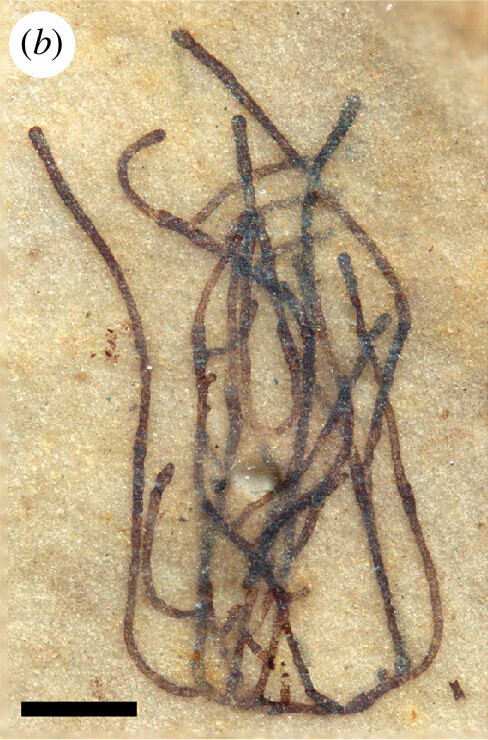
The later three species—Proterocladus major, P. minor, and P. hermannae—are relatively similar, differentiated only by size and accessory features. All have filaments composed of rows of single cells with occasional branches; individual cells are cylindrical, psilate, thin-walled, much longer than wide, and often separated by septa. Branches often occur near a septum, and filament tips are either rounded or capitate. P. minor differs from P. major by lacking large constrictions at septa and having branches of similar diameter to the main stem. P. hermannae differs from P. minor by having smaller, fewer septa and being larger overall.
With the discovery of P. antiquus and over 1000 specimens, new features emerged: multiple-ordered branches, variants in cell shape (circular, club-shaped, cup-like, barrel-like), occasional extensions on tips of cells at filament ends, and a disc-like holdfast. P. antiquus shows all these features plus distinct akinetes (asexual resting spores), but otherwise resembles P. major in having large constrictions along its septa. Cell size and septa constrictions/frequency are variable in P. antiquus, casting doubt on every other Proterocladus species since those two characters are the only ones separating each species from the Svanbergfjellet Formation.
Reader's Guide
Proterocladus is significant as one of the earliest known branching green algae, extending the fossil record of complex multicellularity in green algae into the Mesoproterozoic–Neoproterozoic boundary. Its branching habit, preserved in multiple formations across China and Norway, suggests a widespread distribution in ancient marine environments. The discovery of P. antiquus, with over 1000 specimens, revealed previously unseen features such as multiple-ordered branches, varied cell shapes, and a disc-like holdfast, indicating a more complex morphology than earlier species suggested. However, the variability in cell size and septa constrictions within P. antiquus has cast doubt on the validity of the other species, which were distinguished solely by those characters. This uncertainty underscores the challenges of classifying fossil algae based on limited morphological traits. The genus also provides a benchmark for studying the evolution of branching and reproductive structures like akinetes in early green algae.
Did You Know?
- Proterocladus derives from Greek words meaning 'earlier' and 'branch'.
- The species P. hermannae honors Tamara Hermann for her work in Proterozoic paleontology.
- P. antiquus is the oldest known species of Proterocladus, with over 1000 specimens found.
- Possible Proterocladus remains from the Nonesuch Formation are too fragmentary to confirm.
Gallery
Frequently Asked Questions
Who is Proterocladus?
Proterocladus is a genus of ancient green algae that lived during the late Mesoproterozoic and early Neoproterozoic eras. Its name is built from two Greek words meaning 'earlier' and 'branch,' a nod to its status as one of the earliest known branching green algae.
What are Proterocladus's powers/role?
Proterocladus is notable for being one of the oldest confirmed examples of a branching green alga, pushing back the timeline for complex multicellular structure in the green lineage. Its fossils display a branched thallus, setting it apart from the simpler single-celled or filamentous algae that dominated the same time window.
Why is Proterocladus important?
It gives researchers one of the earliest fossil confirmations that green algae had already evolved branched body plans well before the Cambrian explosion. That helps pin down when multicellular complexity first emerged in the Viridiplantae lineage.
Where can Proterocladus fossils be found?
Confirmed specimens come from the Nanfen and Diaoyutai Formations in China as well as the Svanbergfjellet Formation in Norway. Fragmentary material in Canada's Nonesuch Formation has also been tentatively linked to the genus, though that assignment remains uncertain due to the poor preservation.
More in Marine Green Macroalgae, Part 2 1-24
Spotted an error? Know more?
Reader corrections go straight into our review queue. Suggest an edit · How this site is sourced