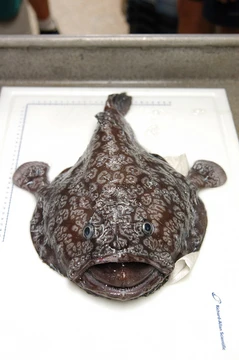
Tetraroge
Venomous waspfishes of the Indian and western Pacific Oceans.
Last updated

Sir Francis Day · via Wikipedia: Tetraroge · Public domain
Tetraroge is a genus of ray-finned fish known as waspfishes, part of the subfamily Tetraroginae within the family Scorpaenidae, which includes scorpionfishes. These fish live in the Indian Ocean and western Pacific Ocean. The genus was first described in 1860 by Albert Günther, a German-born British herpetologist and ichthyologist.
In 1919, David Starr Jordan designated Apistus barbatus, originally described by Georges Cuvier in 1829 from Java, as the type species. The subfamily Tetraroginae is placed within Scorpaenidae in the 5th edition of Fishes of the World, but some authorities put it in the stonefish family Synanceiidae, while others treat it as its own family. The name Tetraroge combines tetra ("four") and rhogos ("clef"), referring to four clefts between the gill, compared to five in Pentaroge, a synonym of Gymnapistes.
Characteristics
Two species are currently recognized: Tetraroge barbata (bearded roguefish) and Tetraroge nigra (freshwater waspfish), both described by Cuvier in 1829. These fish have mostly scaleless bodies, a single spine and five fin rays in the pelvic fins, and teeth on the palatine. The dorsal fin has 14 to 17 spines and begins forward of the rear edge of the eye.
The head’s upper profile is sloping; there are no tentacles on the eyes, but papillae are present on the eyes, head, and body. The lateral line is clearly separate from the dorsal fin base, and the tip of the operculum does not reach as far back as the dorsal fin base. The larger species, T. nigra, reaches a maximum total length of 13.5 cm, while T. barbata reaches 10 cm.
Distribution and habitat
These waspfishes occur from India east to Fiji, north to Japan, and south to New Guinea and New Caledonia. They inhabit estuaries and mangroves and enter freshwater rivers up to 40 km from the coast. They are predators that feed on fish and crustaceans, and at least some of their fin spines carry venom.
Scientific classification
- KingdomAnimalia
- PhylumChordata
- ClassActinopterygii
- DivisionTeleostei
- OrderPerciformes
- FamilySynanceiidae
- GenusTetraroge
Named by Günther, 1860
Sources: Wikipedia taxobox: Tetraroge (CC BY-SA 4.0)
Quick Facts
- Type species
- Apistus barbatus
Facts from the source article.
Lore & Background
The genus Tetraroge was first described in 1860 by the German-born British herpetologist and ichthyologist Albert Günther. In 1919, David Starr Jordan designated Apistus barbatus, described by Georges Cuvier in 1829 from Java, as the type species. The genus name combines tetra, meaning 'four', with rhogos, meaning 'clef', referring to the four clefts between the gill, compared to five in Pentaroge, a synonym of Gymnapistes. The classification of Tetraroge is disputed: the 5th edition of Fishes of the World places it in the subfamily Tetraroginae within Scorpaenidae, but other authorities place that subfamily within the stonefish family Synanceiidae, while others classify it as a family in its own right.
Tetraroge waspfishes have largely naked bodies with no scales. They possess a single spine and five fin rays in the pelvic fins, and have teeth on the palatine. The dorsal fin contains between 14 and 17 spines, originating forward of the level of the rear margin of the orbit.
The head profile is oblique, with papillae on the eyes, head, and body but no tentacles on the eyes. The lateral line is clearly separated from the base of the dorsal fin, and the tip of the operculum does not extend as far back as the dorsal fin base. The largest species is Tetraroge nigra, reaching a maximum total length of 13.5 cm, while Tetraroge barbata reaches 10 cm.
Two species are recognized: Tetraroge barbata (bearded roguefish) and Tetraroge nigra (freshwater waspfish). These fishes are predators feeding on fishes and crustaceans, and at least some of their fin spines are venom-bearing.
Reader's Guide
Tetraroge represents a genus of small, venomous waspfishes that occupy a unique ecological niche in coastal and freshwater systems of the Indo-Pacific. Their ability to penetrate rivers up to 40 km from the coast distinguishes them among scorpionfishes, which are typically marine. The genus is notable for its disputed taxonomic placement, reflecting ongoing uncertainty in the classification of the Tetraroginae subfamily. The two recognized species, Tetraroge barbata and Tetraroge nigra, are predators of fishes and crustaceans, and their venomous fin spines serve as a defense mechanism.
The genus name's etymology—referring to four gill clefts—highlights a morphological distinction from related genera. Despite their small size (maximum 13.5 cm), these fishes are significant as venomous inhabitants of estuarine and freshwater habitats, contributing to the biodiversity of these environments. The historical description by Albert Günther in 1860 and the later type species designation by David Starr Jordan anchor the genus in ichthyological taxonomy, while the ongoing classification debates underscore the complexity of scorpionfish relationships.
More in Marine Fish Genera
Test yourself
Three questions drawn from this entry’s sources. Pick an answer to check it.
Answers checked against the source article
Sources
Compiled from Wikipedia and the sources listed below. Text from Wikipedia is available under CC BY-SA 4.0; this entry is adapted from it.
- Wikipedia: Tetraroge (CC BY-SA 4.0).
- Word definitions: the Codexery glossary, each quoted from its Wikipedia article.
Spotted an error? Know more?
Reader corrections go straight into our review queue. Suggest an edit · How this site is sourced