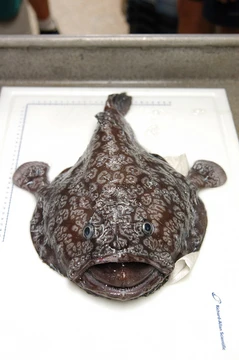
Neocentropogon
A poorly known genus of waspfishes from the Indian and western Pacific Oceans.
Last updated
Neocentropogon is a genus of marine ray-finned fishes, commonly known as waspfishes, belonging to the subfamily Tetraroginae. This subfamily is classified within the family Scorpaenidae, the scorpionfishes and their relatives, though some authorities place it in the stonefish family Synanceiidae or treat it as a separate family. The genus is native to the Indian Ocean and the western Pacific Ocean and remains poorly known.
Scientific classification
- KingdomAnimalia
- PhylumChordata
- ClassActinopterygii
- DivisionTeleostei
- OrderPerciformes
- FamilySynanceiidae
- GenusNeocentropogon
Named by Matsubara, 1943
Sources: Wikipedia taxobox: Neocentropogon (CC BY-SA 4.0)
Quick Facts
- Type species
- Paracentropogon aeglefinus
Facts from the source article.
Lore & Background
The genus Neocentropogon was first formally described in 1943 by Japanese ichthyologist Kiyomatsu Matsubara. He designated Paracentropogon aeglefinus, described in 1913 by Max Carl Wilhelm Weber from locations in Indonesia, as the type species, at which time the genus was considered monotypic. The name combines 'neo', meaning new, with the genus name Centropogon, reflecting its resemblance to that group, and the type species was originally placed in Paracentropogon.
Neocentropogon waspfishes are characterized by an oblique dorsal profile of the head, bodies covered in cycloid scales, teeth on the palatine, and 13 to 16 spines in the dorsal fin. The rearmost ray of the dorsal fin is connected to the uppermost ray of the caudal fin by a membrane. The pelvic fin has a single spine and five soft rays, and the lowermost four rays of the pectoral fin are separated from the upper rays, with their tips free of the basal membrane.
The largest species is the threespotted waspfish (Neocentropogon trimaculatus), which reaches a maximum published standard length of 81 cm, though most species are much smaller, with lengths under 20 cm. Six recognized species are currently placed in the genus, including the onespot waspfish (Neocentropogon aeglefinus) and the threespotted waspfish.
Taxonomic Origins and Classification Controversies
Neocentropogon entered the scientific record in 1943 when Japanese ichthyologist Kiyomatsu Matsubara formally erected it as a genus. The type species, Paracentropogon aeglefinus, had already been described back in 1913 by Max Carl Wilhelm Weber, a German-born Dutch zoologist who collected specimens from various sites across Indonesia. At the time of Matsubara's description, the genus was regarded as monotypic, containing only that single species. Today, the taxonomic placement of Neocentropogon remains a point of genuine disagreement among ichthyologists.
The fifth edition of Fishes of the World slots the genus into the subfamily Tetraroginae, nested within the large family Scorpaenidae, which encompasses scorpionfishes and their close relatives. However, other taxonomic authorities prefer to assign Tetraroginae to the stonefish family, Synanceiidae, while yet another group of researchers elevates the subfamily to full family rank in its own right. This ongoing uncertainty underscores just how poorly understood this lineage of marine ray-finned fishes still is, with its precise evolutionary relationships to neighboring scorpionfish groups remaining unresolved.
Six Species Across Two Oceans
The genus Neocentropogon currently encompasses six formally recognized species, all of which are marine waspfishes inhabiting the Indian Ocean and the western Pacific Ocean. The type species, N. aeglefinus, commonly called the onespot waspfish, was the first to be described in 1913.
Since then, additional species have been added over several decades: N. affinis (Lloyd, 1909), N. japonicus (Matsubara, 1943), N. mesedai (Klausewitz, 1985), N. profundus (J. L. B. Smith, 1958), and N. trimaculatus (W. L. Y. Chan, 1966), the latter commonly known as the threespotted waspfish. The spread of descriptions across more than seventy years, from 1909 to 1985, reflects the gradual pace at which this poorly known group has been catalogued. The geographic range spanning the Indian Ocean and western Pacific suggests a broad Indo-Pacific distribution, yet the relatively small number of recognized species and the limited published information available indicate that much of the diversity of these waspfishes may still await formal description or thorough revision.
Morphology and Size Variation
Members of Neocentropogon share a distinctive suite of morphological traits that set them apart from other scorpionfish relatives. The head presents an oblique dorsal profile, giving the fish a sloping forehead appearance. Their bodies are armored with cycloid scales, and they possess teeth on the palatine bones.
The dorsal fin bears between thirteen and sixteen spines, and notably, the rearmost dorsal-fin ray is joined to the uppermost ray of the caudal fin by a connecting membrane, a feature that blurs the boundary between these two fins. The pelvic fin is relatively simple, consisting of a single spine accompanied by five soft rays. In the pectoral fin, the four lowermost rays are detached from the upper rays, their tips extending free of the basal membrane that otherwise binds the fin together.
Size varies considerably within the genus. The threespotted waspfish, N. trimaculatus, is by far the largest, reaching a maximum published standard length of 81 centimeters (32 inches). In stark contrast, the remaining five species are all considerably smaller, each measuring less than 20 centimeters (7.9 inches) in standard length.
Nomenclature and Phylogenetic Context
The name Neocentropogon is deliberately constructed to signal a close morphological resemblance to the genus Centropogon. The prefix 'neo,' meaning 'new,' was appended to Centropogon to distinguish this newly recognized group from its apparent look-alike. This naming choice is particularly revealing when one considers that the type species, N. aeglefinus, was originally placed within the genus Paracentropogon by Weber in 1913 before Matsubara's 1943 revision separated it into its own taxon.
The genus belongs to the broader family Scorpaenidae, a diverse assemblage commonly known as scorpionfishes and their relatives, and more specifically to the subfamily Tetraroginae, whose members are colloquially referred to as waspfishes. As marine ray-finned fishes, Neocentropogon species occupy a position within one of the most species-rich families of bony fishes, yet they remain among the least thoroughly studied lineages within it. The fact that the genus was long treated as monotypic, and that its subfamily's placement continues to shift between Scorpaenidae, Synanceiidae, and independent family status, highlights how much foundational work still lies ahead for ichthyologists seeking to clarify the evolutionary history of these enigmatic Indo-Pacific fishes.
More in Marine Fish Genera
Test yourself
Three questions drawn from this entry’s sources. Pick an answer to check it.
Answers checked against the source article
Sources
Compiled from Wikipedia and the sources listed below. Text from Wikipedia is available under CC BY-SA 4.0; this entry is adapted from it.
- Wikipedia: Neocentropogon (CC BY-SA 4.0).
- Word definitions: the Codexery glossary, each quoted from its Wikipedia article.
Spotted an error? Know more?
Reader corrections go straight into our review queue. Suggest an edit · How this site is sourced