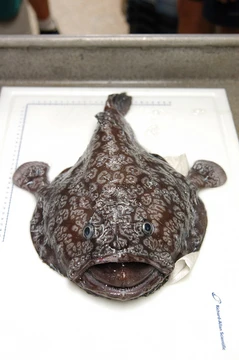
Parahollardia
A genus of spikefishes with lockable spines and a deep body.
Last updated

NOAA's Fisheries Collection · via Wikipedia: Parahollardia · Public domain
Parahollardia is a genus of marine ray-finned fish in the spikefish family Triacanthodidae. These bottom-dwelling fish live in the Western Atlantic Ocean.
The genus was first proposed in 1941 by British ichthyologist Alec Fraser-Brunner as a monospecific group, with Triacanthodes lineatus as its type and only species. That species had been originally described in 1935 by Canadian-American botanist and marine biologist William Harding Longley, with the type locality given as Tortugas, Florida. In 1968, American ichthyologist James C. Tyler placed Parahollardia and Hollardia together in a new subfamily, Hollardiinae, within Triacanthodidae. The fifth edition of Fishes of the World places Triacanthodidae in the suborder Triacanthoidei, within the order Tetraodontiformes.
Etymology
The name Parahollardia means "close to Hollardia," referring to the close relationship between the two genera.
Two valid species belong to the genus: Parahollardia lineata (commonly called the jambeau) and Parahollardia schmidti.
Characteristics
These spikefishes have rather deep, slightly compressed bodies, small mouths that open forward, and short snouts. Each jaw carries two rows of conical teeth, with one to ten (typically two to four) irregularly placed teeth outside the outer row. The dorsal fin usually begins just behind the upper corner of the gill opening and is supported by six spines; the first spine is long and robust, and the spines become smaller toward the rear. These spines can be locked upright, and the soft rays are branched.
A single large lockable spine is also present in the pelvic fin. The lower surface of the scale-covered part of the pelvis is rounded. The fish have thick, rough skin covered with many small scales, each bearing tiny spines. They are small fish; the maximum published total length for P. lineata is 20 cm.
Distribution and habitat
Parahollardia species are found in the Western Atlantic Ocean off the southeastern United States, the Gulf of Mexico, and the Caribbean Sea. P. lineata occurs at depths between 119 and 396 meters, over soft substrates near the edge of the continental shelf and along the continental slope.
Scientific classification
- KingdomAnimalia
- PhylumChordata
- ClassActinopterygii
- DivisionTeleostei
- OrderTetraodontiformes
- FamilyTriacanthodidae
- GenusParahollardia
Named by Fraser-Brunner, 1941
Sources: Wikipedia taxobox: Parahollardia (CC BY-SA 4.0)
Lore & Background
Parahollardia was first proposed as a monospecific genus in 1941 by the British ichthyologist Alec Fraser-Brunner, with Triacanthodes lineatus designated as its type species. T. lineatus was first formally described in 1935 by the Canadian-American botanist and marine biologist William Harding Longley, with its type locality given as Tortugas in Florida. In 1968, the American ichthyologist James C. Tyler classified this genus, alongside Hollardia, in a new subfamily of the family Triacanthodidae, the Hollardiinae. The 5th edition of Fishes of the World classifies the family Triacanthodidae in the suborder Triacanthoidei in the order Tetraodontiformes.
Parahollardia spikefishes have rather deep, slightly compressed bodies with small mouths that open to the front and a short snout. There are two series of conical teeth on each jaw with between one and ten, typically two to four, irregularly positioned teeth outside of the outer row. The dorsal fin typically has its origin immediately to the rear of the gill opening's top corner. It is supported by six spines, the first being long and robust, and these decrease in size towards the rear.
The spines can be locked upright and the soft rays are branched. There is a single large lockable spine in the pelvic fin as well. The lower surface of the scale-covered part of the pelvis is rounded. These fishes have thick, rough skin which is covered in many small scales, each one with tiny spines on it.
Parahollardia spikefishes are found in the Western Atlantic Ocean off the southeastern United States, the Gulf of Mexico and the Caribbean Sea. P. lineata is found at depths between 119 and 396 m over soft substrates close to the edge of the continental shelf and along the continental slope.
Reader's Guide
Parahollardia represents a distinctive lineage within the spikefishes, notable for its lockable dorsal and pelvic spines, a feature that aids in defense against predators. The genus was established by Alec Fraser-Brunner in 1941, and its classification within the subfamily Hollardiinae alongside Hollardia, proposed by James C. Tyler in 1968, underscores its close evolutionary relationship to that genus. The etymology of the name, meaning 'close to Hollardia', directly reflects this affinity. The two recognized species, Parahollardia lineata and Parahollardia schmidti, are demersal inhabitants of the Western Atlantic, with P. lineata occurring over soft substrates on the continental shelf and slope.
The genus contributes to the understanding of tetraodontiform diversity, particularly in the context of the suborder Triacanthoidei. Its morphological traits, such as the double series of conical teeth and the rough, spiny skin, are characteristic of the family Triacanthodidae. The maximum recorded length of 20 cm for P. lineata indicates these are relatively small fishes, adapted to benthic life in deeper waters.
More in Marine Fish Genera
Test yourself
Three questions drawn from this entry’s sources. Pick an answer to check it.
Answers checked against the source article
Sources
Compiled from Wikipedia and the sources listed below. Text from Wikipedia is available under CC BY-SA 4.0; this entry is adapted from it.
- Wikipedia: Parahollardia (CC BY-SA 4.0).
- Word definitions: the Codexery glossary, each quoted from its Wikipedia article.
Spotted an error? Know more?
Reader corrections go straight into our review queue. Suggest an edit · How this site is sourced