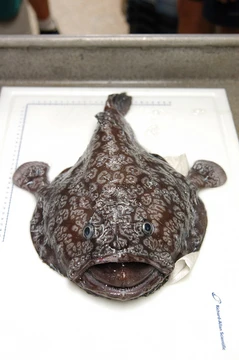
Pitted stonefish
A venomous stonefish, the sole member of the genus Erosa.
Last updated

Tom demeyer · via Wikipedia: Pitted stonefish · CC BY 3.0
The pitted stonefish (Erosa erosa), also known as the Pacific monkey-fish, is a venomous ray-finned fish and the only species in the monotypic genus Erosa. It belongs to the subfamily Synanceiinae of the family Scorpaenidae, the scorpionfishes and their relatives, and is found in the eastern Indian Ocean and the western Pacific Ocean.
Scientific classification
- KingdomAnimalia
- PhylumChordata
- ClassActinopterygii
- DivisionTeleostei
- OrderPerciformes
- FamilySynanceiidae
- GenusErosa
- SpeciesErosa erosa
Named by (Cuvier, 1829)
Sources: Wikipedia taxobox: Pitted stonefish (CC BY-SA 4.0) · order, family and genus agree with WoRMS AphiaID 280708 (CC BY 4.0)
Conservation status
Least Concern (LC)
- LC▲ this species
- NT
- VU
- EN
- CR
- EW
- EX
Source: IUCN Red List assessment · GBIF copy of the Red List category
How big is it?
Largest length in the source, 0.15 m, next to a 1.8 m person.
Diagram: drawn by Codexery, schematic shapes to scale (not a likeness). Length: Wikipedia: Pitted stonefish
Where the pitted stonefish has been recorded
Each dot is a place where the species has been observed and reported (549 records, half-degree grid) — not a modelled range. 13 inland records left out (institution coordinates).
Map: drawn by Codexery. Data: GBIF occurrence search (records CC0 / CC BY) · Natural Earth basemap (public domain) · place coordinates: Wikipedia (CC BY-SA 4.0)
Lore & Background
The pitted stonefish was first formally described as Synanceia erosa in 1829 by the French zoologist Georges Cuvier, with the type locality given as the Seas of Japan. In 1839, William Swainson placed it in the monotypic genus Erosa.
The genus is considered by some to include the daruma stinger (Dampierosa daruma). The genus Erosa is classified within the tribe Synanceiini, one of three tribes in the subfamily Synanceeinae within the family Scorpaenidae; however, other authorities regard Synanceiidae as a valid family and the Synanceiini as the subfamily Synanceiinae. The name Erosa means 'gnawed' or 'eaten away', an allusion to the dimpled surfaces of the bones.
The pitted stonefish has a large head with a rounded profile, a bony hump above the eyes, and a deep pit on the nape. Its snout is very short, giving the head a nearly vertical anterior profile. The overall color varies from reddish to orange or brown mottled with white, and there may be dark crossbands and lines of irregular white spots on the pectoral, pelvic, anal, and caudal fins. This benthic species is found on sand and mud substrates down to 90 m in depth, though it is commoner at deeper depths.
Taxonomic History & Classification Debates
The pitted stonefish entered the scientific record in 1829, when the French zoologist Georges Cuvier gave it its original name, Synanceia erosa, and pointed to the waters off Japan as the location where the type specimen was collected. A decade later, William Swainson carved it out into its own genus, Erosa, a name drawn from Latin roots meaning 'gnawed' or 'eaten away'—a fitting nod to the pitted, dimpled texture of the fish's skeletal structure. Erosa remains a monotypic genus, housing only this single species, though some researchers have argued that the daruma stinger, currently placed in Dampierosa, should also be folded into it.
The broader classification is not settled: the species sits in the tribe Synanceiini, one of three tribes within the subfamily Synanceiinae of the scorpionfish family Scorpaenidae. Yet other taxonomists prefer to elevate Synanceiidae to full family rank, which would relegate the tribe to subfamily status. This ongoing disagreement underscores how much complexity hides within the venomous stonefish lineage.
Physical Morphology & Cryptic Appearance
At first glance, the pitted stonefish looks less like a typical fish and more like a lumpy, armored nodule resting on the seafloor. Its head is disproportionately large and rounded, crowned by a bony hump that sits directly above the eyes, while a pronounced pit marks the nape behind. The snout is so short that the front of the head presents an almost perfectly vertical face. Fin architecture is modest: the dorsal fin carries fourteen spines followed by nine soft rays, and the anal fin holds two spines plus five or six soft rays.
Coloration shifts across a palette of reddish, orange, and brown tones broken up by white mottling, with dark crossbands and irregular white blotches sometimes scattered over the pectoral, pelvic, anal, and tail fins. Despite its rugged, almost prehistoric look, the species stays small, topping out at fifteen centimeters—roughly six inches—of total length. The gnawed, pitted bone surfaces that earned the genus its name add a final layer of textural oddity to an already unusual body plan.
Indo-Pacific Range & Seafloor Habitat
The pitted stonefish roams a wide arc of warm Indo-Pacific waters, stretching from the southern coast of Japan down through a chain of island nations and continental shelves to Australian shores. Documented sightings span Korea, China, Taiwan, the Philippines, Indonesia, New Caledonia, and Tonga, painting a picture of a species comfortably at home across both the eastern Indian and western Pacific basins. Along the Australian coastline, its range runs from Exmouth Gulf in the northwest to Moreton Bay in the southeast.
Ecologically, this is a strictly benthic animal, meaning it lives on or in the seafloor rather than in open water. It tolerates depths of up to ninety meters, or about three hundred feet, though it seems to favor the deeper end of that window. Its preferred substrate is soft—sandy or muddy bottoms—where its mottled, earth-toned coloration and compact, low-profile body allow it to blend seamlessly into the sediment and remain nearly invisible to both prey and potential threats.
Venomous Defense Within the Scorpionfish Lineage
Like its close relatives in the scorpionfish family, the pitted stonefish wields venom as its primary defensive weapon. Its fins are armed with spines that deliver a potent toxin, a trait shared across the subfamily Synanceiinae—or family Synanceiidae, depending on which taxonomic framework one follows.
This venomous armament is especially consequential given the species' small size, never exceeding fifteen centimeters, and its habit of resting camouflaged on sandy and muddy substrates where it is easy to step on or brush against unknowingly. The combination of cryptic coloration, a body shape that mimics a rock or sediment clump, and concealed venomous spines makes the pitted stonefish a deceptively hazardous resident of its Indo-Pacific seafloor habitats. Its placement within the broader Scorpaenidae family, alongside the infamous stonefish and the daruma stinger, situates it in a lineage where venom is not merely a trait but a defining evolutionary strategy for survival in a world of larger, more mobile predators.
Reader's Guide
The pitted stonefish is notable as the sole species in the monotypic genus Erosa, representing a distinct lineage within the venomous stonefishes. Its classification reflects ongoing taxonomic debate: while it is placed in the tribe Synanceiini within the subfamily Synanceeinae of the family Scorpaenidae by some authorities, others recognize Synanceiidae as a valid family, with the tribe elevated to subfamily status. This uncertainty underscores the complexity of scorpionfish systematics. The species' venomous fin spines mark it as a member of a dangerous group, though its small maximum size of 15 cm limits its threat to humans.
Its distribution across the eastern Indian Ocean and western Pacific, from southern Japan to Australia and as far as Tonga, indicates a broad but shallow benthic habitat preference on sand and mud substrates. The pitted stonefish's common name 'Pacific monkey-fish' and its scientific name Erosa erosa, referencing the dimpled bone surfaces, highlight its distinctive morphology. As the only representative of its genus, it holds particular interest for ichthyologists studying evolutionary relationships within venomous fishes.
Frequently Asked Questions
Where can you find the Pitted stonefish in the wild?
This species ranges across the eastern Indian Ocean and the western Pacific Ocean. It has been recorded at depths extending down to 90 metres, so it is not limited to the very shallowest reef zones.
How big does the Pitted stonefish get?
It is a compact fish, topping out at just 15 centimetres in total length. Its fin formula includes 14 dorsal spines paired with 9 soft dorsal rays, along with 2 anal spines and 5 or 6 anal soft rays.
More in Marine Fish Genera
Test yourself
Three questions drawn from this entry’s sources. Pick an answer to check it.
Answers checked against the source article
Sources
Compiled from Wikipedia and the sources listed below. Text from Wikipedia is available under CC BY-SA 4.0; this entry is adapted from it.
- Wikipedia: Pitted stonefish (CC BY-SA 4.0).
- Classification: the source article's taxobox; order, family and genus checked against WoRMS, the World Register of Marine Species (CC BY 4.0).
- Conservation status: IUCN Red List assessment.
- Occurrence records: GBIF (CC0 / CC BY). Basemap: Natural Earth (public domain).
- Word definitions: the Codexery glossary, each quoted from its Wikipedia article.
Spotted an error? Know more?
Reader corrections go straight into our review queue. Suggest an edit · How this site is sourced