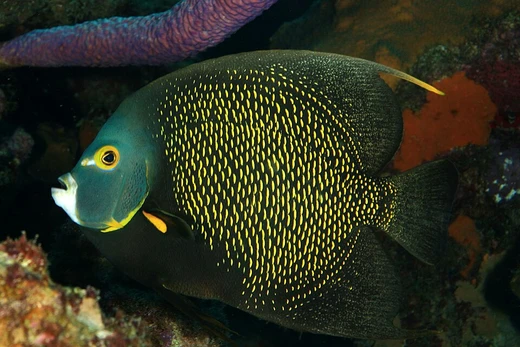
Holacanthus bermudensis
A western Atlantic angelfish that hybridizes with the queen angelfish.
Last updated

Cliff from Arlington, Virginia, USA · CC BY 2.0
Holacanthus bermudensis, the blue angelfish, was originally described by Goode in 1876.[1] This species is placed in the family Pomacanthidae and order Acanthuriformes according to WoRMS.[2] While not a target for commercial fishing, this species is frequently sold for home aquariums.[3]
Scientific classification
- KingdomAnimalia
- PhylumChordata
- ClassActinopterygii
- DivisionTeleostei
- OrderAcanthuriformes
- FamilyPomacanthidae
- GenusHolacanthus
- SpeciesHolacanthus bermudensis
Named by (Goode, 1876)
Close relatives
Other species of Holacanthus with a Codexery entry.
- Queen angelfish Holacanthus ciliaris
- Clarion angelfish Holacanthus clarionensis
- Clipperton angelfish Holacanthus limbaughi
- Guinean angelfish Holacanthus africanus
- Holacanthus passer Holacanthus passer
- Rock beauty Holacanthus tricolor
Sources: Wikipedia taxobox: Holacanthus bermudensis (CC BY-SA 4.0) · order, family and genus agree with WoRMS AphiaID 159284 (CC BY 4.0)
Conservation status
Least Concern (LC)
- LC▲ this species
- NT
- VU
- EN
- CR
- EW
- EX
Source: IUCN Red List assessment · GBIF copy of the Red List category
How big is it?
Largest length in the source, 0.45 m, next to a 1.8 m person.
Diagram: drawn by Codexery, schematic shapes to scale (not a likeness). Length: Wikipedia: Holacanthus bermudensis
Where the holacanthus bermudensis has been recorded
Each dot is a place where the species has been observed and reported (27,949 records, half-degree grid) — not a modelled range. 10 inland records left out (institution coordinates).
Map: drawn by Codexery. Data: GBIF occurrence search (records CC0 / CC BY) · Natural Earth basemap (public domain) · place coordinates: Wikipedia (CC BY-SA 4.0)
Biology and range
Its body and fins are blue-grey, with yellow outer edges on the pectoral and tail fins and yellow filaments on the dorsal and anal fins.[4] It is found in the western Atlantic from North Carolina to Bermuda, the Bahamas, Florida, the Gulf of Mexico, Yucatan, and east to Puerto Rico and the Virgin Islands.[3] Adult fish display a body that is bluish-yellow and a face that is bright yellow.[5] Young fish have a yellowish front half of the body that shifts to a brownish-yellow color toward the rear.[5]
The largest recorded total length for this species is 45 cm.[5][4] This angelfish lives near the ocean floor in habitats with sponges, coral, or rock, found at depths ranging from 2 to 93 meters.[6] Sponges make up the bulk of its food, but it will also eat tunicates, corals, and algae on occasion.[7][1] Young individuals serve as cleaner fish, removing external parasites from other fish at shared cleaning sites.[7]
Mature fish are typically seen in pairs throughout the year, a behavior that suggests they are monogamous.[7]
What the specialist sources record
The Discover Fish account notes that Holacanthus bermudensis resembles a subdued version of its iridescent relative, the queen angelfish (Holacanthus ciliaris).[1] According to the Saltcorner! account, the blue angelfish is closely related to the queen angelfish and commonly crossbreeds with it.[8] The Shorefishes of the Greater Caribbean account describes the adult as having no black and blue ocellus on the nape and no blue spot on the pectoral base.[4] The Saltcorner! account gives a maximum size of 15 inches (38 cm) for this species.[8]
According to the same source, this fish can make loud thumping noises believed to scare predators and get attention.[1][7] That source also mentions that each clear, floating egg has a single oil droplet that helps it stay buoyant.[1][7]
References
- "Holacanthus bermudensis", Discover Fish, 10 May 2017. facts only, no text reused. floridamuseum.ufl.edu
- World Register of Marine Species, Holacanthus bermudensis (AphiaID 159284). CC BY 4.0. marinespecies.org
- Wikipedia, "Holacanthus bermudensis" (CC BY-SA 4.0), which cites: Pyle, R., "Holacanthus bermudensis", 2010; (original not read by us) en.wikipedia.org
- "Species: Holacanthus bermudensis, Blue angelfish", Shorefishes of the Greater Caribbean online information. facts only, no text reused. biogeodb.stri.si.edu
- Wikipedia, "Holacanthus bermudensis" (CC BY-SA 4.0), which cites: "Holacanthus bermudensis", Saltcorner!, 2012; "Species: Holacanthus bermudensis, Blue angelfish", Shorefishes of the Greater Caribbean online information; (we also read that source) en.wikipedia.org
- Wikipedia, "Holacanthus bermudensis" (CC BY-SA 4.0) en.wikipedia.org
- Wikipedia, "Holacanthus bermudensis" (CC BY-SA 4.0), which cites: "Holacanthus bermudensis", Discover Fish, 10 May 2017 (we also read that source) en.wikipedia.org
- "Holacanthus bermudensis", Saltcorner!, 2012. facts only, no text reused. saltcorner.com
Each numbered sentence above was checked against the source it cites before publication. Sentences citing Wikipedia adapt text from the English Wikipedia article Holacanthus bermudensis (contributors), used under CC BY-SA 4.0; this entry is available under the same licence. Other sources were used for facts only; no text or images are copied from them.
More in Marine Angelfish
Test yourself
Three questions drawn from this entry’s sources. Pick an answer to check it.
Answers checked against the source article
Sources
Compiled from Wikipedia and the sources listed below. Text from Wikipedia is available under CC BY-SA 4.0; this entry is adapted from it.
- Wikipedia: Holacanthus bermudensis (CC BY-SA 4.0).
- Classification: the source article's taxobox; order, family and genus checked against WoRMS, the World Register of Marine Species (CC BY 4.0).
- Conservation status: IUCN Red List assessment.
- Occurrence records: GBIF (CC0 / CC BY). Basemap: Natural Earth (public domain).
- Word definitions: the , each quoted from its Wikipedia article.
Spotted an error? Know more?
Reader corrections go straight into our review queue. Suggest an edit · How this site is sourced