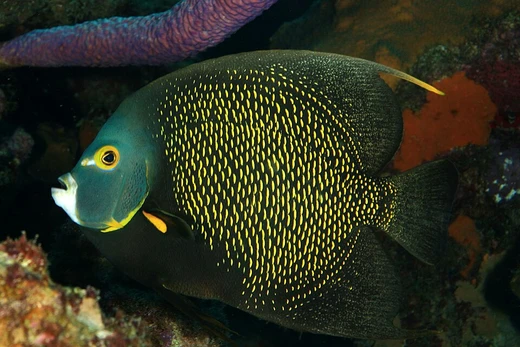
Pomacanthus xanthometopon
A marine angelfish with a striking yellow and blue face.
Last updated

Leonard Low from Australia · via Wikipedia: Pomacanthus xanthometopon · CC BY 2.0
The blueface angelfish is a marine species in the family Pomacanthidae, order Acanthuriformes.[1] The species is known under multiple English names including Blueface Angelfish and Yellowface Angelfish.[2] The largest scientifically measured specimen of this species reached 38 cm, and its body shape is laterally compressed.[2][3]
Scientific classification
- KingdomAnimalia
- PhylumChordata
- ClassActinopterygii
- DivisionTeleostei
- OrderAcanthuriformes
- FamilyPomacanthidae
- GenusPomacanthus
- SpeciesPomacanthus xanthometopon
Named by (Bleeker, 1853)
Close relatives
Other species of Pomacanthus with a Codexery entry.
- Arabian angelfish Pomacanthus asfur
- Old woman angelfish Pomacanthus rhomboides
- Pomacanthus annularis Pomacanthus annularis
- Pomacanthus arcuatus Pomacanthus arcuatus
- Pomacanthus chrysurus Pomacanthus chrysurus
- Pomacanthus imperator Pomacanthus imperator
- Pomacanthus maculosus Pomacanthus maculosus
- Pomacanthus navarchus Pomacanthus navarchus
Sources: Wikipedia taxobox: Pomacanthus xanthometopon (CC BY-SA 4.0) · order, family and genus agree with WoRMS AphiaID 276027 (CC BY 4.0)
Conservation status
Least Concern (LC)
- LC▲ this species
- NT
- VU
- EN
- CR
- EW
- EX
Source: IUCN Red List assessment · GBIF copy of the Red List category
Where the pomacanthus xanthometopon has been recorded
Each dot is a place where the species has been observed and reported (696 records, half-degree grid) — not a modelled range. 20 inland records left out (institution coordinates). 1 isolated far-off record not drawn.
Map: drawn by Codexery. Data: GBIF occurrence search (records CC0 / CC BY) · Natural Earth basemap (public domain)
Quick Facts
- Dorsal fin spines
- 13–14
- Dorsal fin soft rays
- 16–18
- Anal fin spines
- 3
Facts from the source article.
Biology and range
The Aquatic Community account states it is found from 25°N to 24°S and from the Maldives to Vanuatu.[2] It inhabits lagoons, channels and outer reef slopes with prolific algae growth.[2][4] The species usually lives singly or in pairs.[5] Coral reefs in the eastern tropical Indo-Pacific are where the blueface angelfish is found.[4]
Tunicates, sponges, other encrusting organisms, and algae make up the majority of its diet.[5][2] This species reproduces by laying eggs, which are scattered onto the seabed.[5][2] Caves are a common habitat for juvenile individuals.[6] Because the yellowface angelfish is widespread and abundant across most of its range, the IUCN Red List categorizes it as of least concern.[7]
What the specialist sources record
The Aquatic Community account notes the largest scientifically measured specimen was 38 cm.[2] That same source advises against keeping the species in aquariums smaller than 100 gallons.[2] It describes the blueface angelfish as semi-aggressive and territorial when it is the largest fish in the aquarium.[2] The account recommends a high-quality angelfish preparation containing sponge material for captive diets.[2]
The GBIF database holds 842 occurrence records for this taxon as of October 2026.[8]
References
- World Register of Marine Species, Pomacanthus xanthometopon (AphiaID 276027). CC BY 4.0. marinespecies.org
- Blueface Angelfish: Pomacanthus xanthometopon Aquatic Community. Retrieved 2012-02-26.. facts only, no text reused. aquaticcommunity.com
- Wikipedia, "Pomacanthus xanthometopon" (CC BY-SA 4.0), which cites: ; Pomacanthus xanthometopon Bleeker 1853: Yellowface Angelfish Retrieved 2012.02.26.; Pomacanthus xanthometopon Bleeker 1853: Yellowface Angelfish Retrieved 2012.02.26. (we also read that source) en.wikipedia.org
- Wikipedia, "Pomacanthus xanthometopon" (CC BY-SA 4.0), which cites: Pomacanthus xanthometopon Bleeker 1853: Yellowface Angelfish Retrieved 2012.02.26. (we also read that source) en.wikipedia.org
- Wikipedia, "Pomacanthus xanthometopon" (CC BY-SA 4.0), which cites: Pomacanthus xanthometopon Bleeker 1853: Yellowface Angelfish Retrieved 2012.02.26.; Blueface Angelfish: Pomacanthus xanthometopon Aquatic Community. Retrieved 2012-02-26. (we also read that source) en.wikipedia.org
- Wikipedia, "Pomacanthus xanthometopon" (CC BY-SA 4.0) en.wikipedia.org
- Wikipedia, "Pomacanthus xanthometopon" (CC BY-SA 4.0), which cites: Pyle, R., "Pomacanthus xanthometopon", 2010 (original not read by us) en.wikipedia.org
- GBIF Backbone Taxonomy and occurrence index, Pomacanthus xanthometopon (taxon key 2396411). CC BY 4.0 (backbone); counts are facts. gbif.org
Each numbered sentence above was checked against the source it cites before publication. Sentences citing Wikipedia adapt text from the English Wikipedia article Pomacanthus xanthometopon (contributors), used under CC BY-SA 4.0; this entry is available under the same licence. Other sources were used for facts only; no text or images are copied from them.
More in Marine Angelfish
Test yourself
Three questions drawn from this entry’s sources. Pick an answer to check it.
Answers checked against the source article
Sources
Compiled from Wikipedia and the sources listed below. Text from Wikipedia is available under CC BY-SA 4.0; this entry is adapted from it.
- Wikipedia: Pomacanthus xanthometopon (CC BY-SA 4.0).
- Classification: the source article's taxobox; order, family and genus checked against WoRMS, the World Register of Marine Species (CC BY 4.0).
- Conservation status: IUCN Red List assessment.
- Occurrence records: GBIF (CC0 / CC BY). Basemap: Natural Earth (public domain).
- Word definitions: the Codexery glossary, each quoted from its Wikipedia article.
Spotted an error? Know more?
Reader corrections go straight into our review queue. Suggest an edit · How this site is sourced