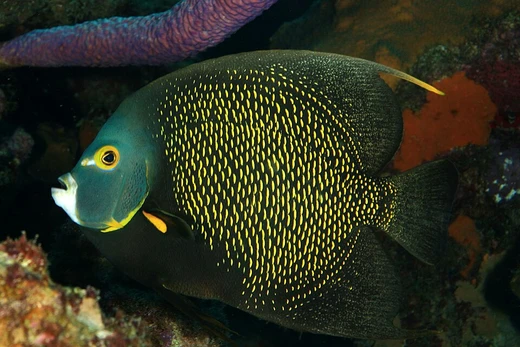
Pomacanthus zonipectus
Eastern Pacific angelfish with distinct juvenile and adult color patterns.
Last updated

Alberto Alcalá · via Wikipedia: Pomacanthus zonipectus · CC BY 4.0
The Cortez angelfish is a large marine angelfish from the eastern Pacific Ocean.[1] It was first formally described in 1862 by the American ichthyologist Theodore Nicholas Gill.[2] The species name zonipectus refers to a dark-brown belt on the breast.[3]
Scientific classification
- KingdomAnimalia
- PhylumChordata
- ClassActinopterygii
- DivisionTeleostei
- OrderAcanthuriformes
- FamilyPomacanthidae
- GenusPomacanthus
- SpeciesPomacanthus zonipectus
Named by (T. N. Gill, 1862)
Close relatives
Other species of Pomacanthus with a Codexery entry.
- Arabian angelfish Pomacanthus asfur
- Old woman angelfish Pomacanthus rhomboides
- Pomacanthus annularis Pomacanthus annularis
- Pomacanthus arcuatus Pomacanthus arcuatus
- Pomacanthus chrysurus Pomacanthus chrysurus
- Pomacanthus imperator Pomacanthus imperator
- Pomacanthus maculosus Pomacanthus maculosus
- Pomacanthus navarchus Pomacanthus navarchus
Sources: Wikipedia taxobox: Pomacanthus zonipectus (CC BY-SA 4.0) · order, family and genus agree with WoRMS AphiaID 276028 (CC BY 4.0)
Conservation status
Least Concern (LC)
- LC▲ this species
- NT
- VU
- EN
- CR
- EW
- EX
Source: IUCN Red List assessment · GBIF copy of the Red List category
How big is it?
Largest length in the source, 0.46 m, next to a 1.8 m person.
Diagram: drawn by Codexery, schematic shapes to scale (not a likeness). Length: Wikipedia: Pomacanthus zonipectus
Where the pomacanthus zonipectus has been recorded
Each dot is a place where the species has been observed and reported (1,016 records, half-degree grid) — not a modelled range. 51 inland records left out (institution coordinates). 1 isolated far-off record not drawn.
Map: drawn by Codexery. Data: GBIF occurrence search (records CC0 / CC BY) · Natural Earth basemap (public domain) · place coordinates: Wikipedia (CC BY-SA 4.0)
Biology and range
It can reach a total body length of about 46 cm.[4] Juveniles have a brownish black background with six vertical vivid yellow bands and parallel blue bars between them.[5] This species is found between depths of 6 and 50 m and feeds mainly on sponges.[6] From the northern Gulf of California in Mexico down to Peru, this species is found in the eastern Pacific Ocean.[6]
A deep, compressed body shape, a short blunt snout, and a small mouth are physical traits of the Cortez angelfish.[4] Crisscrossing lines cover the back half of adult bodies, with the tail taking on a yellowish-green hue.[7]
What the specialist sources record
The Saltcorner! account notes that the juvenile is quite pretty, with six vertical bright yellow bands on a brownish black body.[8] Jake Adams wrote in 2016 that the Cortez angelfish is a little appreciated large species from the East Pacific.[1] The GBIF database holds 1,136 occurrence records for this taxon as of October 2026.[9] The World Register of Marine Species lists this species in the family Pomacanthidae and order Acanthuriformes.[10]
Adams noted that on a large adult, the rear half shows a network of reticulating lines, turning olive yellow on the tail.[1]
References
- Jake Adams, "Who Knew that a Cortez Angelfish Could Be This Attractive", reef builders.com, 30 September 2016. facts only, no text reused. reefbuilders.com
- Wikipedia, "Pomacanthus zonipectus" (CC BY-SA 4.0) en.wikipedia.org
- Wikipedia, "Pomacanthus zonipectus" (CC BY-SA 4.0), which cites: "Order ACANTHURIFORMES (part 1): Families LOBOTIDAE, POMACANTHIDAE, DREPANEIDAE and CHAETODONTIDAE", The ETYFish Project Fish Name Etymology Database, 21 July 2020 (original not read by us) en.wikipedia.org
- Wikipedia, "Pomacanthus zonipectus" (CC BY-SA 4.0), which cites: "Species: Pomacanthus zonipectus, Cortez angelfish", Shorefishes of the Eastern Pacific online information system; (original not read by us) en.wikipedia.org
- Wikipedia, "Pomacanthus zonipectus" (CC BY-SA 4.0), which cites: "Pomacanthus zonipectus", Saltcorner!, 2012; "Species: Pomacanthus zonipectus, Cortez angelfish", Shorefishes of the Eastern Pacific online information system; "Pomacanthus zonipectus", Saltcorner!, 2012; "Species: Pomacanthus zonipectus, Cortez angelfish", Shorefishes of the Eastern Pacific online information system (we also read that source) en.wikipedia.org
- Wikipedia, "Pomacanthus zonipectus" (CC BY-SA 4.0), which cites: Pyle, R., "Pomacanthus zonipectus", 2010 (original not read by us) en.wikipedia.org
- Wikipedia, "Pomacanthus zonipectus" (CC BY-SA 4.0), which cites: Jake Adams, "Who Knew that a Cortez Angelfish Could Be This Attractive", reef builders.com, 30 September 2016 (we also read that source) en.wikipedia.org
- "Pomacanthus zonipectus", Saltcorner!, 2012. facts only, no text reused. saltcorner.com
- GBIF Backbone Taxonomy and occurrence index, Pomacanthus zonipectus (taxon key 2396396). CC BY 4.0 (backbone); counts are facts. gbif.org
- World Register of Marine Species, Pomacanthus zonipectus (AphiaID 276028). CC BY 4.0. marinespecies.org
Each numbered sentence above was checked against the source it cites before publication. Sentences citing Wikipedia adapt text from the English Wikipedia article Pomacanthus zonipectus (contributors), used under CC BY-SA 4.0; this entry is available under the same licence. Other sources were used for facts only; no text or images are copied from them.
More in Marine Angelfish
Sources
Compiled from Wikipedia and the sources listed below. Text from Wikipedia is available under CC BY-SA 4.0; this entry is adapted from it.
- Wikipedia: Pomacanthus zonipectus (CC BY-SA 4.0).
- Classification: the source article's taxobox; order, family and genus checked against WoRMS, the World Register of Marine Species (CC BY 4.0).
- Conservation status: IUCN Red List assessment.
- Occurrence records: GBIF (CC0 / CC BY). Basemap: Natural Earth (public domain).
Spotted an error? Know more?
Reader corrections go straight into our review queue. Suggest an edit · How this site is sourced