Rolling (metalworking)
Metal forming process using rolls to shape and reduce stock.

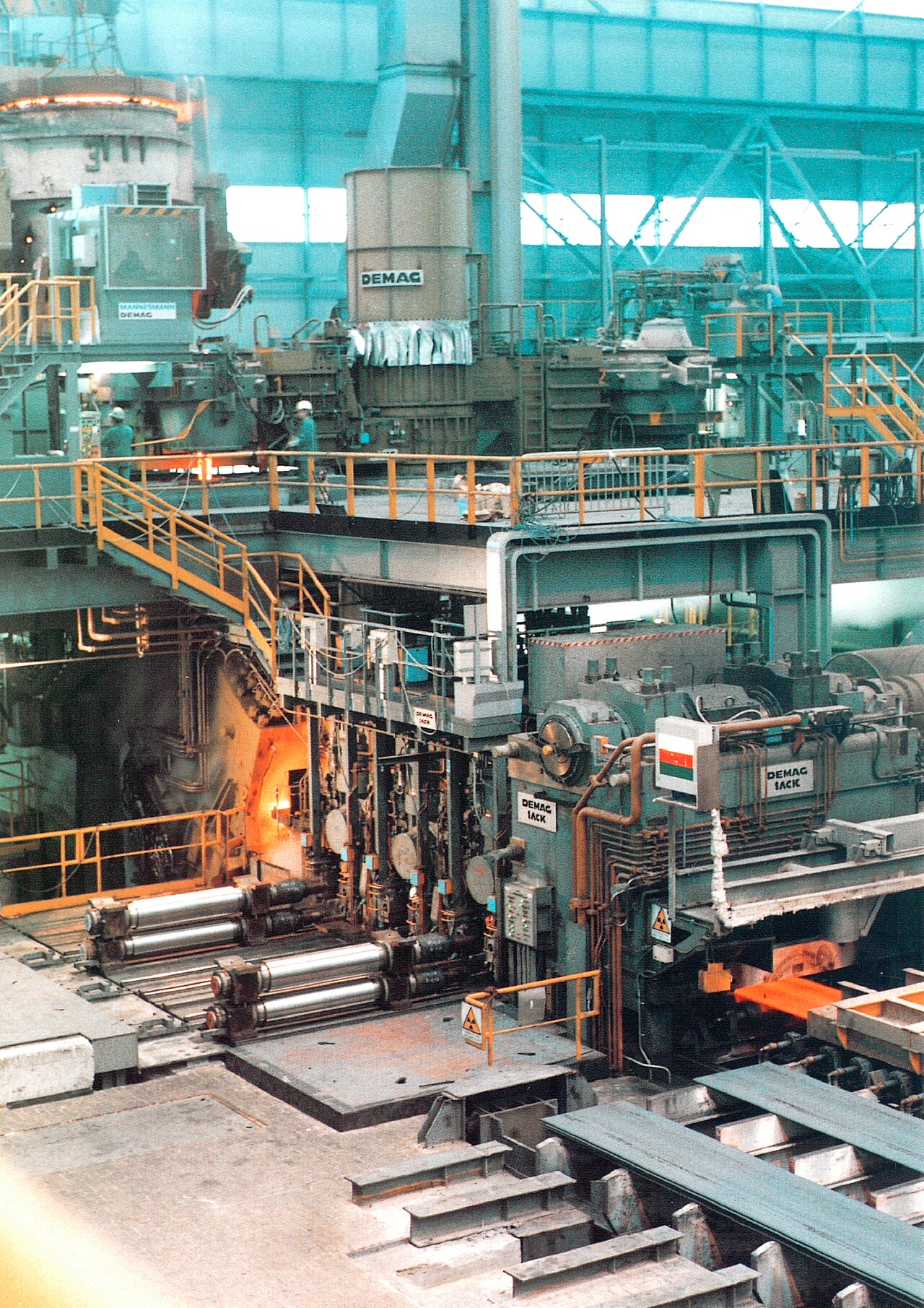
European Coal and Steel Community · CC BY-SA 4.0
Rolling is a metal forming process in which metal stock is passed through one or more pairs of rolls to reduce thickness, make thickness uniform, or impart desired mechanical properties. It is classified by temperature: hot rolling occurs above the recrystallization temperature, cold rolling below. Rolling mills, groups of roll stands, process metal into products such as structural steel, bar stock, and rails. Hot rolling handles more tonnage than any other manufacturing process, while cold rolling accounts for the most tonnage among cold working processes. The earliest rolling mills were slitting mills, introduced from what is now Belgium to England in 1590, which passed flat bars between rolls to form iron plate, then through grooved slitters to produce rods. Experiments rolling iron for tinplate began around 1670, and Major John Hanbury erected a mill at Pontypool in 1697 to roll blackplate, later rerolled and tinned. The slitting mill was adapted for hoops and half-round sections, subject to patents around 1679. Swedish engineer Christopher Polhem, in 1761, described rolling mills for plate and bar iron, noting they could produce ten to twenty or more bars simultaneously, saving time and labor. A 1759 patent to Thomas Blockley covered polishing and rolling metals; Richard Ford received a 1766 patent for the first tandem mill, used for hot rolling wire rods. Rolling mills for lead existed by the late 17th century, and copper and brass were rolled by the late 18th century. Early mills were water-powered; the first steam engine directly driving a mill was at John Wilkinson’s Bradley Works in 1786, using a Boulton and Watt engine. Modern rolling practice owes much to Henry Cort, who in 1783 patented grooved rolls for iron bars, enabling mills to produce fifteen times more output per day than hammers. The first rail rolling mill was established by John Birkenshaw in 1820 at Bedlington Ironworks, producing fish-bellied wrought iron rails. Three-high mills for heavy sections appeared in 1853. Modern mills include continuous mills for wire rods, bars, and strips; tandem mills for precise thickness control; and universal mills with horizontal and vertical rolls for H-beams, rails, and wide plates.
Lore & Background
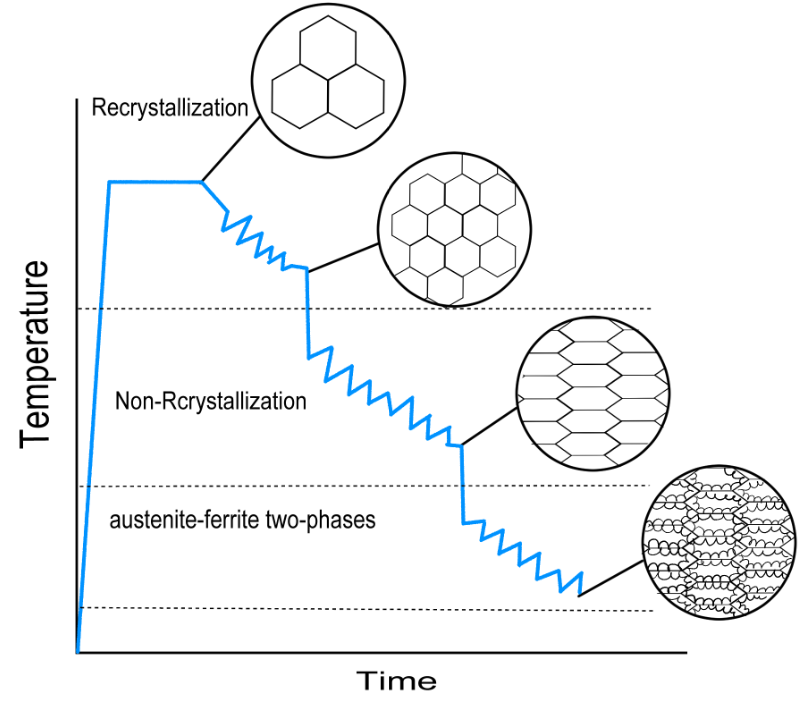
Rolling is a metal forming process where metal stock is passed through one or more pairs of rolls to reduce thickness, achieve uniform thickness, or impart desired mechanical properties, conceptually similar to rolling dough. The process is classified by temperature: hot rolling occurs above the metal’s recrystallization temperature, allowing deformed grains to recrystallize into an equiaxed microstructure without work hardening; cold rolling occurs below that temperature. Hot rolling processes more tonnage than any other manufacturing process, while cold rolling processes the most tonnage among cold working processes. Roll stands holding pairs of rolls are grouped into rolling mills that quickly process metal, typically steel, into structural shapes like I-beams, angle stock, channel stock, bar stock, and rails. Most steel mills have rolling mill divisions converting semi-finished casting products into finished goods. Types include ring rolling, roll bending, roll forming, profile rolling, and controlled rolling. The earliest rolling mills were slitting mills, introduced from Belgium to England in 1590, passing flat bars between rolls to form iron plate, then through grooved slitters to produce rods. Early experiments rolling iron for tinplate occurred around 1670, and by 1697 Major John Hanbury erected a mill at Pontypool to roll blackplate, later rerolled and tinned. Slitting mills were adapted for hoops and half-round sections by patents circa 1679. Swedish engineer Christopher Polhem noted in 1761 that rolling mills could produce 10 to 20 or more bars simultaneously, saving time and labor. Thomas Blockley received a 1759 patent for polishing and rolling metals; Richard Ford patented the first tandem mill in 1766 for hot rolling wire rods. Rolling mills for lead existed by the late 17th century, and for copper and brass by the late 18th. Until the 18th century, mills were water-powered; the first steam engine directly driving a mill was at John Wilkinson’s Bradley Works in 1786. Henry Cort’s 1783 patent for grooved rolls enabled mills to produce 15 times more output per day than hammers, earning him the title “father of modern rolling.” The first rail rolling mill was established by John Birkenshaw in 1820 at Bedlington Ironworks, producing fish-bellied wrought iron rails. By 1851, the Consett Iron Company exhibited a plate 20 feet long, 3 feet wide, and
Reader's Guide
Rolling is a metal forming process where metal stock is passed through pairs of rolls to reduce thickness, achieve uniformity, or impart desired mechanical properties, analogous to rolling dough. It is classified by temperature: hot rolling occurs above the metal’s recrystallization temperature, allowing deformed grains to recrystallize into an equiaxed microstructure and preventing work hardening; cold rolling occurs below that temperature. Hot rolling processes more tonnage than any other manufacturing process, while cold rolling processes the most tonnage among all cold working processes. The earliest rolling mills were slitting mills, introduced from Belgium to England in 1590, which produced iron rods from flat bars. By the late 17th century, mills rolled lead, and by the late 18th century, copper and brass. Early mills were water-powered; the first steam-engine-driven mill was recorded in 1786 at John Wilkinson’s Bradley Works. Henry Cort’s 1783 patent for grooved rolls enabled mills to produce 15 times more output per day than hammers, earning him the title “father of modern rolling.” The first rail rolling mill was established in 1820 at Bedlington Ironworks. Modern rolling includes continuous mills for uninterrupted high-rate production, tandem mills for precise thickness control, and universal mills with horizontal and vertical rolls for H-beams and rails. The process is essential for producing structural steel, bar stock, rails, and sheet metal, with most steel mills having rolling mill divisions that convert semi-finished casting products into finished goods.
Did You Know?
- The concept of rolling metal is similar to rolling dough.
- Hot rolling processes more tonnage than any other manufacturing process.
- Henry Cort's grooved rolls allowed mills to produce 15 times more output per day than with a hammer.
The Core Process and Its Two Temperatures
Rolling is a fundamental metal forming technique in which a piece of metal stock is fed through one or more pairs of rolls. The objective is threefold: reduce the thickness, achieve uniformity across the piece, and impart a specific mechanical property to the final product. The principle is intuitively comparable to rolling out dough in a kitchen. The process is divided into two categories based on where the metal's working temperature sits relative to its recrystallization point. When the metal is above that threshold, the operation is called hot rolling; when it is below, it is called cold rolling. In sheer volume, hot rolling handles more tonnage than any other manufacturing process, while cold rolling dominates among all cold working methods. The individual roll stands are assembled into rolling mills, which rapidly convert semi-finished casting products—typically steel—into finished goods such as I-beams, angle stock, channel stock, bar stock, and railway rails. Most steel mills maintain dedicated rolling mill divisions for this conversion step.
Origins in Iron and Steel Production
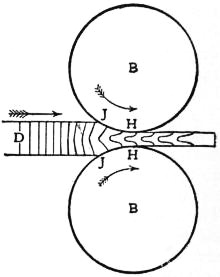
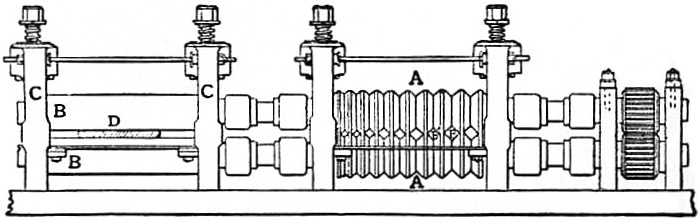
These early machines pressed flat bars between rolls to create iron plate, then forced it through grooved rolls—called slitters—to yield rods. Before these mills, European plate iron had been shaped in forges.
From Water Wheels to the Father of Modern Rolling
For well into the eighteenth century, rolling mills relied on water wheels for their driving power. Steam dramatically boosted production capacity and remained the dominant power source until electric motors took over shortly after 1900. A pivotal figure in the evolution of rolling was Henry Cort of the Funtley Iron Mills near Fareham, Hampshire. While he was not the very first to employ grooved rolls, he was the first to integrate the best features of multiple ironmaking and shaping processes known at the time into a single system. The result was a mill capable of producing fifteen times more output per day than a hammer. For this synthesis, modern writers have dubbed him the "father of modern rolling." Meanwhile, rolling mills for lead existed by the late 17th century, and copper and brass were being rolled by the late 18th century.
Modern Mill Configurations and the Scale of Production
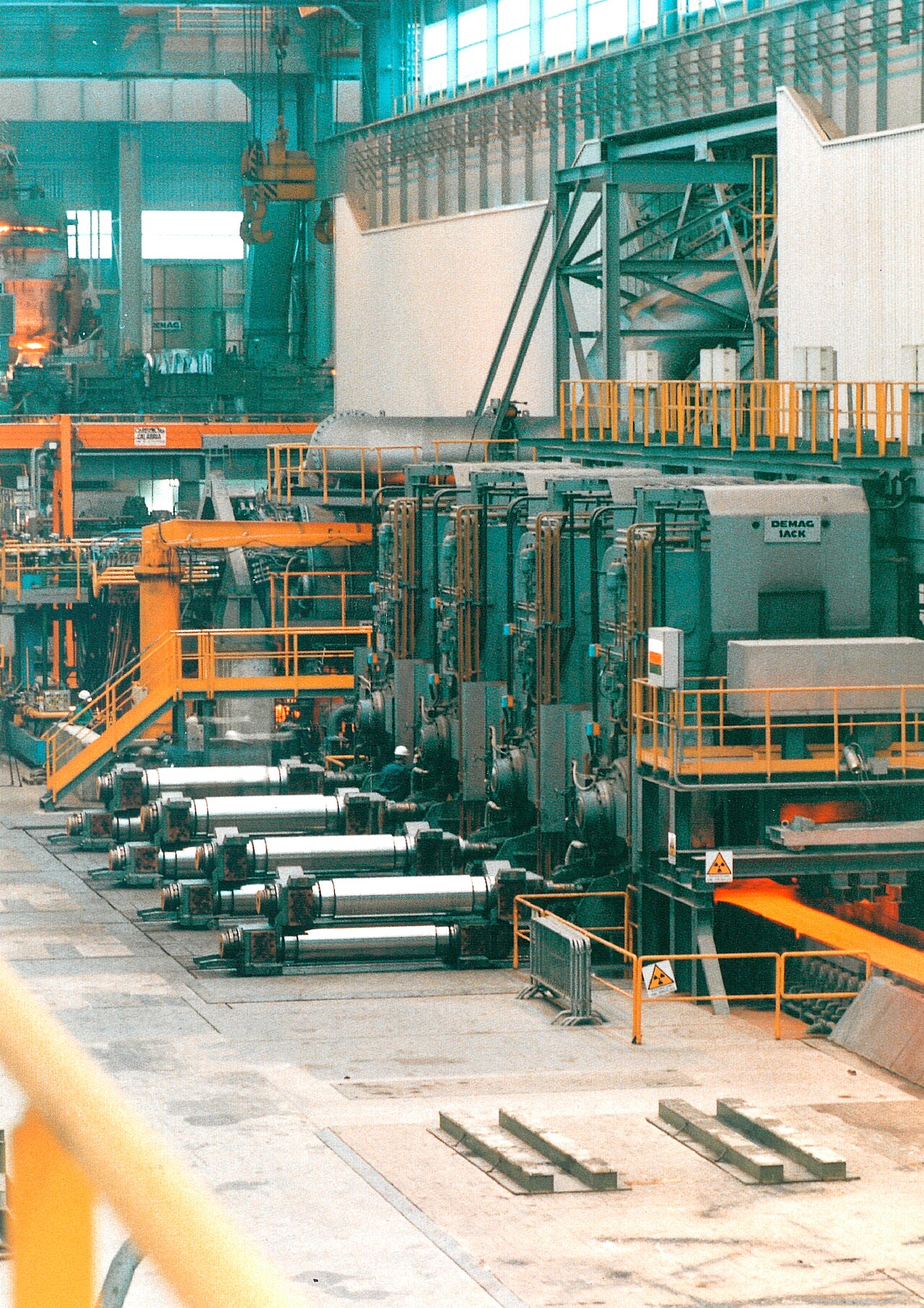
As technology advanced, the scale of rolling operations grew rapidly. Today's rolling mills have evolved far beyond those early two-high and three-high layouts. Continuous mills, in which metal passes unbroken through a sequence of stands, are the workhorses for wire rods, bars, and strips, delivering high production rates and uniform quality. Tandem mills, with multiple stands operating in series, are favored for hot and cold strip rolling to achieve precise thickness control and superior surface finish. Universal mills employ both horizontal and vertical rolls, making them ideal for H-beams, rails, and wide plates with high dimensional accuracy. Beyond these, specialized processes such as ring rolling, roll bending, roll forming, profile rolling, and controlled rolling address particular product geometries and property requirements.
Gallery
Frequently Asked Questions
What is Rolling (metalworking)?
Rolling is a metal forming process in which metal stock is fed through one or more pairs of rotating rolls to thin it, even out its thickness, or alter its mechanical properties. It is the standard method for producing structural steel, bar stock, and railway rails.
What are Rolling (metalworking)'s powers/role?
Its core capability is shaping and reducing metal by passing it between successive roll stands within a mill. It operates in two distinct modes—hot rolling above the recrystallization temperature and cold rolling below it—letting it tailor the final properties of the product.
Why is Rolling (metalworking) important?
It is the primary means of converting raw metal into the uniform structural components—beams, bars, rails—that underpin construction and transportation worldwide. Without rolling, the standardized metal products that modern infrastructure relies on simply could not be produced at the required scale and consistency.
More in Manufacturing & Materials 1-20
Spotted an error? Know more?
This is a living reference — every entry is fact-audited, and reader corrections feed straight into our audit queue. Suggest an edit · See this site's audit record