Mass production
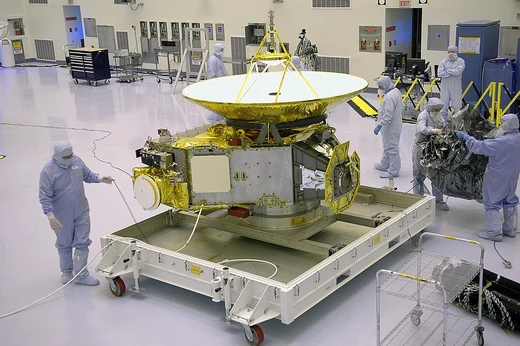
Mass production is a method of making standardized products in constant flow.

Dennis G. Jarvis · CC BY-SA 2.0
Mass production—also called series production, series manufacture, or continuous production—is a method for turning out large quantities of standardized goods in a steady stream, most famously on assembly lines. It ranks alongside job production and batch production as one of the three fundamental approaches to manufacturing.
The phrase “mass production” gained wide currency after a 1926 article in an Encyclopædia Britannica supplement, written based on correspondence with the Ford Motor Company. However, *The New York Times* had already used the term in a headline before that Britannica piece appeared. The method applies to an enormous range of products: fluids and particulates handled in bulk (food, fuel, chemicals, mined minerals), clothing and textiles, as well as parts and assembled items like household appliances and automobiles.
Some of its core techniques—standardized sizes and production lines—existed centuries before the Industrial Revolution. Yet modern mass production only became possible in the mid-19th century, after the development of machine tools and methods for making interchangeable parts.
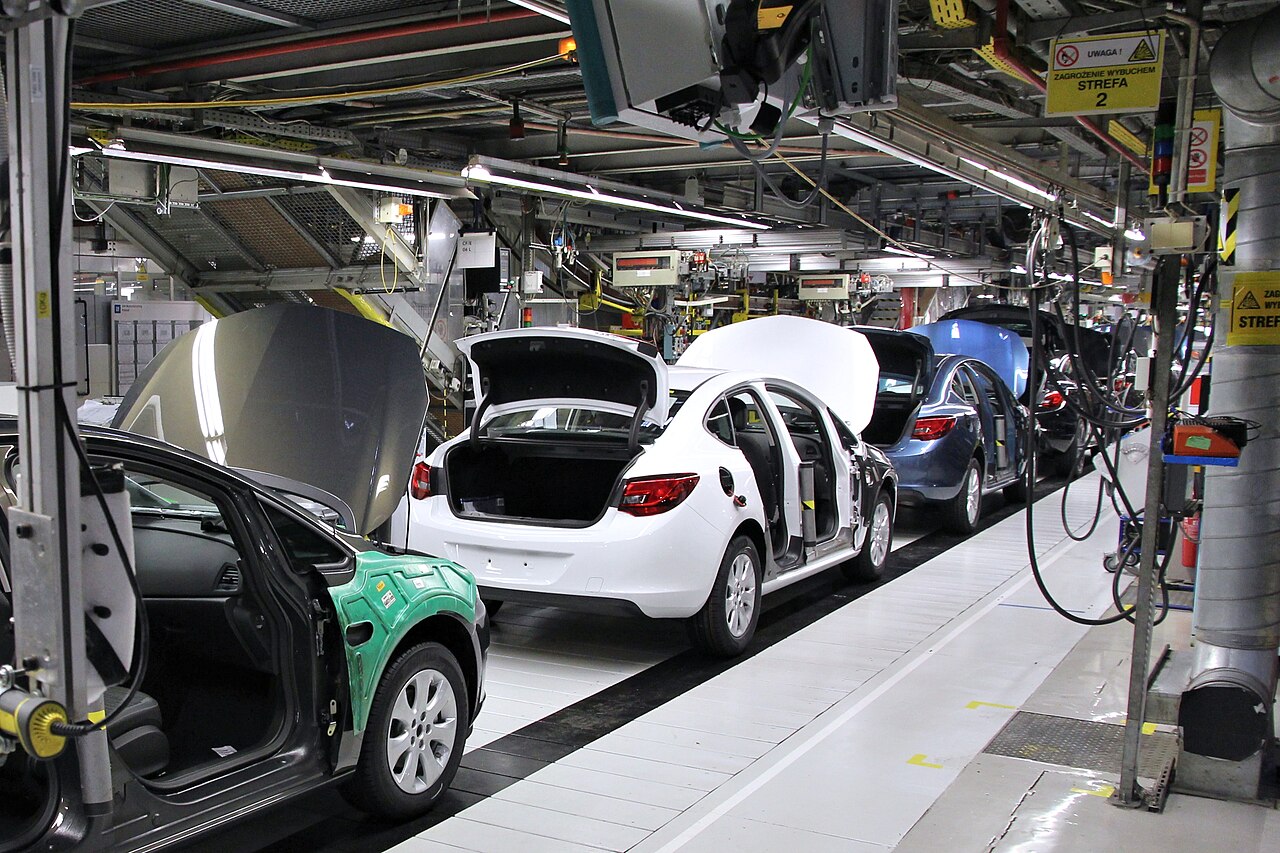
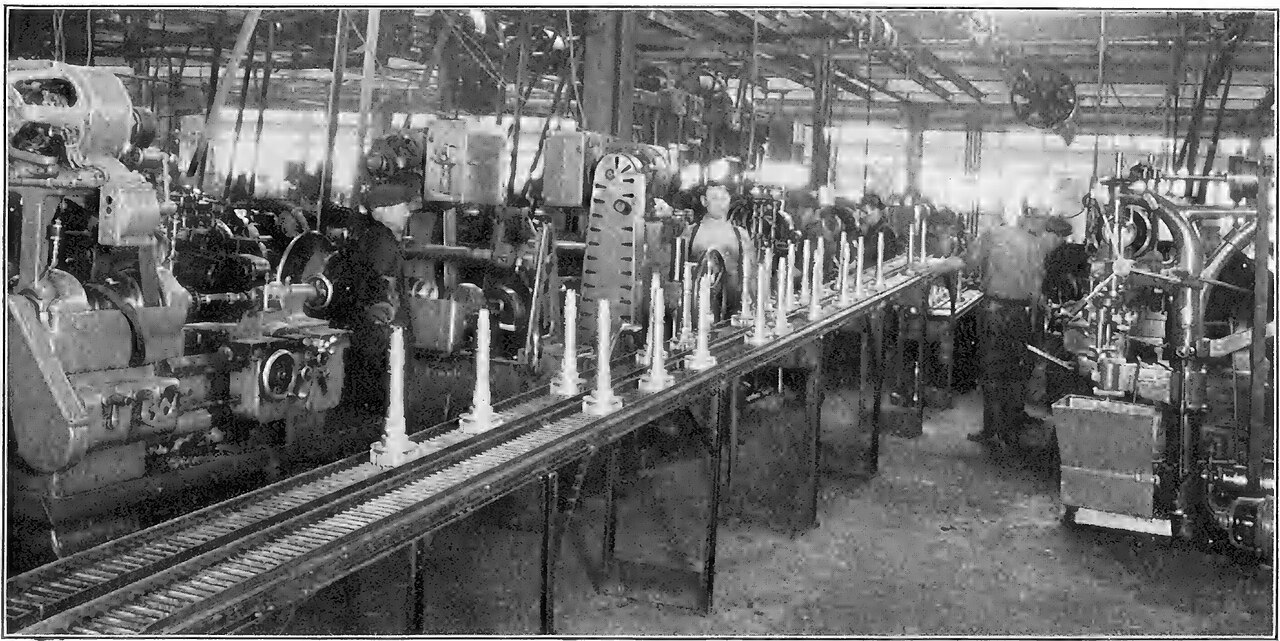
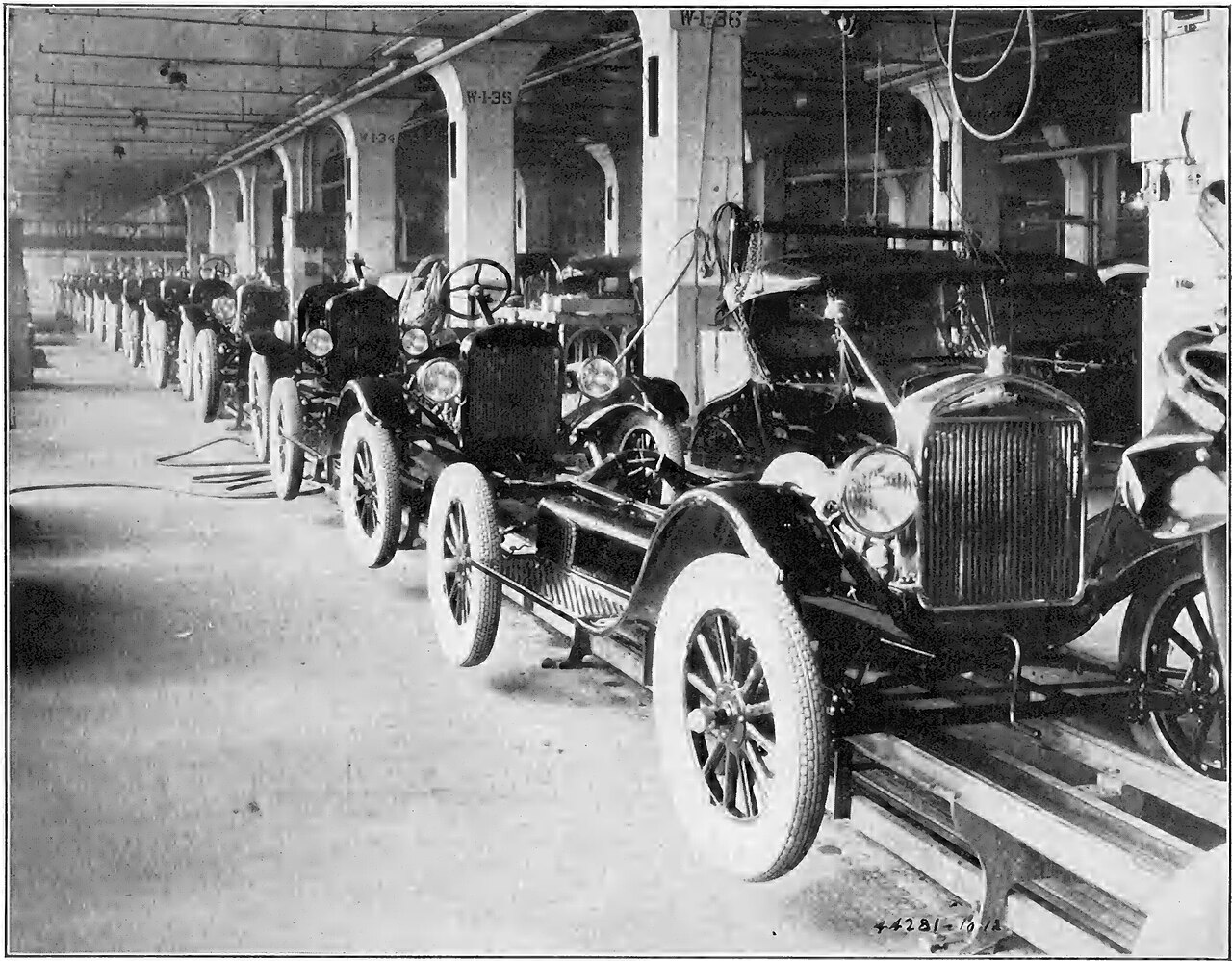
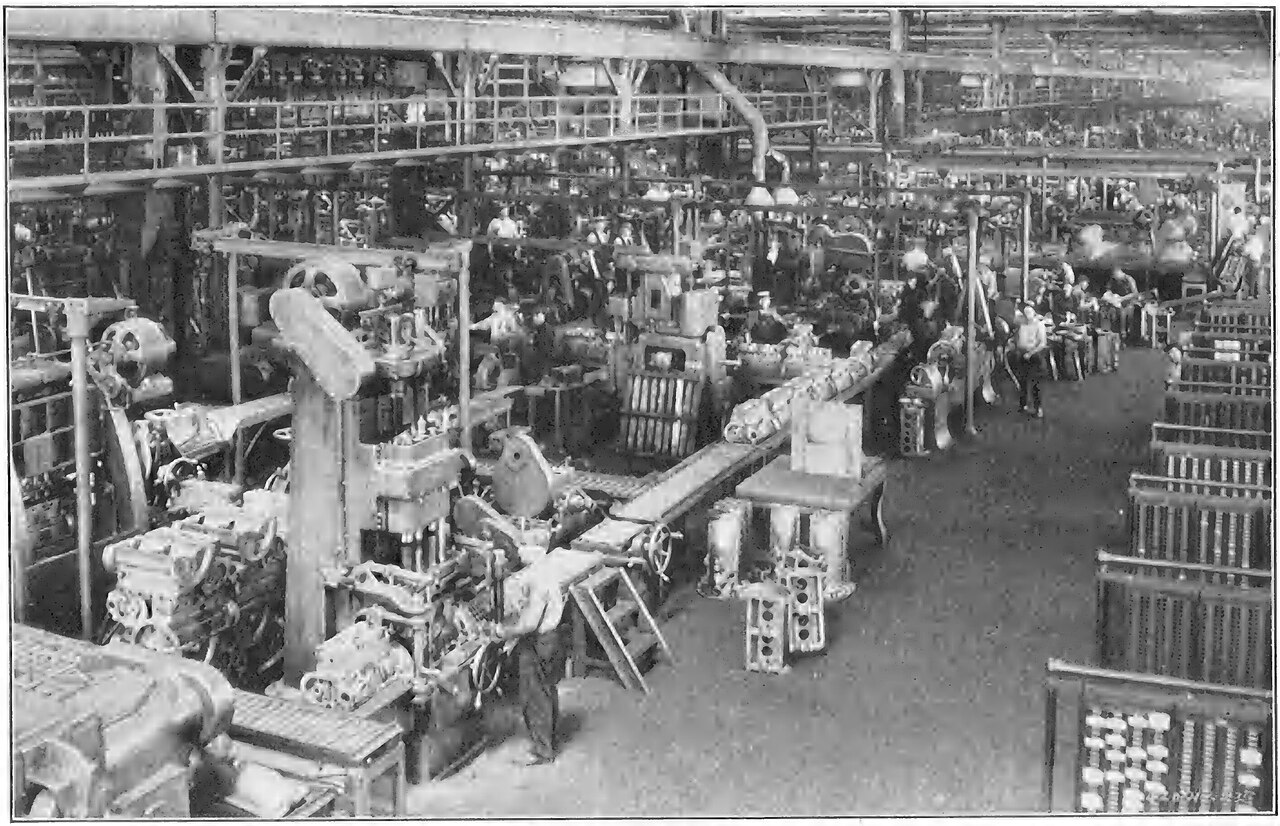
In mass production, copies of a product are made quickly, mainly by machines, using assembly lines that move partially finished items from worker to worker. Each worker handles a single step rather than building the whole product from scratch. This efficiency let supply outstrip demand in many markets, pushing companies to find new ways to compete. It also ties into concerns about overconsumption and the idea that humans consume too much.
For fluids, mass production relies on piping, centrifugal pumps, or screw conveyors (augers) to move raw materials or semi-finished goods between vessels. Processes like oil refining and handling bulk materials such as wood chips and pulp are automated through process control systems, which use instruments to measure temperature, pressure, volume, and level, then adjust accordingly. Bulk solids like coal, ores, grains, and wood chips travel on belt, chain, slat, pneumatic, or screw conveyors, bucket elevators, and mobile equipment like front-end loaders. Pallets are moved with forklifts, and heavy items such as reels of paper, steel, or machinery are handled by electric overhead cranes (sometimes called bridge cranes) that span large factory bays.
Mass production is capital-intensive and energy-intensive, using a high proportion of machinery and energy relative to workers. It is usually automated, and the total cost per unit drops. But the machinery needed to set up a line—robots, machine presses, and the like—is so expensive that a product must be nearly certain of success to turn a profit.
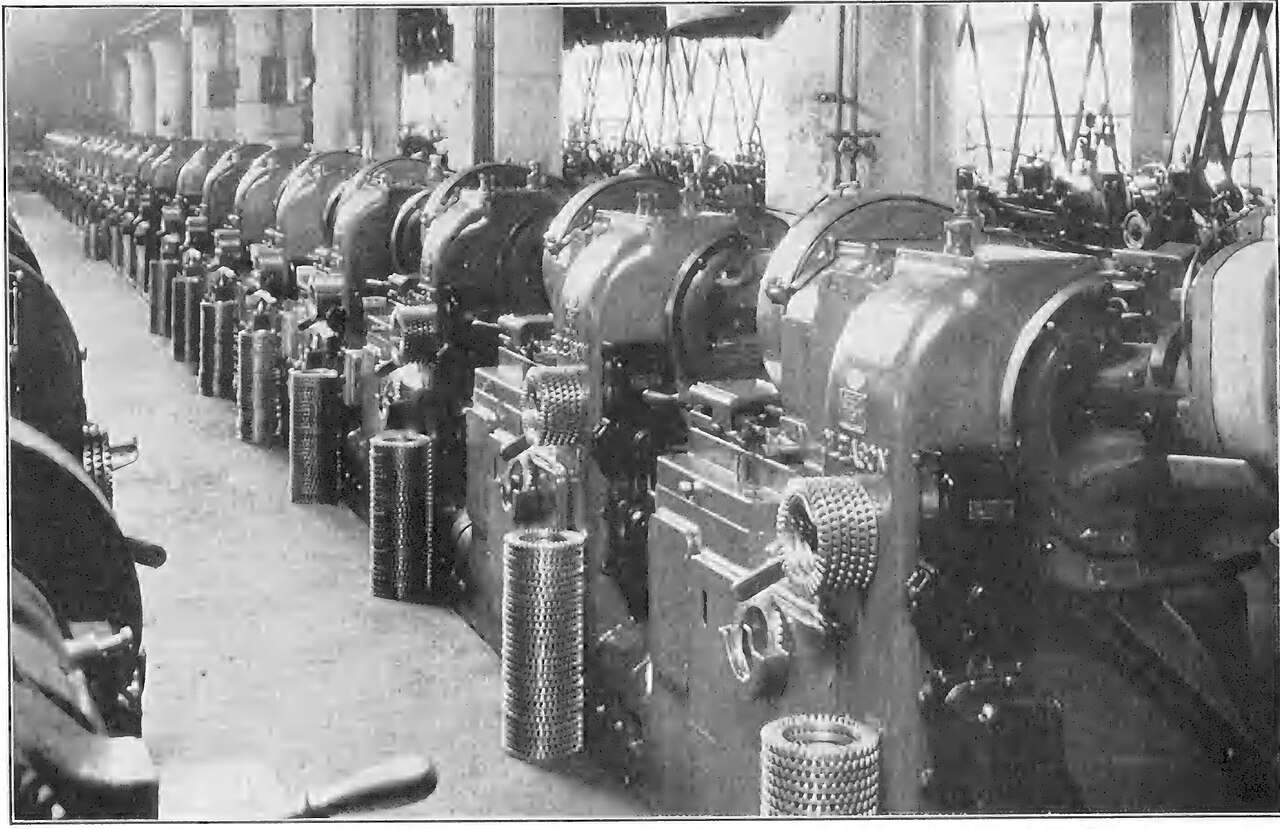
A key description of mass production is that “the skill is built into the tool.” The worker using the tool may not need the skill; in the 19th or early 20th century, this was expressed as “the craftsmanship is in the workbench itself,” not in the worker’s training. Instead of a skilled worker measuring every dimension of each part against plans or other parts during forming, jigs were ready at hand to ensure the part fit the setup. The finished part was already guaranteed to match all other finished parts, and it was made faster, with no time spent on fitting pieces together. Later, computerized control (like CNC) made jigs unnecessary, but the principle held: the knowledge resided in the tool, process, or documentation, not in the worker’s head. This is the specialized capital required for mass production—each workbench, set of tools, CNC cell, or fractionating column is fine-tuned to its specific task.
**History**
**Pre-industrial**
Standardized parts, sizes, and factory techniques existed before the Industrial Revolution, but before machine tools, making precision parts—especially metal ones—was highly labor-intensive. In China’s Warring States period, crossbows with bronze parts were produced, and the Qin Emperor unified China partly by equipping large armies with these weapons, which had a sophisticated trigger mechanism made of interchangeable parts. The Terracotta Army guarding his tomb is believed to have been created using standardized molds on an assembly line. Ancient Carthage mass-produced warships on a large scale at moderate cost, helping it control the Mediterranean. Centuries later, the Republic of Venice followed suit, building ships with prefabricated parts on an assembly line at the Venetian Arsenal—effectively the world’s first factory, which at its peak employed 16,000 people and turned out nearly one ship per day.
The invention of movable type allowed documents like books to be mass-produced. The first movable type system was created in China by Bi Sheng during the Song dynasty, used for items including paper money. The oldest surviving book printed with metal type is *Jikji*, produced in Korea in 1377. Johannes Gutenberg introduced movable type to Europe through his printing press and the Gutenberg Bible, making mass production standard in European publishing and spurring a democratization of knowledge, increased literacy, and broader education.
- field
- Manufacturing and industrial production
- known_for
- Standardized products, assembly lines, interchangeable parts, and capital-intensive automated production
- key_techniques
- Assembly lines, jigs, machine tools, process control, and interchangeable parts
Lore & Background
Mass production, also known as series or continuous production, involves creating large quantities of standardized products in a constant flow, most famously on assembly lines. It is one of the three main production methods, alongside job and batch production. The term was popularized by a 1926 Encyclopædia Britannica article based on correspondence with Ford Motor Company, though The New York Times had used it earlier. The method applies to a vast range of goods: from fluids and particulates like food, fuel, and chemicals, to clothing, textiles, and complex assemblies such as household appliances and automobiles. While techniques like standardized sizes and production lines existed centuries before the Industrial Revolution, modern mass production only became possible with the mid-19th-century development of machine tools and interchangeable parts. In mass production, workers each perform a single step on partially complete products moving along a line, rather than building a whole item. This approach is capital- and energy-intensive, relying heavily on machinery and automation to reduce per-unit costs, though the expensive equipment requires a successful product to be profitable. A defining characteristic is that "the skill is built into the tool"—jigs, workbenches, or later computerized controls ensure parts fit specifications without requiring skilled measurement by the worker. Historical examples include ancient Carthage’s mass-produced warships, Chinese Warring States crossbows with interchangeable bronze parts, and the Terracotta Army, believed created using standardized molds on an assembly line.
Reader's Guide
Modern mass production became possible with the introduction of machine tools and techniques to produce interchangeable parts in the mid-19th century. The Portsmouth Block Mills in England, using machinery designed by Marc Isambard Brunel and Henry Maudslay, achieved a dramatic increase in productivity: ten men could accomplish what formerly required the uncertain labor of one hundred and ten. Mass production is capital-intensive and energy-intensive, using a high proportion of machinery and energy in relation to workers. The machinery needed to set up a mass production line is so expensive that there must be assurance the product will be successful. A key description is that 'the skill is built into the tool,' meaning the worker may not need the skill; jigs and later computerized control (CNC) ensure parts are made to specifications without skilled measurement.
Did You Know?
- Johannes Gutenberg's introduction of movable type to Europe led to mass production in publishing, democratizing knowledge and increasing literacy.
Ancient and Pre-Industrial Roots
Long before factories hummed with electric motors, the principles of mass production were already at work across civilizations. In China's Warring States period, bronze crossbows were manufactured using interchangeable components, and the Qin Emperor leveraged these standardized weapons to unify the region. The Terracotta Army, which guards his tomb, is believed to have been shaped using standardized molds arranged in an assembly-line fashion. Across the Mediterranean, Carthage built warships in volume at moderate cost to sustain naval dominance, a strategy later echoed by the Republic of Venice. The Venetian Arsenal, employing up to sixteen thousand workers, turned out nearly one vessel per day, functioning as what historians regard as the world's first true factory. Gutenberg's press carried the technique into Europe, sparking a wave of literacy and scientific inquiry. In military engineering, the French officer Jean-Baptiste de Gribeauval reduced cannon production to just three calibers and introduced interchangeable wheels, screws, and axles, streamlining both manufacture and field repair.
The Skill Built Into the Tool
A defining philosophical shift in mass production is the transfer of expertise from the individual worker into the equipment itself. In the nineteenth and early twentieth centuries, this principle was captured in the phrase that craftsmanship lived in the workbench rather than in the artisan's training. Instead of a skilled craftsman measuring every dimension of each component against blueprints or mating parts, purpose-built jigs guided the hand so that the finished piece would slot correctly into the assembly without any time-consuming finishing work. The precision had already been verified: the part was guaranteed to fit every other finished component in the system. When computerized numerical control arrived, physical jigs became largely unnecessary, yet the underlying logic persisted. Knowledge and skill were embedded in the software, the process documentation, or the machine program rather than residing in a single person's memory. Each workbench, each CNC cell, each fractionating column is individually fine-tuned to its specific task, representing the specialized capital that mass production demands. The worker operates the system; the system carries the expertise.
Operational Mechanics and Economic Demands
In practice, mass production moves partially completed products along an assembly line, where each worker or station handles a single discrete step rather than crafting an entire item from scratch. For fluid materials—refined oils, chemical feeds, or pulp—the transfer between vessels relies on centrifugal pumps or screw conveyors, with automated process-control systems continuously measuring temperature, pressure, flow rate, and level to maintain consistency. Bulk solids such as coal, ore, grain, and wood chips travel via belt, chain, slat, pneumatic, or screw conveyors, bucket elevators, and mobile machinery like front-end loaders. Palletized goods move by forklift, while heavy reels of paper, steel, or entire machine frames are hoisted by electric overhead cranes that span wide factory bays. Economically, the model is both capital-intensive and energy-intensive: a high ratio of machinery and power to human labor drives the per-unit cost down through automation, yet the upfront investment in robots, presses, and specialized tooling is enormous. Profitability therefore depends on a reasonable guarantee that the product will find a market large enough to justify the setup.
Scope, Terminology, and the Modern Threshold
Mass production—also called series production, series manufacture, or continuous production—sits alongside job production and batch production as one of the three principal methods of making goods. The technique's reach is remarkably broad: it encompasses fluids and particulates handled in bulk (food, fuel, chemicals, mined minerals), as well as clothing, textiles, household appliances, and automobiles. Crucially, elements such as standardized sizes and linear production sequences existed long before the Industrial Revolution. What transformed these earlier practices into the modern system was the mid-nineteenth-century development of machine tools and methods for producing interchangeable parts. Before that breakthrough, precision metalwork remained extraordinarily labor-intensive, and the leap from artisanal repetition to true industrial throughput depended on the ability to machine parts to tolerances that guaranteed mutual fit without hand-fitting. That technological threshold is what separates ancient assembly-line intuition from the mass-production era we recognize today.
Gallery

Frequently Asked Questions
What is Mass production in manufacturing terms?
Mass production is a manufacturing approach that generates large quantities of identical, standardized goods in a continuous, uninterrupted flow. It sits alongside job production and batch production as one of the three fundamental methods of industrial manufacturing.
What key techniques does Mass production rely on?
The core toolkit includes assembly lines, jigs, precision machine tools, process control systems, and interchangeable parts. Together these elements let a single product be built by a sequence of specialized stations rather than one craftsman working start to finish.
How does Mass production differ from batch or job production?
While job production crafts one-off custom items and batch production runs a limited quantity of a variant before switching, mass production keeps a single standardized design flowing continuously. This makes it far more capital-intensive but dramatically cheaper per unit at high volume.
More in Manufacturing & Materials 1-20
Spotted an error? Know more?
This is a living reference — every entry is fact-audited, and reader corrections feed straight into our audit queue. Suggest an edit · See this site's audit record