
Metallurgy
The science and technology of metals and alloys.

Niridya · CC BY-SA 4.0
Metallurgy is a branch of materials science and engineering that examines how metallic elements, their inter-metallic compounds, and their mixtures (called alloys) behave physically and chemically. It covers both the scientific understanding and the practical technology of metals—from how they are produced to how metal parts are engineered for consumer and industrial products. Unlike the craft of metalworking, metallurgy provides a scientific basis for that craft, similar to how medical science underpins the practice of medicine. A specialist in this field is called a metallurgist.
The science of metallurgy splits into two main categories: chemical metallurgy and physical metallurgy. Chemical metallurgy deals with the reduction and oxidation of metals, as well as their chemical behavior. Its subjects include mineral processing, metal extraction, thermodynamics, electrochemistry, and corrosion. Physical metallurgy, on the other hand, focuses on the mechanical and physical properties of metals and how they perform. Topics here include crystallography, material characterization, mechanical metallurgy, phase transformations, and failure mechanisms.
Historically, metallurgy has centered on metal production. This starts with processing ores to extract the metal and then mixing metals to create alloys. Alloys typically combine two or more metallic elements, but non-metallic elements are often added to achieve desired properties. Metal production is divided into ferrous metallurgy (also called black metallurgy), which involves iron-based processes and alloys, and non-ferrous metallurgy (colored metallurgy), which covers all other metals. Ferrous metals account for 95% of global metal production.
Modern metallurgists work in both traditional and emerging fields as part of interdisciplinary teams alongside material scientists and other engineers. Traditional areas include mineral processing, metal production, heat treatment, failure analysis, and metal joining (such as welding, brazing, and soldering). Emerging areas include nanotechnology, superconductors, composites, biomedical materials, electronic materials (semiconductors), and surface engineering.
**Etymology and pronunciation** The word "metallurgy" comes from the Ancient Greek *metallourgós*, meaning "worker in metal," from *métallon* ("mine, metal") and *érgon* ("work"). Originally an alchemist's term for extracting metals from minerals, the suffix "-urgy" signified a manufacturing process, as discussed in the 1797 Encyclopædia Britannica. In the late 19th century, its definition expanded to the general scientific study of metals, alloys, and related processes. In English, the pronunciation /mɪˈtælərdʒi/ is more common in the UK, while /ˈmɛtəlɜːrdʒi/ is more common in the US and is listed first in American dictionaries like Merriam-Webster Collegiate and American Heritage.
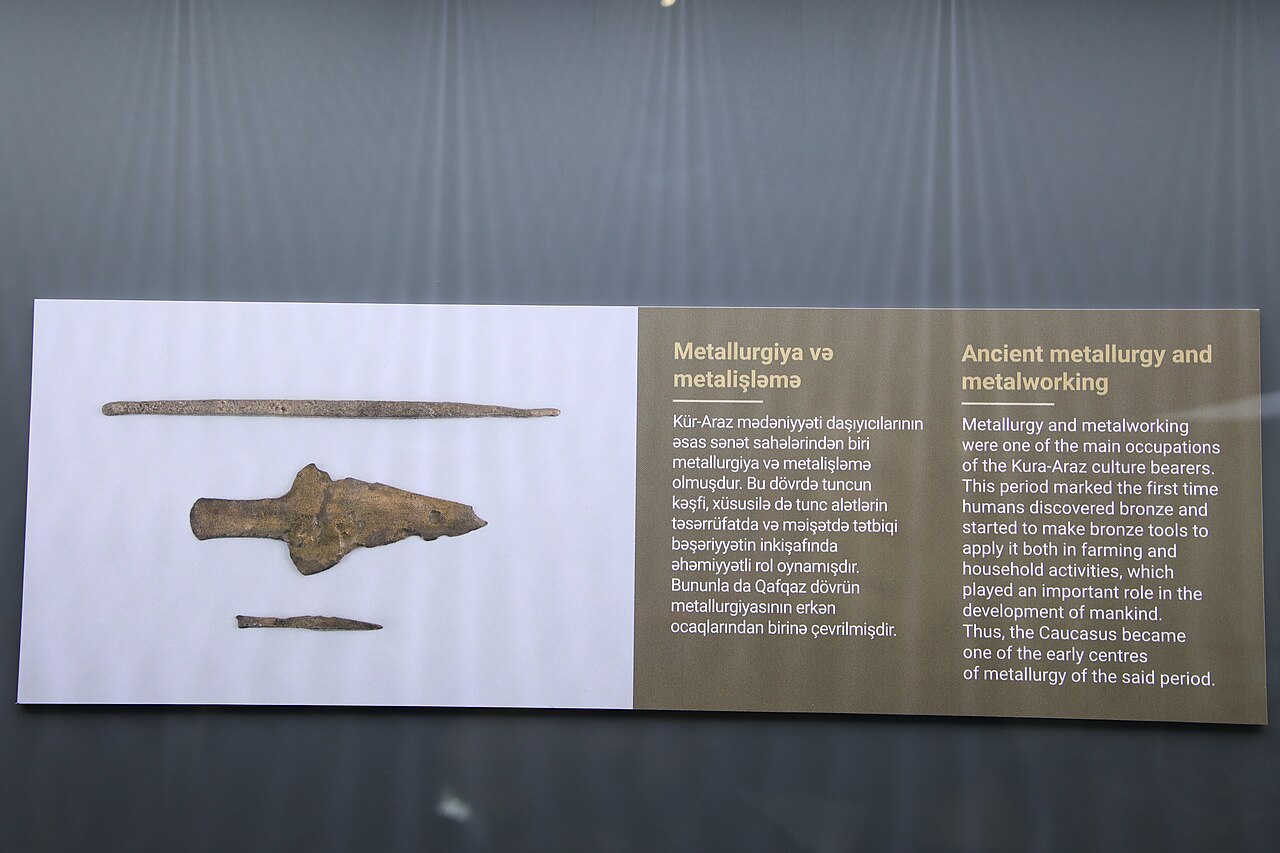
**History** The earliest metal used by humans appears to be gold, found in its native form. Small amounts of natural gold, dating to the late Paleolithic period (40,000 BCE), have been discovered in Spanish caves. Silver, copper, tin, and meteoric iron also occur naturally, allowing early cultures to do limited metalworking. Early cold metallurgy—using native copper without smelting—has been documented at sites in Anatolia and at Tell Maghzaliyah in Iraq, dating from the 7th–6th millennia BCE.
The earliest archaeological evidence of smelting (hot metallurgy) in Eurasia comes from the Balkans and Carpathian Mountains, with findings of cast and smelted metal objects dated to around 6,200–5,000 BCE, marking the invention of copper metallurgy. Some metals like tin, lead, and copper can be recovered from ores by heating rocks in a moderate-temperature fire or blast furnace—a process called smelting. The first evidence of copper smelting, from the 6th millennium BCE, has been found at Majdanpek, Jarmovac, and Pločnik in present-day Serbia. At Pločnik, a smelted copper axe dating to 5,500 BCE, belonging to the Vinča culture, was unearthed. The Balkans and adjacent Carpathian region were home to major Chalcolithic cultures—Vinča, Varna, Karanovo, Gumelnița, and Hamangia—often grouped as "Old Europe." The Carpatho-Balkan region is described as the "earliest metallurgical province in Eurasia," and its scale and technical quality of metal production in the 6th–5th millennia BCE far surpassed any other contemporary center.
The earliest documented use of lead (possibly native or smelted) in the Near East dates from the 6th millennium BCE at the late Neolithic settlements of Yarim Tepe and Arpachiyah in Iraq. These artifacts suggest lead smelting may have predated copper smelting. Lead metallurgy also appeared in the Balkans during the same period. Copper smelting is documented at sites in Anatolia and at Tal-i Iblis in southeastern Iran from around 5,000 BCE. In Africa, the first evidence of copper smelting comes from the Delta region of northern Egypt around 4,000 BCE, associated with the Maadi culture. The Varna Necropolis in Bulgaria is a burial site located about 4 km from the city center in the western industrial zone.
- field
- Materials science and engineering
- subdivisions
- Chemical metallurgy and physical metallurgy
- production branches
- Ferrous metallurgy (black metallurgy) and non-ferrous metallurgy (colored metallurgy)
- world metal production share (ferrous)
- 95%
- practitioner
- Metallurgist
- etymology
- From Ancient Greek μεταλλουργός (metallourgós), 'worker in metal'
Lore & Background
Metallurgy derives from the Ancient Greek μεταλλουργός, metallourgós, 'worker in metal', from μέταλλον, métallon, 'mine, metal' + ἔργον, érgon, 'work'. In the late 19th century, metallurgy's definition was extended to the more general scientific study of metals, alloys, and related processes. In English, the pronunciation is the more common one in the United Kingdom while the pronunciation is the more common one in the United States and is the first-listed variant in various American dictionaries, including Merriam-Webster Collegiate and American Heritage. The science of metallurgy is subdivided into chemical metallurgy and physical metallurgy. Chemical metallurgy is chiefly concerned with the reduction and oxidation of metals, and the chemical performance of metals, including mineral processing, extraction, thermodynamics, electrochemistry, and corrosion. Physical metallurgy focuses on mechanical properties, physical properties, and physical performance of metals, including crystallography, material characterization, mechanical metallurgy, phase transformations, and failure mechanisms. Historically, metallurgy has predominantly focused on the production of metals, beginning with the processing of ores to extract the metal, and including the mixture of metals to make alloys. Metal alloys are often a blend of two or more metallic elements, but non-metallic elements are often added to achieve suitable properties.
Reader's Guide
Metallurgy has been fundamental to human civilization, enabling the transition from stone tools to metalworking and the development of alloys such as bronze and steel. The earliest metal employed by humans appears to be gold, found native in Spanish caves dating to 40,000 BCE. Early cold metallurgy using native copper has been documented in Anatolia and Iraq from the 7th–6th millennia BCE. The earliest archaeological support of smelting in Eurasia is found in the Balkans and Carpathian Mountains, with copper smelting dating to around 6,200–5,000 BCE. The Wootz process, developed in the Indian subcontinent as early as 300 BCE, produced ultra-high carbon steel with unique properties, later known as Damascus steel in Europe. A 16th century book by Georg Agricola, De re metallica, described the highly developed processes of mining and metallurgy of the time, and Agricola has been described as the 'father of metallurgy'. Modern metallurgists work in interdisciplinary teams alongside material scientists and other engineers, in traditional areas such as mineral processing, heat treatment, and failure analysis, as well as emerging areas including nanotechnology, superconductors, composites, biomedical materials, electronic materials, and surface engineering.
Did You Know?
- The earliest metal employed by humans appears to be gold, found in Spanish caves dating to 40,000 BCE.
- The Wootz process for producing ultra-high carbon steel was developed in the Indian subcontinent as early as 300 BCE.
- Ferrous metallurgy accounts for 95% of world metal production.
Building Up Rather Than Cutting Away
Powder metallurgy embodies a manufacturing philosophy that inverts the traditional machining approach. Instead of beginning with a solid billet and shaving away material until the desired geometry appears, the PM route assembles components from loose metal particles. This strategy dramatically cuts material waste and trims the cost of the finished product, a benefit that is particularly pronounced when producing small metal parts such as gears for compact machinery. The technique also opens doors that conventional foundry work simply cannot: when a material carries an extremely high melting point, or when two constituents are mutually insoluble—as in a copper-and-graphite mixture—melting becomes impractical or outright impossible, and PM sidesteps the problem entirely. The foundational workflow runs through three stages: blending the powder (sometimes with additives), compacting it in a die at room temperature, and sintering the compressed mass in a controlled-atmosphere furnace below the metal's melting point. The resulting part closely tracks the die dimensions while retaining five to fifteen percent porosity, giving it mechanical properties distinct from fully wrought steel. This basic press-and-sinter route still accounts for roughly one million tonnes per year of iron-based structural components worldwide.
Materials That Defy the Melting Furnace
One of powder metallurgy's most remarkable contributions is the ability to produce materials that simply cannot be obtained through conventional melting or forming. The standout example is tungsten carbide, a cutting and shaping tool material created by bonding tungsten carbide particles with a cobalt matrix. This single product absorbs approximately half of the world's tungsten supply, making it the largest and most economically significant application of that element. Beyond tungsten carbide, PM enables the manufacture of porous components engineered to let liquids or gases pass through, sintered filters, self-lubricating oil-impregnated bearings, electrical contacts, and diamond tools serving the construction industry. These products exploit either the inherent porosity of the sintered structure or the capacity to combine otherwise incompatible substances. The technique also handles alloys of mutually insoluble materials, such as copper mixed with graphite, which no amount of furnace heat could achieve. In essence, powder metallurgy expands the catalogue of usable engineering materials well beyond what a foundry can deliver, turning what would remain theoretical combinations into practical, commercially produced components.
Specialized Techniques Pushing Density and Precision
Over the past half-century, a family of advanced powder metallurgy processes has emerged to overcome the density and precision limits of basic press-and-sinter. Powder forging takes a pre-sintered preform, heats it, and hot-forges it to full density, yielding properties comparable to wrought metal. Hot isostatic pressing, invented in the 1950s and reaching tonnage production by the 1970s, seals gas-atomized spherical powder in a metallic can, evacuates it, and subjects it to roughly 100 megapascals of external gas pressure at about 0.7 times the melting point for several hours, producing full-density parts with as-wrought or superior properties. Metal injection moulding, developed in the 1970s, blends ultra-fine powder below 25 microns with a plastic or wax binder at roughly 65 percent volume loading, injection-moulds complex geometries, removes the binder, and sinters the part with about 18 percent shrinkage to achieve 95 to 99 percent density at a surface roughness near 3 microns.
The Additive Manufacturing Frontier and Global Production Shifts
The 2010s marked a transformative chapter for powder metallurgy with the arrival of industrial-scale metal additive manufacturing. Selective laser sintering and related AM processes use focused laser energy to selectively fuse or melt metal powder layer by layer, building three-dimensional parts without the need for traditional dies or moulds. A significant geographic shift in production capacity has accompanied this technological wave. China has positioned itself as a major global hub for metal AM powders, underpinned by government-led research and development programmes and a rapidly expanding base of gas atomization capacity. The alloys in focus include titanium, nickel-based superalloys, and cobalt-chromium, materials that find critical use in high-performance applications such as jet engines. This convergence of advanced powder-production infrastructure and additive manufacturing technology represents the latest evolution in a field that has been assembling components from metal particles for well over a century.
Gallery

Frequently Asked Questions
Who is Metallurgy?
Metallurgy is a branch of materials science and engineering devoted to understanding the physical and chemical behavior of metallic elements, inter-metallic compounds, and alloys. It spans both the underlying science of metals and the applied technology for producing and engineering metal components in consumer and industrial products.
What are Metallurgy's powers/role?
The field splits into chemical metallurgy and physical metallurgy as its two core subdivisions, while its production side divides into ferrous (black) and non-ferrous (colored) metallurgy. Its practitioners, metallurgists, translate raw-metal science into the engineered parts that go into everything from everyday goods to heavy manufacturing equipment.
How does Metallurgy's story end?
As a living discipline, Metallurgy has no fixed conclusion, but its production footprint is heavily weighted toward ferrous metallurgy, which drives roughly 95% of the world's metal output. The field keeps expanding as new alloys, processing routes, and applications are developed.
Why is Metallurgy important?
Metallurgy supplies the rigorous scientific foundation that elevates metalworking from a craft to an engineering discipline, much as medical science underpins clinical practice. Without that theoretical backbone, designing reliable metal components for modern products and manufacturing systems would lack a principled basis.
What is Metallurgy's origin?
The name derives from the Ancient Greek word metallourgós, literally meaning 'worker in metal.' Over centuries the practice evolved from hands-on smithing into a formalized domain within materials science and engineering with its own subdivisions and production branches.
More in Manufacturing & Materials 1-20
Spotted an error? Know more?
This is a living reference — every entry is fact-audited, and reader corrections feed straight into our audit queue. Suggest an edit · See this site's audit record