
Beast of Blood (film)
Third Blood Island horror film—and the series continued with two more films.

Production company: Tigon British Film Productions · Public domain
Beast of Blood, released in the UK as Blood Devils, is a 1970 Filipino horror film directed by Eddie Romero. It is the third entry in the 'Blood Island' series, produced by Romero and Kane W. Lynn, and serves as a direct sequel to The Mad Doctor of Blood Island. The film is notable as Romero's last collaboration with Lynn's Hemisphere Pictures, after which the two parted ways.
Quick Facts
- Director
- Eddie Romero
- Producer
- Eddie Romero · Kane W. Lynn
- Story
- Beverly Miller
- Starring
- John Ashley / Celeste Yarnall / Eddie Garcia
- Music
- Tito Arevalo
- Cinematography
- Justo Paulino
- Studio
- Scepter Industries Production
- Distributor
- Hemisphere Pictures
- Released
- 1970 · 5
- Runtime
- 90 minutes
- Country
- Philippines
- Language
- English
Facts from the source article.
Lore & Background
The plot picks up where The Mad Doctor of Blood Island ends: the ship carrying Dr. Bill Foster, Sheila Willard, her father, and Carlos Lopez explodes after the mutated 'chlorophyll creature' Don Ramon Lopez goes on a rampage. Dr. Foster and Sheila Willard both survive the explosion and are rescued. After months in hospital, Foster returns to Blood Island with reporter Myra Russell, who is investigating the explosion. On the island, they find the natives fearful of the Lopez mansion, and discover that the evil Dr. Lorca is still alive, horribly scarred. Dr. Lorca has removed Don Ramon's head and attached it to machines, while the body remains strapped to a table. The head can speak but refuses. In the climax, Don Ramon's head controls its body from afar, which attacks and apparently kills Dr. Lorca by crushing his head with machinery. Lorca's lab explodes, and Foster and the group escape with a box of Dr. Lorca's papers.
Reader's Guide
Beast of Blood is significant as the concluding chapter of the 'Blood Island' series, a cycle of Filipino horror films that blended exploitation elements with local production. The film's budget, estimated between $125,000 and $200,000, reflects the low-budget nature of the series. Its release on a double feature with Curse of the Vampires and its substantial business in New York theaters indicate its commercial appeal in the drive-in market. The film also marks a turning point in the careers of its creators: after this film, producer Kane W. Lynn was cut out of the deal for John Ashley's next horror film, Beast of the Yellow Night, which Ashley produced with director Romero and distributed through Roger Corman's New World Pictures. Critical response was mixed; TV Guide awarded one out of four stars, calling it 'ridiculous' and criticizing the make-up effects and production values, while an IMDb review noted it was the weakest entry in the series, showing the concept had been 'milked dry.' The film's promotional campaign, which included fake $10 bills and a poster depicting the monster ripping its own head off (a scene not in the film), became better known than the movie itself.
Did You Know?
- The film was released in the UK under the title Blood Devils.
- Actor Ronald Remy did not return to play Dr. Lorca; Eddie Garcia took over the role.
- Co-producer Beverly Miller played the ship's captain in the film.
- The poster depicted the chlorophyll monster ripping its own head off, though no such scene exists in the picture.
- Despite being marketed as the final entry, Beast of Blood is actually the third film in the five-film Blood Island series.
The Blood Island Saga and Its Final Chapter
Beast of Blood stands as the fourth and concluding entry in the "Blood Island" series, a quartet of Filipino horror films produced by Eddie Romero and Kane W. Lynn under the Hemisphere Pictures banner. The series also encompassed Terror Is a Man, Brides of Blood, and The Mad Doctor of Blood Island, the latter serving as the direct predecessor to this installment. Released in 1970 and given the alternate UK title Blood Devils, the film marked a significant turning point in the partnership between Romero and Lynn. It was, in fact, Romero's final project for Lynn's production company, as the two creative forces parted ways once the picture was completed. The estimated budget fell between $125,000 and $200,000, a modest sum for a horror feature of that era. Notably, the casting underwent a significant shift from the previous film: Ronald Remy, who had portrayed the mad doctor Dr. Lorca in The Mad Doctor of Blood Island, did not reprise the role. Instead, veteran Filipino actor Eddie Garcia stepped into the part, bringing a different energy to the character. Co-producer Beverly Miller also took on an on-screen role as the ship's captain, blending her behind-the-scenes contributions with a performance in front of the camera.
A Narrative of Mutated Horrors and Scientific Hubris
The story picks up directly where its predecessor left off. After the ship carrying Dr. Bill Foster and his companions explodes and sinks—triggered by the mutated chlorophyll creature Don Ramon Lopez going on a destructive rampage—the monstrous figure washes back onto Blood Island and vanishes into the jungle. Foster, the sole other survivor, recovers in a hospital before returning to the island months later aboard a new vessel. Alongside him is reporter Myra Russell, investigating the mysterious explosion. Upon arrival, the group discovers the island's natives gripped by fear, convinced the old Lopez mansion is cursed. Their investigation leads them to the scarred and still-living Dr. Lorca, who has been conducting grotesque experiments in a hidden mountain laboratory. In one of the film's most striking set pieces, Lorca has severed Don Ramon's head and attached it to machinery while the decapitated body remains strapped to a table. The head, capable of speech, refuses to cooperate. The climax sees the disembodied head remotely commanding the body to crush Lorca's skull with a piece of equipment, followed by a catastrophic lab explosion that kills everyone inside.
Guerrilla Marketing and the Poster That Outlived the Film
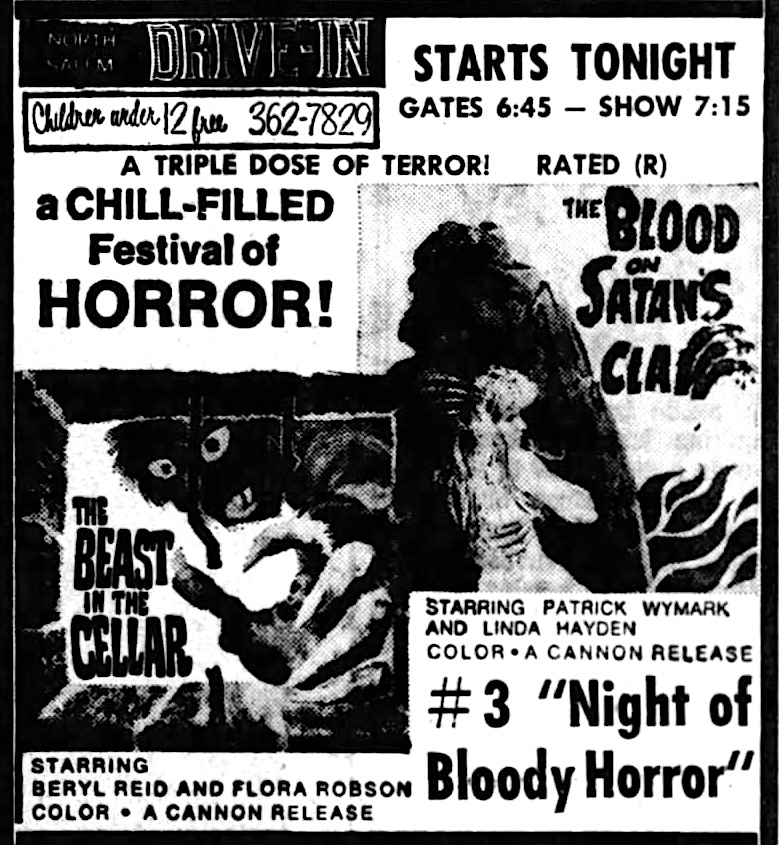
The promotional campaign for Beast of Blood was as inventive as it was unorthodox. To generate buzz around the drive-in screening, the producers commissioned fake ten-dollar bills that, when folded in half, revealed a printed advertisement for the film. These phony currency notes were scattered throughout the neighborhood surrounding the theater, turning everyday transactions into a marketing tool. Even more memorable was the film's poster, which depicted the chlorophyll monster gruesomely tearing its own head off. As Jim Arena later recalled, no such scene actually exists in the movie, yet the lurid image became more widely recognized than the film itself. The tantalizing, over-the-top artwork did its job, drawing long lines of cars to the drive-in. The film was released in 1970 as part of a double feature alongside Curse of the Vampires, a 1966 Filipino horror picture directed by Gerardo de Leon. The pairing proved commercially successful, with Beast of Blood doing substantial business in New York theaters. This box-office momentum led producer Lynn to anticipate securing distribution rights for Ashley's next horror project, Beast of the Yellow Night, though that plan would ultimately fall through.
Critical Reception and the Parting of Ways
Despite its commercial success in certain markets, Beast of Blood received largely unfavorable critical attention. TV Guide awarded the film a single star out of four, dismissing it as ridiculous and singling out its poor make-up effects and overall production values for criticism. The featured review on IMDb offered a slightly more nuanced take, acknowledging that while the film was far from horrible, it represented the weakest entry in the Blood Island series. The reviewer suggested the creators had milked the concept dry, though conceding the presence of some nice moments. Beyond the critical reception, the film's aftermath carried significant professional consequences. Producer Lynn had hoped to leverage the film's New York success to lock down distribution for John Ashley's next horror picture, Beast of the Yellow Night. However, Ashley and his own production company, Four Associates Ltd., independently financed the project with Romero directing, and struck a deal with Roger Corman's then-fledgling New World Pictures for distribution. Lynn was effectively cut out of the arrangement entirely, cementing the split between the two collaborators that had begun with the completion of Beast of Blood.
Gallery

Frequently Asked Questions
What is Beast of Blood?
Beast of Blood is a 1970 Filipino horror film directed by Eddie Romero and produced under Kane W. Lynn's Hemisphere Pictures. It is known in the UK market under the alternate title Blood Devils.
What series does Beast of Blood belong to?
It is the third installment in the Blood Island franchise, serving as a straight sequel to The Mad Doctor of Blood Island. Two additional films were later added to the series after this entry.
What is Beast of Blood's alternate release title?
In the United Kingdom, the picture went out under the name Blood Devils. Its original Filipino-market title remains Beast of Blood.
How does Beast of Blood fit into the larger Blood Island storyline?
It picks up the narrative directly from The Mad Doctor of Blood Island, making it a true sequel rather than a standalone. The franchise continued beyond this third entry with two more films.
Why is Beast of Blood significant in Eddie Romero's career?
It stands as the last project Romero completed alongside producer Kane W. Lynn before the two parted ways professionally. After this film, Romero no longer collaborated with Hemisphere Pictures.
More in Mad scientist films 1-24
Spotted an error? Know more?
Reader corrections go straight into our review queue. Suggest an edit · How this site is sourced