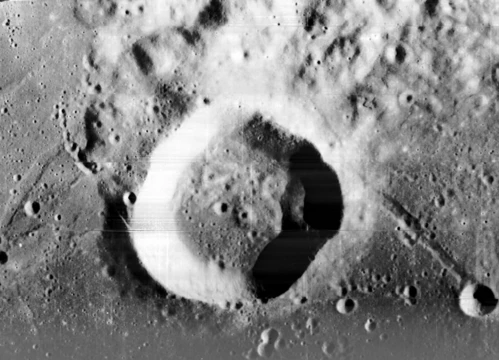
Tycho (lunar crater)
A young, bright lunar crater with extensive rays.
Tycho is a bright lunar impact crater in the southern highlands, named for the Danish astronomer Tycho Brahe. It measures about 85 km across and 4.7 km deep, with an age of roughly 108 million years. Nearby craters include Street to the south, Pictet to the east, and Sasserides to the north-northeast. The surrounding terrain is covered with many craters, some formed by large ejecta from Tycho itself.
Quick Facts
- Diameter
- 85 km / 52.8 mi
- Depth
- 4.7 km / 2.92 mi
- Eponym
- Tycho Brahe
- Location
- The Moon
- Age
- 108 million years
Facts from the source article.
Age and description
Tycho Crater is a relatively fresh lunar feature, estimated to be 108 million years old according to data from NASA's Lunar Reconnaissance Orbiter. That age once led scientists to think the object that formed it might have come from the Baptistina asteroid family, but since the impactor's makeup was never confirmed, that idea was just speculation. In 2011, the Wide-field Infrared Survey Explorer disproved the link by showing the Baptistina family actually formed around 80 million years ago, much later than previously thought. The crater itself has a crisp, well-defined shape, unlike older craters worn down by later impacts. Its bright interior stands out when the Sun is directly overhead, and it is encircled by a prominent ray system with long streaks extending up to 1,500 kilometers. In raw size, the debris field from Tycho's impact is roughly equal to the one from the K-Pg impact on Earth, and proportionally, the only earthly feature of similar scale is the Pacific Ocean. Parts of these rays are visible even when only earthlight illuminates the crater. Because of these bright rays, Tycho is classified within the Copernican System. The ramparts beyond the rim are darker than the interior for more than a hundred kilometers and lack any ray markings, likely because minerals dug up during the impact created this darker zone. The inner walls have slumped and formed terraces, sloping down to a rough but mostly flat floor dotted with small, knobby domes. Pure crystalline plagioclase has been detected on the southeast wall and rim using infrared spectroscopy. The floor shows evidence of past volcanic activity, probably from rock melted by the impact. Close-up images reveal the floor is crisscrossed with cracks and small hills. The central peaks rise 1,600 meters above the floor, with a smaller peak just northeast of the main massif. Anorthosite with very low mafic content has been found in these central peaks. Infrared observations taken during a lunar eclipse show that Tycho cools more slowly than surrounding areas, making it a thermal hot spot, an effect caused by the different materials covering the crater.
Names
The crater Tycho honors the Danish astronomer Tycho Brahe. Its name, like those of many nearside lunar features, was assigned by Italian astronomer Giovanni Riccioli in his 1651 system, which later became the standard. Earlier mapmakers had their own labels: Pierre Gassendi called it Umbilicus Lunaris, or the Moon’s navel; on van Langren’s 1645 chart it appears as Vladislai IV for Poland’s King Władysław IV Vasa; and Johannes Hevelius named it Mons Sinai after the biblical mountain.
Fictional references
A chapter in Jules Verne's 1870 novel Around the Moon describes the crater Tycho and its ray system. In R.A. Heinlein's 1940 story "Blowups Happen," a character suggests Tycho might once have housed a sentient race's main atomic power plant when the Moon was habitable; an explosion supposedly created the craters, the rays, and wiped out lunar life. C.D. Simak's 1961 novelette The Trouble with Tycho is set at the crater, where the rays are imagined as volcanic glass tektites, similar to a theory later proposed by NASA researchers Dean Chapman and John O'Keefe. Heinlein's 1966 novel The Moon Is a Harsh Mistress places the habitat "Tycho Under" at the crater. In the 1968 film 2001: A Space Odyssey and Arthur C. Clarke's book, Tycho is the site of the Tycho Magnetic Anomaly (TMA-1) and the excavation of an alien monolith. The 1987 film Can't Buy Me Love has Cindy spotting Tycho through a telescope. The 1996 film Star Trek: First Contact features "Tycho City," a lunar metropolis by the 24th century. Jack Williamson's 2001 novel Terraforming Earth uses the crater for "Tycho Base," a robot-controlled installation tasked with restoring life to Earth after an asteroid sterilizes the biosphere. In the 2019 film Ad Astra, the Moon base is located in Tycho crater, where Roy begins his journey to Mars. The crater appears prominently in Jerome Beatty's Matthew Looney and Maria Looney children's book series. In R.M. Allen's Hunted Earth novels, a former penal colony called "Tycho Purple Penal" exists in or near the crater. The band Cojum Dip references Tycho in their song "Waltz in E Major, Op. 15 Moon Waltz." The 2022 game Horizon Forbidden West places a Helium-3 mine at Tycho. In both the book series and TV adaptation The Expanse, Tycho is a mobile construction platform or space station.
More in Lunar Craters
Spotted an error? Know more?
Reader corrections go straight into our review queue. Suggest an edit · How this site is sourced