Clavius (crater)
One of the grandest cavities on the Moon's near side.
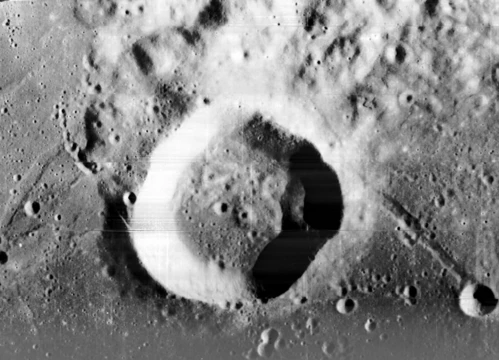
Clavius is a massive crater on the Moon’s near side, the largest visible there. Located in the rugged southern highlands south of the ray crater Tycho, it can sometimes be seen with the naked eye when along the terminator.
Quick Facts
- Diameter
- 230.77 km / 143 mi
- Depth
- 4.76 km / 15,617 ft
- Colong
- 15
- Formation
- Nectarian
- Eponym
- Christoph Klau
Facts from the source article.
Description
Clavius sits near the Moon’s southern limb, so foreshortening makes it look elongated. Because it is so large, you can spot it with the naked eye as a distinct notch along the terminator a day or two after first quarter. It formed during the Nectarian period. Compared to its size, its outer wall is low, heavily eroded, and dotted with small craters. The rim barely rises above the surrounding ground, giving it the feel of a walled depression. The inner rim is hilly, uneven, and notched, with the steepest section in the south. Overall, the rim has a somewhat angular, polygonal shape. The northeast side is broken by Porter crater. The floor is a convex plain with several interesting impacts. The most striking feature is a curved chain of craters starting with Rutherfurd in the south, then arcing counterclockwise across the floor in a sequence of shrinking diameters: Clavius D, C, N, J, and JA. This diminishing series helps amateur astronomers test their small telescopes’ resolution. The crater is big enough that it might have once had a peak ring, but if it did, nothing remains. A remnant of a central massif survives between Clavius C and N. Its spectrum matches anorthositic gabbro. The floor’s relative smoothness and the central peaks’ low height suggest the crater’s surface formed later than the original impact.
Presence of water
In October 2020, NASA found molecular water at Clavius, with levels reaching 412 parts per million. This water might be locked inside tiny glassy beads formed by the intense heat of micrometeorite impacts, or it could be hidden between grains of lunar soil. Another explanation involves very small asteroid strikes. A rubble pile from a much larger parent asteroid collision could break apart during descent, much like Comet Shoemaker–Levy 9 did. If such a body hit the surface at a low, oblique angle over a small area, with little mass, it might bounce, leaving some water trapped in the rock matrix. Water-rich carbonaceous chondrite asteroids, especially the CI subgroup, can contain up to 22 percent water.
More in Lunar Craters
Spotted an error? Know more?
Reader corrections go straight into our review queue. Suggest an edit · How this site is sourced