Eratosthenes (crater)
Lunar impact crater at the Apennine mountain terminus.
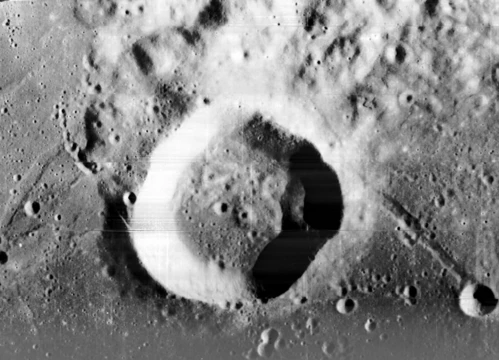
Eratosthenes is a notably deep lunar impact crater situated where the Mare Imbrium meets the Sinus Aestuum. It marks the western end of the Montes Apenninus range. The crater honors the ancient Greek astronomer Eratosthenes of Cyrene, famous for calculating Earth’s circumference and the distance to the Sun.
Quick Facts
- Diameter
- 59 km / 36.7 mi
- Depth
- 3.43 km / 11,253 ft
- Colong
- 12
- Formation
- Eratosthenian
- Eponym
- Eratosthenes
Facts from the source article.
Description
Eratosthenes is a lunar impact crater with a clearly defined circular rim, terraced inner walls, a set of central peaks, an uneven floor, and an outer blanket of ejected material. On its central peak, scientists have detected pure crystalline plagioclase using infrared spectroscopy. The crater does not have its own system of bright rays, but rays from the larger crater Copernicus, located to the southwest, cross over it. The Eratosthenian period in the Moon's geological history takes its name from this crater, though the crater itself does not mark the beginning of that period. Eratosthenes is believed to have formed roughly 3.2 billion years ago. When the Sun is low on the horizon, the crater is easy to see because its rim casts a long shadow. However, when the Sun is directly overhead, the crater blends into the surrounding landscape and becomes hard to spot; the brighter rays from Copernicus help hide it. In 1851, the Shropshire astronomer Henry Blunt created a model of the Moon's surface that included Eratosthenes. He based the model on observations made with a reflecting telescope from his home in Shrewsbury and exhibited it that same year at the Great Exhibition in London. Between 1910 and the 1920s, William H. Pickering noticed dark patches inside the crater that changed in a regular pattern over the course of each lunar day. He first speculated that these patches moved across the surface, which he thought indicated plant life. Believing the Moon had a thicker atmosphere, he reported seeing frost and snow and called the crater the "Gardens of Eratosthenes." Later, he changed his mind and argued the patches were actually swarms of animals, which he often described as lunar insects. The scientific community did not accept these ideas, but they did attract some attention in the popular press because of Pickering's reputation.
More in Lunar Craters
Spotted an error? Know more?
Reader corrections go straight into our review queue. Suggest an edit · How this site is sourced