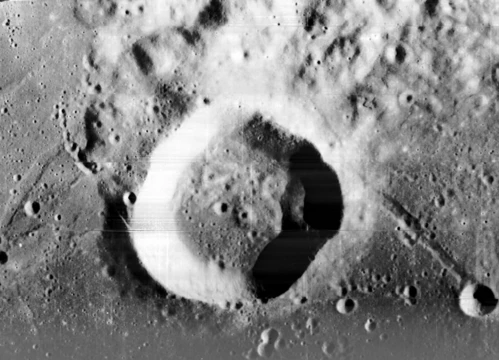
Bullialdus (crater)
A well-formed Eratosthenian crater in western Mare Nubium.
Bullialdus is an impact crater on the Moon, sitting in the western Mare Nubium. Often called a miniature Copernicus, it boasts a quadruple central hill. The crater honors French astronomer Ismaël Boulliau.
Quick Facts
- Diameter
- 61 km / 37.9 mi
- Depth
- 3.5 km / 11,483 ft
- Colong
- 2
- Formation
- Eratosthenian
- Eponym
- Ismaël Boulliau
Facts from the source article.
Did You Know?
- Bullialdus A lies just to the south-west of Bullialdus, within its ramparts.
- To the south of Bullialdus A is the slightly smaller Bullialdus B.
- To the north by north-west of Bullialdus is the broken-rimmed and lava-flooded crater Lubiniezky.
Description
Bullialdus stands out because it sits in a relatively empty area, which makes its crisp shape easy to see. The crater’s high outer rim is basically circular, though some observers have described it as slightly polygonal. Inside, the walls are terraced and show plenty of evidence of landslides. The outer slopes are draped with a wide ejecta blanket that reveals a radial pattern of low ridges and valleys. At the center, a group of peaks and rises reaches more than a kilometer high. A raised ridge extends from these peaks toward the southeast, eventually blending into the inner wall. The floor is mostly rough, dotted with low rises, but the flatter parts are covered by lava that formed after the impact. The floor also bulges upward in the middle, giving it a convex shape. When the Sun is high, the rim and central peaks look brighter than the surrounding area, and white patches appear on the floor. Infrared studies show at least three layers of rock beneath the surface. The impact may have hit a mafic pluton, a body of crystallized igneous rock rich in heavier elements like magnesium. The central peak’s spectrum matches a gabbroic norite composition, which came from depth. Hydroxyl-bearing magmatic material has also been found, likely dug up from below during the impact.
More in Lunar Craters
Spotted an error? Know more?
Reader corrections go straight into our review queue. Suggest an edit · How this site is sourced