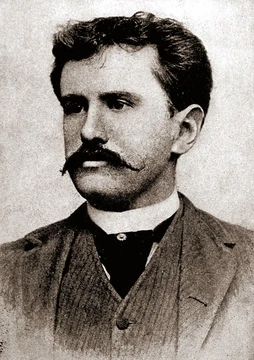
Victor Hugues
German canon regular and leading theologian at the Abbey of Saint Victor.

Jean-Baptiste Victor Hugues (July 20, 1762 – August 12, 1826) was a French politician and colonial administrator best known for his governorship of Guadeloupe from 1794 to 1798 during the French Revolutionary Wars. Born into a wealthy merchant family in Marseille, he moved with his family to Saint-Domingue in the early 1780s, where he came to own several slave plantations. Forced back to France by the Haitian Revolution, he gained the support of the Jacobin Club in La Rochelle and was appointed prosecutor for the Committee of Public Safety there. In 1794, the National Convention, which had just abolished slavery in French colonies, appointed him governor of Guadeloupe.
Arriving in June 1794 with over a thousand troops, Hugues found the colony occupied by a British expeditionary force that had been invited by counter-revolutionary French royalists. He immediately proclaimed the abolition of slavery, winning over most of the island’s Black population. His forces captured Pointe-à-Pitre and forced a large British force to surrender in October, expelling all British troops by December. Though he used abolition as a military tool, Hugues remained personally pro-slavery and racist, maintaining a system of forced labor. He reorganized Guadeloupe’s military into racially integrated units, including Black officers, and raised an army of 10,000 men. He executed alleged counter-revolutionaries with a guillotine and built a successful cash-crop export economy. Hugues authorized privateers to attack British and American shipping, sparking the Quasi-War with the United States, and launched mixed-success invasions of British-held islands like Saint Lucia and Anguilla. Replaced in November 1798, he returned to France.
In 1799, the Consulate sent Hugues to Cayenne. Though personally opposed to abolition, he initially followed orders but later oversaw the restoration of slavery there, implementing harsh labor codes and extending enslavement to those brought before abolition. His brutal methods made Cayenne economically prosperous. In 1809, Anglo-Portuguese forces captured Cayenne without a fight; Hugues surrendered and was disgraced upon returning to France. He later went back to Cayenne, where he died in 1826.
- field
- Theology, mysticism, philosophy, the arts
- nationality
- German
Lore & Background
Hugh was probably born in the 1090s, possibly in the Duchy of Saxony. Some sources say his birth occurred in the Harz district, being the eldest son of Baron Conrad of Blankenburg. Over the protests of his family, he entered the Priory of St. Pancras, a community of canons regular, at Hamerleve or Hamersleben, near Halberstadt. Due to civil unrest shortly after his entry, his uncle, Bishop Reinhard of Blankenburg, advised him to transfer to the Abbey of Saint Victor in Paris, where he himself had studied theology. Hugh accepted and made the move at a date which is unclear, possibly 1115–18 or around 1120. He spent the rest of his life there, advancing to head the school. Hugh wrote many works from the 1120s until his death; Migne's *Patrologia Latina* contains 46 works by Hugh, and this is not a full collection. His works include theology, commentaries (mostly on the Bible but also on pseudo-Dionysius' *Celestial Hierarchies*), mysticism, philosophy, the arts, letters, and sermons. Hugh was influenced chiefly by Saint Augustine, especially in holding that the arts and philosophy can serve theology. In 1125–30, Hugh wrote three treatises structured around Noah's ark: *De arca Noe morali*, *De arca Noe mystica*, and *De vanitate mundi*. His description of the ark—a ship's hull with a sloped roof and a side door—became the 'standard description' of the ark, whose shape is not clearly described in Genesis. Hugh's commentary on pseudo-Dionysius, *In Hierarchiam celestem commentaria*, perhaps begun around 1125, became a major part of the twelfth and thirteenth-century surge in interest in Dionysius; his and Eriugena's commentaries were often attached to the Dionysian corpus in manuscripts.
Reader's Guide
Hugh's *Didascalicon de studio legendi* (Didascalicon, or, On the Study of Reading) was written for students at the school of Saint Victor. It is a preliminary introduction to theological and exegetical studies taught at the Parisian schools, the most advanced centers of learning in Europe in the 12th century. Citing a wide range of classical and medieval sources, and with Augustine as his principal authority, Hugh sets forth a comprehensive synthesis of rhetoric, philosophy, and exegesis, designed to serve as a foundation for advanced theological study. The *Didascalicon* is primarily pedagogical, not speculative, in nature. In it, Hugh outlined three types of philosophy or 'science' [scientia] that can help mortals improve themselves and advance toward God: theoretical philosophy (theology, mathematics, physics) provides them with truth, practical philosophy (ethics, economics, politics) aids them in becoming virtuous and prudent, and 'mechanical' or 'illiberal' philosophy (e.g., carpentry, agriculture, medicine) yields physical benefits. A fourth philosophy, logic, is preparatory to the others. Hugh's deeply mystical bent did not prevent him from seeing philosophy as a useful tool for understanding the divine. Hugh separated everything along the lines of *opus creationis* and *opus restaurationis*. *Opus Creationis* refers to God's creative activity, the true good natures of things, and the original state and destiny of humanity. The *opus restaurationis* deals with the reasons for God sending Jesus and the consequences of that. Hugh believed that God did not have to send Jesus and that He had other options open to Him. Within the Abbey of St Victor, many scholars who followed him are often known as the 'School of St Victor'. Andrew of St Victor studied under Hugh. Others, who probably entered the community too late to be directly educated by Hugh, include Richard of Saint Victor and Godfrey. Hugh was also an influence on the critic Erich Auerbach, who cited a passage from Hugh in his essay 'Philology and World Literature': 'It is therefore, a source of great virtue for the practiced mind to learn, bit by bit, first to change about in visible and transitory things, so that afterwards it may be able to leave them behind altogether. The person who finds his homeland sweet is a tender beginner; he to whom every soil is as his native one is already strong; but he is perfect to whom the entire world is as a foreign place.'
Did You Know?
- Hugh's description of Noah's ark—a ship's hull with a sloped roof and a side door—became the 'standard description' of the ark, whose shape is not clearly described in Genesis.
- Migne's *Patrologia Latina* contains 46 works by Hugh, and this is not a full collection.
- Hugh's commentary on pseudo-Dionysius, *In Hierarchiam celestem commentaria*, perhaps begun around 1125, helped spark a twelfth and thirteenth-century surge in interest in Dionysius.
- One of Hugh's works, *De contemplatione et ejus speciebus*, appears not to have been written by Hugh himself, but composed by one of his students, possibly from classnotes from his lectures.
- Hugh was an influence on the critic Erich Auerbach, who cited a passage from Hugh in his essay 'Philology and World Literature'.
More in Literature And Writers 1-24
Spotted an error? Know more?
This is a living reference — every entry is fact-audited, and reader corrections feed straight into our audit queue. Suggest an edit · See this site's audit record