Moesgård
Former manor house, now a museum and university teaching site.
Last updated
Where it is
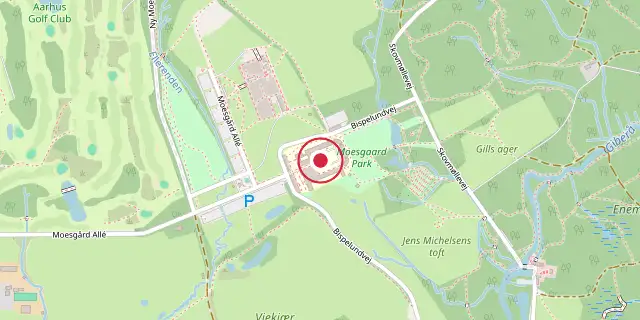
Coordinates: 56°05′13″N 10°13′34″E (56.0870, 10.2260) · Open in OpenStreetMap
Coordinates and connected clubs: the infobox of Wikipedia: Moesgård (CC BY-SA 4.0). Map: drawn by Codexery from OpenStreetMap tiles.
Moesgård is a former manor house and a listed building in Aarhus Municipality, completed in 1778 and listed in the Danish registry of protected buildings and places on 17 July 1918. It is situated in the district of Højbjerg, 10 kilometers south of the city centre of Aarhus, and is today owned by Moesgård Museum, which cooperates with the School of Culture and Society from Aarhus University on subjects including history, archaeology, anthropology and oriental studies.
History
The story of Moesgård stretches back to the late 1300s, though people likely worked the land there even earlier. The manor house we see today probably isn't on the original farm's spot. That first farm was likely moved and rebuilt after it burned during the mid-1600s wars with Sweden. In the 1800s, remains of a courtyard were found about a kilometer southwest of the current manor, and that's thought to be where the original farm stood.
The name "Moesgård" means "bog farm," which fits with archaeological finds of old wetlands in the area. In 1660, Mogens Friis owned Moesgård along with two other manors south of Aarhus. Two years later, he got new lands north of the city as payment for losses in the Dano-Swedish War, and he set up the county of Frijsenborg. He sold his southern manors to Gabriel Marselis, who had received land from the crown to settle war debts.
Marselis rebuilt the burned Moesgård on its current site. When he died in 1673, his son Vilhelm inherited Skrumstrup and Moesgaard. Vilhelm turned Skrumstrup into a barony called Vilhelmsborg and took the name Gyldenkrone. Moesgård became a title tied to that barony but stayed in the Marselis family until the early 1800s.
The main building we see today went up between 1780 and 1784, built by Christian Frederik Gyldenkrone. But the manor was in financial trouble, and his son Frederik Christian was the last family owner; the state took over in 1822. Torkild Dahl bought it in 1838, and the Dahl family kept it until the mid-1900s. Thorkild Dahl served in the Folketing, loved history and classics, built a big library, and pushed to start a history museum in Aarhus.
Architecture
The main building of Moesgård, built in a historicist style, faces west and is flanked by two curved wings that form the eastern side of a large central courtyard. Symmetrically placed on either side of this courtyard are the 1800s farm buildings. To the east lies an expansive romantic garden, complete with waterways, bridges, and stone embankments. A long poplar-lined driveway, created in the 1800s when the Aarhus-to-Odder road was built, provides access to the manor.
More in Listed Castles and Manor Houses in Denmark
Sources
Compiled from Wikipedia and the sources listed below. Text from Wikipedia is available under CC BY-SA 4.0; this entry is adapted from it.
- Wikipedia: Moesgård (CC BY-SA 4.0).
Spotted an error? Know more?
Reader corrections go straight into our review queue. Suggest an edit · How this site is sourced