Bregentved
Manor house on Zealand owned by the Moltke family since 1746.
Last updated
Where it is
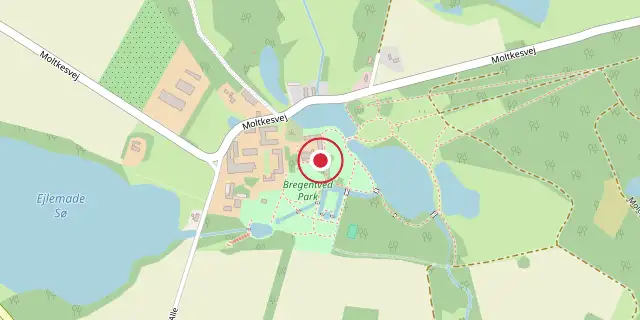
Coordinates: 55°18′25″N 12°00′25″E (55.3070, 12.0070) · Open in OpenStreetMap
Coordinates and connected clubs: the infobox of Wikipedia: Bregentved (CC BY-SA 4.0). Map: drawn by Codexery from OpenStreetMap tiles.
Bregentved is a manor house on the Danish island of Zealand, situated 3 km east of Haslev. It has been in the possession of the Moltke family since the mid-18th century.
History
The earliest known mention of Bregentved dates from 1319, when King Eric VI transferred the estate to Roskilde Abbey. From the late 14th century until 1718, various aristocratic families held the property, including the Krognos family in the 1500s; King Frederick IV then acquired it. During the 18th century, Bregentved belonged to separate Birks, giving it independent legal jurisdiction from Haslev Sogn and old Ringsted Herred. The north wing, built 1731-36 by Lauritz de Thurah, features a black-tiled, hipped roof and contains a first-floor chapel.
In 1746, King Frederick V granted the estate to Adam Gottlob Moltke, who was simultaneously made lord chamberlain and a count. Moltke adapted the two remaining wings with architects G.D. Anthon and Nicolai Eigtved, and commissioned Eigtved to build a mansion in Copenhagen (the south-western Amalienborg Palace, completed 1754). Moltke introduced agricultural reforms inspired by Holstein.
He died at Bregentved on 25 September 1792, passing the estate to his eldest son, Joachim Godske Moltke. After the 1794 fire of Christiansborg Palace, the family ceded their Copenhagen mansion to the royal family. Adam Wilhelm Moltke, the first Prime Minister under Denmark's constitutional monarchy, later acquired a new mansion known as Moltke's Mansion. In the 1880s, Count Frederik Christian Moltke modernized the house, demolishing the two Eigtved wings and replacing them with new wings completed in 1891 to designs by Axel Berg.
Architecture
The current three-winged structure consists of a main east wing and a south wing, both built during Axel Berg's 1891 expansion atop foundations laid by Eigtved. These wings are Neo-Rococo in style and feature a Mansard roof made of copper and tile.
The east wing includes a three-bay risalit with pilasters and a triangular pediment, along with two-bay corner risalits topped by segmental pediments. The entrance tower was also added during Berg's work. The north wing, constructed between 1731 and 1736 by Lauritz de Thurah, has a black-tiled hipped roof and houses a first-floor chapel containing pieces by sculptor Johann Friedrich Hännel.
Gardens
A. G. Moltke hired Nicolas-Henri Jardin in the 1760s to create a French formal garden, which was later turned into a landscape garden in 1835. Some original features remain, such as avenues, traces of a parterre ringed by canals, and a fountain system restored in 1994. Also surviving are vases, Frederik V's Obelisk (1770) by Johannes Wiedewelt, a copy of a Giambologna statue, and a statue of A. W. Moltke by Herman Wilhelm Bissen from 1858-59.
Bregentved today
The Bregentved-Turebyholm estate spans 6,338 hectares, with farmland making up a little more than half and forest covering the rest. The property includes 163 houses, such as Turebylille, Holtegård, and Eskilstrup. A staff of 40 runs the estate, which generates about DKK 60 million each year through agriculture, forestry, renting homes, leasing hunting grounds, hiring out storage, and offering machine pool services. While the main house is closed to visitors, the park is open for free on Wednesdays, Saturdays, Sundays, and public holidays.
More in Listed Castles and Manor Houses in Denmark
Sources
Compiled from Wikipedia and the sources listed below. Text from Wikipedia is available under CC BY-SA 4.0; this entry is adapted from it.
- Wikipedia: Bregentved (CC BY-SA 4.0).
Spotted an error? Know more?
Reader corrections go straight into our review queue. Suggest an edit · How this site is sourced