Beldringe
Manor house near Præstø with 1561 main building and listed barn.
Last updated
Where it is
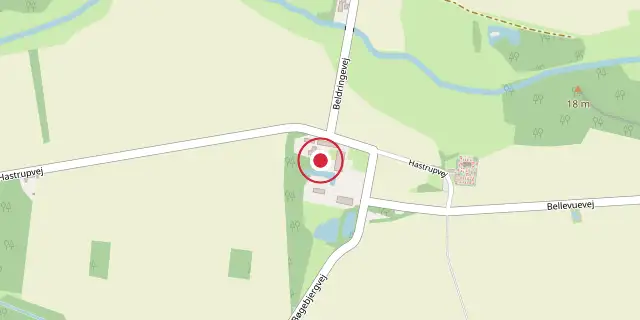
Coordinates: 55°06′25″N 11°59′28″E (55.1070, 11.9910) · Open in OpenStreetMap
Coordinates and connected clubs: the infobox of Wikipedia: Beldringe (CC BY-SA 4.0). Map: drawn by Codexery from OpenStreetMap tiles.
Beldringe is a manor house and estate in Vordingborg Municipality, Denmark, located four kilometres southwest of Præstø. Its main building dates from 1561, and the estate was owned by members of the Raben/Raben-Levetzau family from 1774 to 1993. The main building and a large half-timbered barn from the 1710s were listed on the Danish registry of protected buildings and places in 1918.
History
The first known owner of Beldringe was Joseph Nielsen Blade, mentioned in 1360. The estate then passed to his son Anders Jensen Basse, and later to his niece Dorthe Christoffersdatter Basse, who was married to Jacob Jensen Ravensberg til Kindholm. In 1522, she married Joachim Beck, who already owned nearby Førslevgaard.
Beck family
Beck became royal treasurer of Eastern Denmark in 1537 and was granted considerable land on Zealand. Joachim Beck and Anna Ravnsberg are buried at Førslev Church. In 1607, Beldringe went to his son Jacob Beck, while Førslevgaard went to another son, Sivert Beck. In 1621, Jacob Beck ceded Beldringe to Christian IV in exchange for Gladsaxe in Scania; the king used the land as hunting grounds.
1521–1774: Royal ownership
At that time, Beldringe comprised the manor and 52 tenant farms. The manor was expanded and the main building renovated in 1622. In his 1665 will, Frederick III bequeathed Vordingborg Castle and the manors of Beldringe and Lekkende to his youngest son, Prince George.
1774–1993: The Raben-Levetzau family
After Prince George's death in 1708, all his holdings reverted to the Crown, and the estate was included in the new Vordingborg Cavalry District. In 1769, it was decided to sell the district, and in 1774 it was divided into 12 estates and sold at auction at Vordingborg Castle on 27 September. Beldringe and Lekkende were bought by Frederik Sophus Raben, who undertook a comprehensive refurbishment of the main building. On his death, Beldringe passed to his son Carl Vilhelm Raben, a former diplomat in the Hague who returned to manage the estate.
In 1834, he was granted royal permission to use the surname Raben-Levetzau. Having no children, Carl Vilhelm Raben-Levetzau and his wife Julia Adelaide Harriet Bornemann established Den Raben-Levetsauske Fond. After her death in 1888, Beldringe passed to their nephew Frederik Christoffer Otto Raben-Levetzau, who was appointed Minister of Foreign Affairs in 17905.
Architecture
The two-storey main building, built in 1561, is constructed of red brick with bands of partly white-washed limestone, standing on a foundation of field stones with a base of finely cut granite ashlars. Most farm buildings were destroyed in a 1910 fire, except for a large half-timbered barn from 1715 that is 30 bays long and 14 bays wide. The main building and barn were listed in 1918, with the listing scope expanded in 1990. A gatehouse marks the entrance to the complex.
More in Listed Castles and Manor Houses in Denmark
Sources
Compiled from Wikipedia and the sources listed below. Text from Wikipedia is available under CC BY-SA 4.0; this entry is adapted from it.
- Wikipedia: Beldringe (CC BY-SA 4.0).
Spotted an error? Know more?
Reader corrections go straight into our review queue. Suggest an edit · How this site is sourced