Hagestedgaard
Manor house near Holbæk with 13th-century roots and 1747 buildings.
Last updated
Where it is
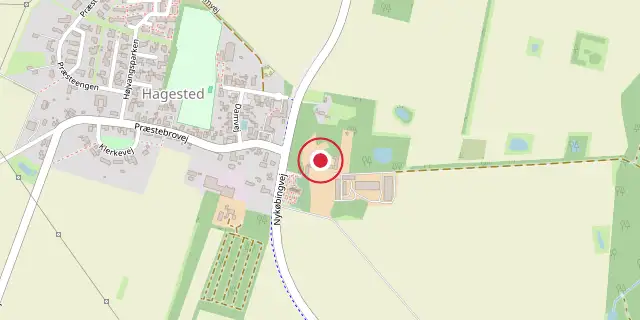
Coordinates: 55°44′46″N 11°37′12″E (55.7460, 11.6200) · Open in OpenStreetMap
Coordinates and connected clubs: the infobox of Wikipedia: Hagestedgaard (CC BY-SA 4.0). Map: drawn by Codexery from OpenStreetMap tiles.
Hagestedgaard is a manor house and estate near Holbæk, roughly 60 kilometres west of Copenhagen. Its history reaches back to the 13th century, but the present asymmetrical complex of white-washed buildings around a central courtyard was constructed in 1747 for Hans Didrik Brinck-Seidelin. The estate has been held by the Castenskiold family since 1769.
History
In the Danish Census Book, Hagested is recorded as crown land. The estate was managed as a fief, with fiefholders including Peder Jensen Pilegrim (1347), Markvard Tiinhuus (1502) and Otte Tiinhuus (1521 and 1540). In 1540, Hagestedgaard was passed to Chancellor Johan Friis in exchange for property in Odsherred, and he also received jus patronatus of the local Hagested Church. Christen Friis remained unmarried; after his death the estate went to his relative Christian Friis of Borreby, who also had no children.
The Dano-Swedish War brought ravages and looting by Swedish troops that economically ruined Thott. In 1663, Thott sold Hagestedgård to Thomas Bartholin, who retired from the university at age 44 and settled on the estate. A fire in 1670 destroyed the main building, rectory and eight farmhouses, along with Bartholin's vast library and many of his works.
As compensation, Christian V granted him tax exemption, contributed building materials for rebuilding, and appointed him court physician. In 1704, Ursula von Putbus, widow of Knud Thott, acquired Hagestedgaard. District judge Ole Bornamann purchased it in 1709.
The estate was sold at public auction in 1711, bought by district judge Peder Benzon, who sold it to his brother Lars Benzon in 1715. Lars Benzon sold it to civil servant and poet Willum Worm in 1725, who sold it two years later to Rachel Sophie Marschalk Fletscher. Hans Seidelin purchased Hagestedgård in 1730; a favourite of King Christian VI, he had recently been appointed Post Master-General of the Royal Danish Mail, Director of the Royal Vajsen House and judge at the Hofretten, and the purchase underscored his new social position. He was ennobled the following year.
Architecture
Most of the present buildings were erected for Hans Didrik Brinck-Seidelin in 1748. The asymmetrical complex consists of single-storey, white-washed structures around a central courtyard, built with timber framing on fieldstone foundations and roofs clad with winged red tile. The main wing on the west side incorporates the remains of a tower and a barrel-vaulted cellar built by Johan Friis in 1555; the tower has a pyramid roof. To the east, two L-shaped residential wings enclose an extra courtyard, and two small pavilions with half-hip roofs stand on the north side of the central courtyard.
More in Listed Castles and Manor Houses in Denmark
Sources
Compiled from Wikipedia and the sources listed below. Text from Wikipedia is available under CC BY-SA 4.0; this entry is adapted from it.
- Wikipedia: Hagestedgaard (CC BY-SA 4.0).
Spotted an error? Know more?
Reader corrections go straight into our review queue. Suggest an edit · How this site is sourced