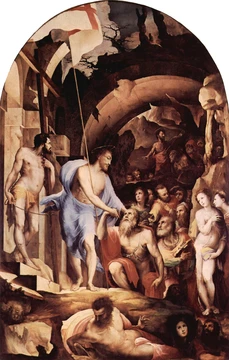
Original sin
Inherited sinfulness from Adam and Eve, central to Christian theology.
Original sin (Latin: peccatum originale) is a Christian theological concept describing the condition of sinfulness inherited by all humans from the Fall of Adam and Eve, involving the loss of original righteousness and the distortion of the Image of God. The doctrine developed incrementally in early Christianity, shaped significantly by Augustine of Hippo, and became a central tenet in Western theology, though its interpretation has varied among traditions.
- Field
- Christian theology
- Known for
- Doctrine of inherited sinfulness from Adam and Eve
- Key scriptural basis
- Genesis 3, Psalm 51:5, Romans 5:12–21
- Early developer
- Irenaeus of Lyons (2nd century)
- Major shaper
- Augustine of Hippo (354–430 AD)
- Councils
- Councils of Carthage (411–418 AD) and Orange (529 AD)
Lore & Background
The biblical basis for original sin is generally found in Genesis 3 (the expulsion from Eden), Psalm 51:5 ('I was brought forth in iniquity'), and Romans 5:12–21 ('sin entered the world through one man'). Early Christianity had no specific doctrine of original sin prior to the 4th century; the idea developed incrementally in the writings of the Early Church Fathers. The late 1st- or early 2nd-century Didache, Shepherd of Hermas, and Epistle of Barnabas assumed children were born sinless, while Clement of Rome and Ignatius of Antioch took universal sin for granted without explaining its origin.
The specific doctrine was developed in the 2nd century struggle against Gnosticism by Irenaeus of Lyons, and was shaped significantly by Augustine of Hippo, who was the first author to use the phrase 'original sin' in his polemics against the Pelagians. Influenced by Augustine, the Councils of Carthage (411–418 AD) and Orange (529 AD) brought theological speculation about original sin into the official lexicon of the Church. Protestant Reformers such as Martin Luther and John Calvin equated original sin with concupiscence, affirming it persisted after baptism and completely destroyed freedom to do good. The Jansenist movement, declared heretical by the Catholic Church, also maintained that original sin destroyed freedom of will.
The Catechism of the Catholic Church declares that baptism erases original sin but the consequences for nature persist. The Council of Trent stated that free will, though attenuated, was by no means extinguished. Greek Fathers emphasized the cosmic dimension of the Fall, that human beings are born into a fallen world.
Reader's Guide
Original sin is a foundational concept in Christian theology, shaping understandings of human nature, salvation, and the role of baptism. Its development from early Jewish texts through the Church Fathers illustrates a shift from individual responsibility for sin to a hereditary condition inherited from Adam. Augustine's formulation, which emphasized transmission through propagation rather than imitation, became dominant in Western Christianity and was affirmed by major councils. The doctrine's interpretation has been a point of contention, particularly between Catholic and Protestant traditions, with Reformers like Luther and Calvin arguing for a more total depravity than the Catholic position articulated at Trent. The concept remains central to discussions of grace, free will, and the necessity of Christ's redemption.
Did You Know?
- The late 1st- or early 2nd-century Didache's preference for adult baptism suggests its author may have believed children were born sinless.
- The biblical story of the Garden of Eden makes no association between sex and the disobedience of Adam and Eve, nor is the serpent associated with Satan.
- The Jansenist movement, which maintained that original sin destroyed freedom of will, was declared heretical by the Catholic Church.
More in Characters
Elsewhere in Limbo
Spotted an error? Know more?
Reader corrections go straight into our review queue. Suggest an edit · How this site is sourced