
Caladrius
Mythical white bird that heals by absorbing sickness.

Unknown author · Public domain
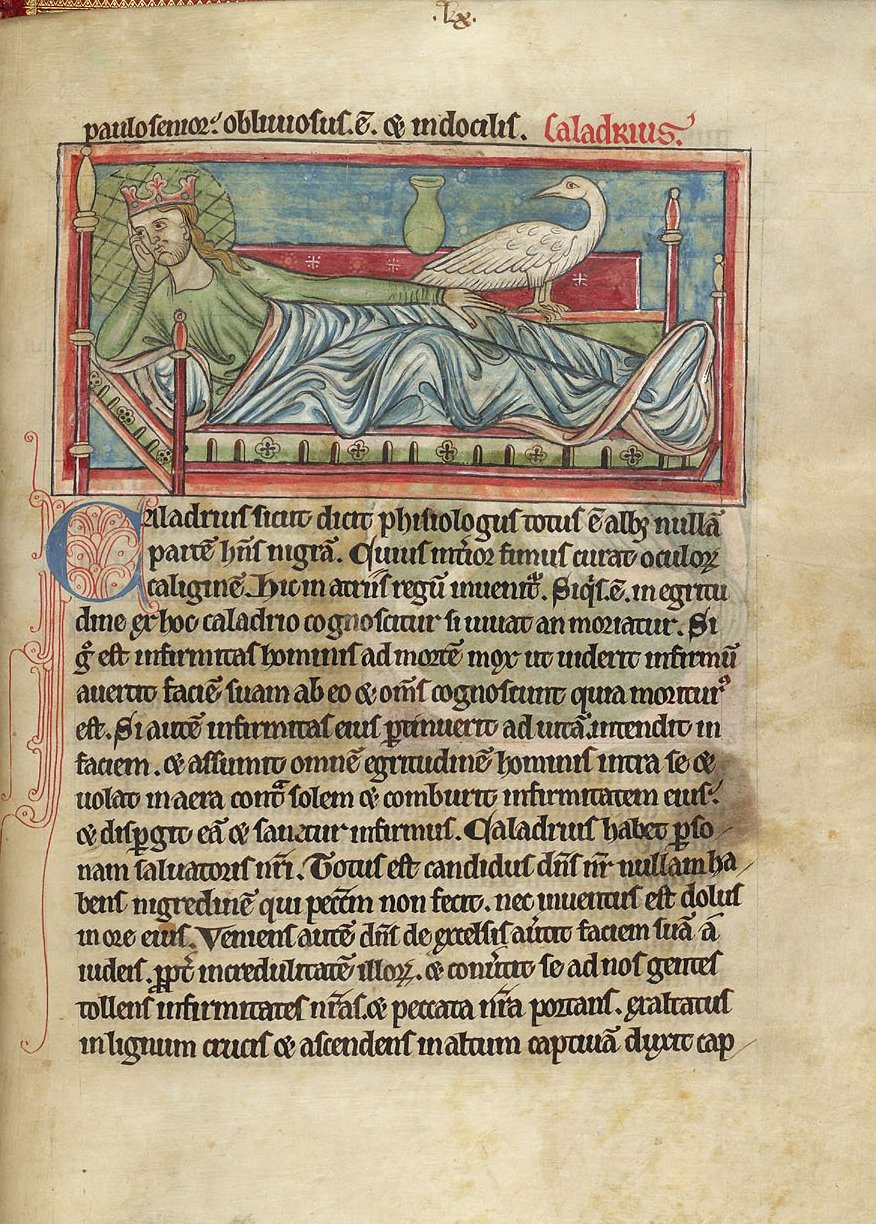
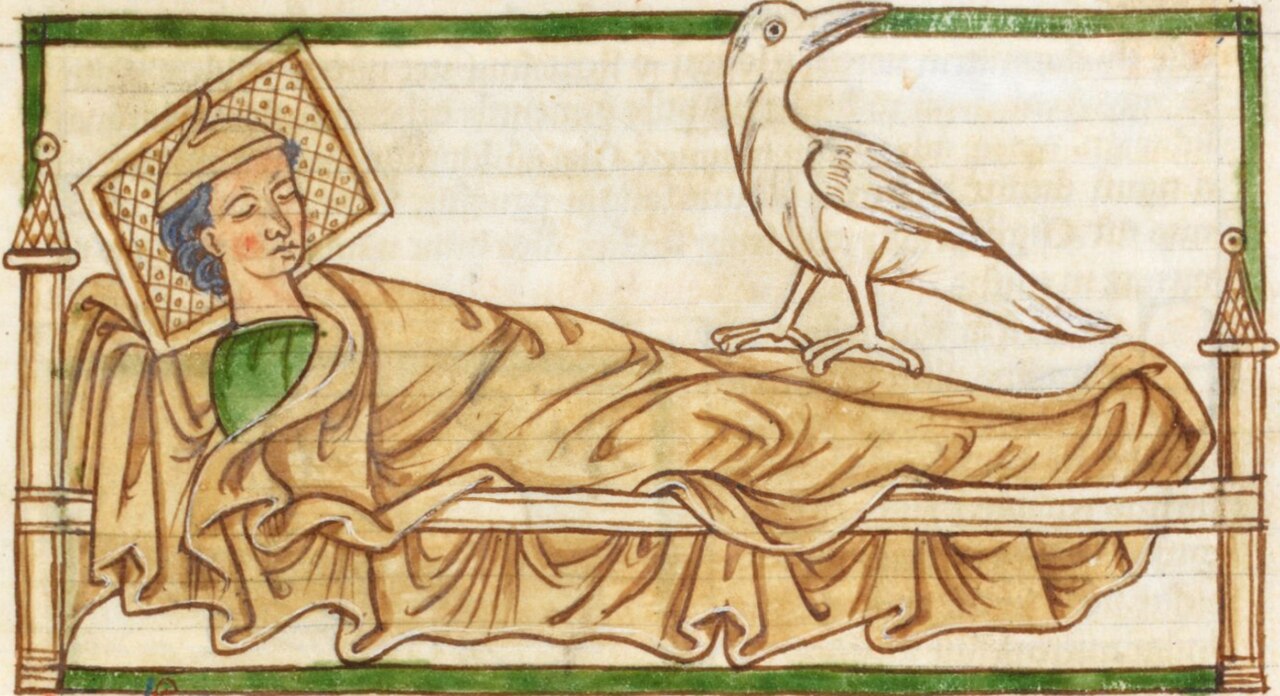
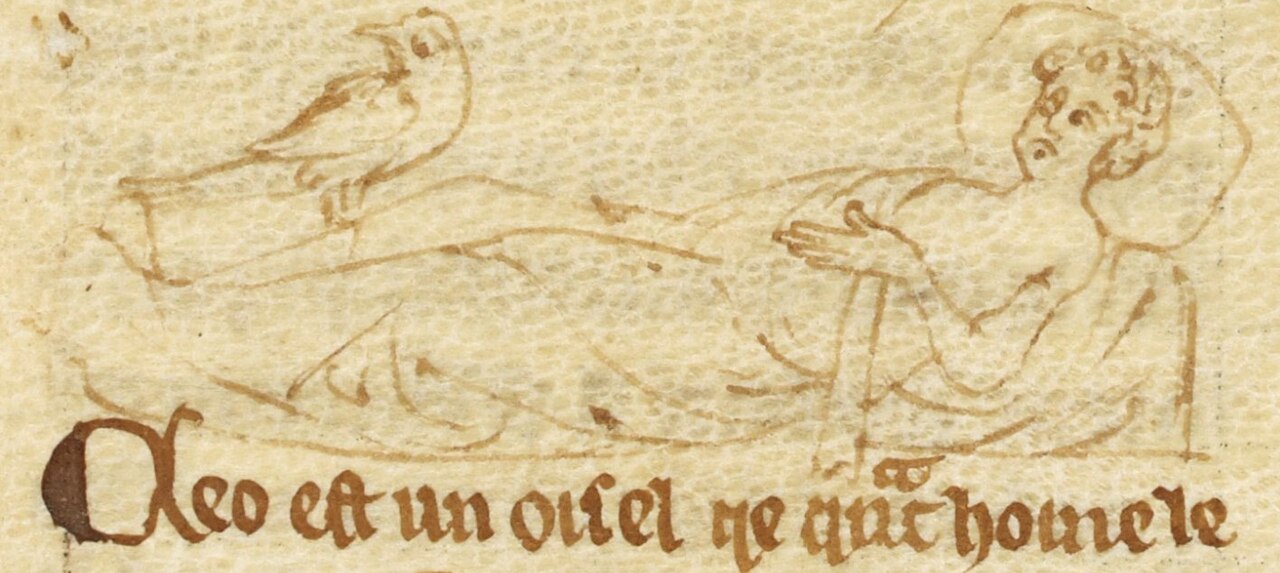
The caladrius (or charadrius), also known as the dhalion in Greek, is a mythical snow-white bird described in Christian mythology within the Physiologus. It is said to live in the king's house and possesses the ability to take sickness into itself, then fly away to disperse the illness, healing both itself and the sick person. The caladrius legend was incorporated into medieval bestiary materials, which typically included a Christian moralization for the animals they discussed.
- field
- Mythology, Medieval Bestiary
- known_for
- Healing by absorbing sickness and flying to the sun; diagnostic gaze that determines life or death
Lore & Background
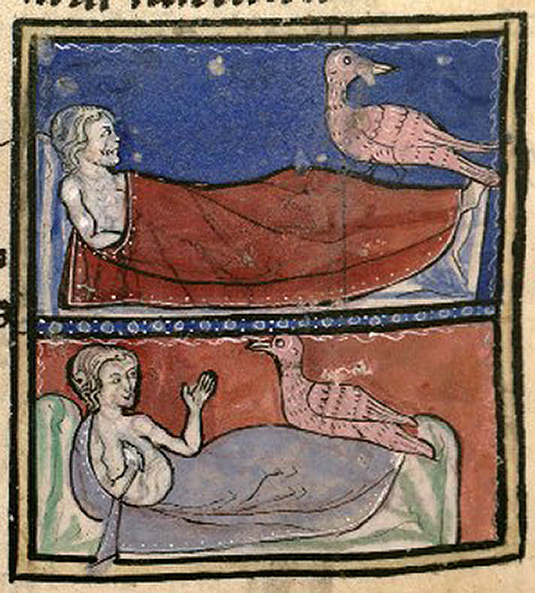
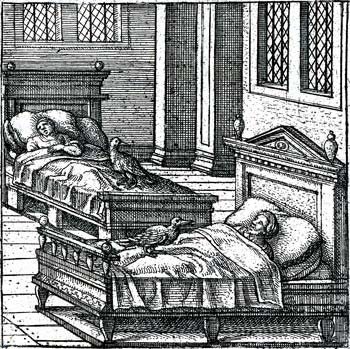
The caladrius is described as a snow-white bird that lives in the king's house. According to the Physiologus, it can take a person's sickness into itself and then fly away, dispersing the illness and restoring health to both itself and the patient. Medieval interpretations added a diagnostic role: if the bird looks into the face of a sick person, the person will live; if it looks away, the person will die. This gaze is said to draw the sickness into the bird, which then flies up to the sun, where the disease is burned up and destroyed.
Reader's Guide
The caladrius holds significance as a symbol in Christian moralization, where it represents Christ—pure white without the blackness of sin. The bird's turning away from unrepentant sinners and casting them off parallels Christ's turning toward the Gentiles after the Jews did not believe, taking away their sins to the cross. The legend has persisted in popular culture, appearing in a Saturday Night Live sketch, the video game Age of Mythology: The Titans, a song by Romanian rock group Transsylvania Phoenix, the Megami Tensei series, the light novel Redo of Healer, the novel Hollow Earth, the game Dragon Age: Origins, the novel Brute of All Evil, the novel Just Stab Me Now, the historical romance The Ornithologist’s Field Guide to Romance, and the InCryptid series. Its origin has been theorized to be based on a real bird, possibly a dove, a water bird like the heron, or most likely a white plover according to art historian Louis Réau.
Did You Know?
- The caladrius is also known as the dhalion in Greek.
- Art historian Louis Réau believed the caladrius was most likely a white plover.
- In medieval bestiaries, if the caladrius looks away from a sick person, the person will die.
The Sacred White Bird of Medieval Christendom
The caladrius, known in Greek as the dhalion, occupies a distinctive place in Christian mythological tradition as recorded in the Physiologus. Described as a bird of pure, unblemished snow-white plumage, it dwells within the king's household, a detail that elevates its status above ordinary creatures. In the medieval bestiary tradition, which paired natural history with spiritual instruction, the caladrius served as a powerful emblem of Christ himself. Its flawless whiteness, free from any trace of black, symbolized a purity untouched by sin. The moral drawn from the bird's behavior was twofold: Christ turns his face away from those who refuse repentance, casting them off, yet when he gazes upon the faithful, he restores them to wholeness. This allegory was sometimes deployed with pointed theological force, particularly in arguments directed against the Jewish people, who were said to have been turned from because of their unbelief, while Christ redirected his compassion toward the Gentiles, carrying their sins to the cross. The caladrius thus functioned not merely as a curiosity of the natural world but as a vehicle for some of the most charged theological debates of the medieval period.
The Mechanics of Divine Diagnosis
In medieval bestiary texts, the caladrius was not merely a symbol but a creature with a precise, almost clinical, function. The bird's gaze carried diagnostic power: if it fixed its eyes upon the face of a sick person, that person would survive; if it averted its look, death was inevitable. This binary judgment made the caladrius something of a supernatural physician, its single glance serving as both prognosis and treatment. The mechanism of healing was equally specific. The bird's stare drew the illness into its own body, internalizing the sickness as though absorbing a poison. It would then take flight upward toward the sun, where the accumulated disease was consumed and annihilated by divine fire. In this process, the caladrius healed not only the patient but also itself, emerging from the ordeal purified. The entire sequence—gaze, absorption, ascent, combustion—gave the legend a satisfying narrative arc that medieval authors found ripe for moralization. The bird's ability to carry corruption to a source of absolute purity and destroy it there mirrored, in the Christian reading, the way Christ bore human sin to the cross and through his sacrifice rendered it powerless.
The Real Bird Behind the Myth
Scholars have long debated whether the caladrius was inspired by an actual species. The consistent description across sources—a bird of entirely white plumage with no black markings—narrowed the possibilities considerably. The most frequently suggested candidate is the common dove, whose pale coloration and gentle demeanor fit the legend's tone. Some researchers have pointed instead to water birds, particularly the heron, given the caladrius's association with healing and its somewhat stately bearing. The art historian Louis Réau, examining the iconographic evidence, concluded that a white plover was the most probable real-world model. The bird's Greek name, dhalion, and its Latin rendering as charadrius both hint at a connection to shorebirds, lending some weight to Réau's identification. What is clear is that the legend's authors took a recognizable, everyday bird and transformed it through theological imagination into a creature of extraordinary spiritual significance. The fact that multiple species have been proposed suggests that the caladrius may not correspond to a single real animal but rather to a composite ideal of whiteness and purity that different observers projected onto different birds in their local environments.
A Legend That Refuses to Stay in the Bestiary
The caladrius has proven remarkably durable in modern popular culture, spanning a wide range of media. In a Saturday Night Live sketch, Steve Martin's medieval barber attempts to use a live bird—likely a dove or pigeon—to diagnose a patient, with the unpredictability of a real animal on live television supplying the comedy. In Age of Mythology: The Titans, an Atlantean unit called the Caladria functions as a flying scout and healer, though its design resembles an angel more than a bird. Romanian rock band Transsylvania Phoenix dedicated a track, "Pasărea Calandrinon," to the creature on their 1975 album Cantafabule. In the Megami Tensei video game series, Caladrius appears as a demon, while the light novel Redo of Healer features it as a monster revered as a god by a demon tribe, capable of both devouring and spreading disease. Novelists have drawn on the legend in varied ways: in Devon Monk's Brute of All Evil, a caladrius takes human form as a town's supernatural doctor; in Seanan McGuire's InCryptid series, a caladrius named Dr. Morrow works at a cryptid hospital; and in the 2024 romance The Ornithologist's Field Guide to Romance, capturing one in a birding competition drives the plot.
Gallery

Frequently Asked Questions
What is the Caladrius?
The Caladrius is a mythical snow-white bird described in early Christian allegorical literature, most prominently in the Physiologus, and later carried into medieval bestiary compilations. In Greek tradition it is also called the dhalion.
What powers does the Caladrius possess?
The bird can gaze upon a sick person, draw the illness into its own body, and then fly to the sun to scatter the sickness, curing both the patient and itself. It is also said to hold a diagnostic stare that reveals whether a sufferer will live or die.
Where does the Caladrius appear in the canon?
Its legend is rooted in the Physiologus, an early Christian text that paired animal descriptions with spiritual allegory, and it was subsequently repeated in medieval bestiaries. Those bestiary entries typically appended a Christian moral lesson to the bird's story.
What does the Caladrius symbolize in Christian tradition?
Medieval writers read the Caladrius as an allegory for Christ, who absorbs the sins and suffering of humanity and then overcomes them through his resurrection. The bird's pure white plumage and its act of taking on sickness reinforce this Christological interpretation.
How is the Caladrius distinct from other healing birds in mythology?
Rather than healing through song, feathers, or distant magic, the Caladrius physically internalizes the disease and expels it by flying to the sun. It is also specifically tied to a domestic setting, as the texts describe it dwelling in the king's household.
More in Legendary birds 1-24
Spotted an error? Know more?
This is a living reference — every entry is fact-audited, and reader corrections feed straight into our audit queue. Suggest an edit · See this site's audit record