
The Cunning Servant
A cunning servant tricks his master into wealth and marriage.

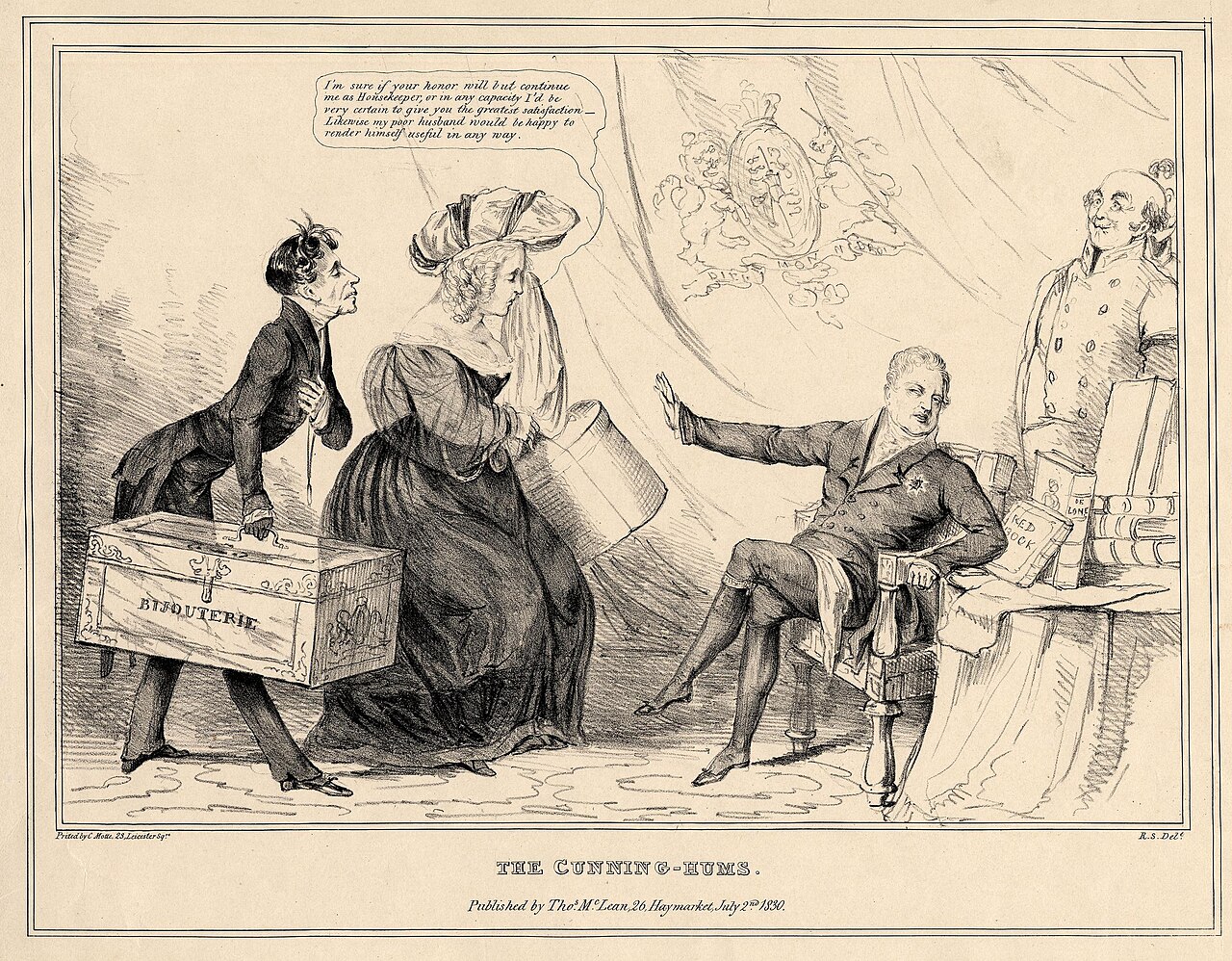
Print made by: Robert Seymour Published by: Thomas McLean Printed by: Charles Mo · Public domain
The Cunning Servant (Kkoejaengi hain) is a comical Korean folktale about a young servant who repeatedly tricks his master, ultimately marrying the master's daughter and living happily. As a socially underprivileged figure, the protagonist relies solely on his wits to overturn authority, offering audiences a sense of mental liberation from conventions.
- Field
- Folklore
- Nationality
- Korean
- Known for
- Trickster tale of a servant outwitting his master and marrying his daughter
- Type
- Folktale protagonist
Lore & Background
The tale is widely passed down throughout the Korean peninsula, with more than twenty variations found in major collections such as Hanguk gubi munhak daegye. It likely circulated orally for hundreds of years and was especially popular during the second half of the Joseon dynasty, when aristocrats had weaker authority. The protagonist is sometimes given folksy names like Makdongi, Aetteugi, Tteogeori, Gageori, or Wangguljangguldae, and is also told as a story about real-life figures such as Bang Hak-jung, Kim Bok-seon, and Jin Pyeong-gu.
In the plot, a nobleman traveling to Seoul with his servant warns him that people there get their noses sliced off. The servant plays pranks: he claims his snot fell into the master's soup, uses a burning hot spoon, and replaces the master's lunch with feces. In Seoul, the servant sells the horse and pretends to fear for his nose. The master writes 'Drown him when he returns' on the servant's back, but the servant tricks a woman, a honey merchant, and a monk into altering the message to 'Let him marry my daughter when he returns.' The servant marries the daughter. The master later tries to kill the servant by hanging him in a sack over a pond, but the servant tricks a one-eyed brassware peddler into taking his place, drowning the peddler. The servant then claims he visited the dragon's palace, and the master and his family jump into the pond and drown. The servant stops the daughter from jumping and lives happily with her and the master's wealth.
Reader's Guide
The protagonist is the archetype of a trickster in Korean folktales—a borderline personality who goes against rules, customs, and norms. Tricksters provide an opportunity to tear down established order, though they never create a new one. In this tale, the servant tricks not only the master but also commoners like a milling woman, a honey merchant, and a brassware peddler, showing self-centered vanity and freedom from collective morals. The story's meaning lies in the ontology of the strong versus the weak rather than good versus evil. Some variations end with the master's daughter killing her husband to avenge her family, depicting the servant negatively. The tale shares commonalities with German folktales The Brave Little Tailor and The Little Peasant, and its protagonist resembles the hare in Korean fables like The Hare and the Tortoise and The Tiger and the Hare, as well as the quail in The Fox and the Quail.
Did You Know?
- More than twenty variations of the tale exist in major Korean folktale collections.
- The protagonist is sometimes identified with real-life figures such as Bang Hak-jung, Kim Bok-seon, or Jin Pyeong-gu.
Gallery
Frequently Asked Questions
Who is The Cunning Servant?
The Cunning Servant, known in Korean as Kkoejaengi hain, is the protagonist of a traditional Korean folktale. He is a young, socially underprivileged servant who uses cleverness and wit rather than physical strength or status to outmaneuver his wealthy master.
What is The Cunning Servant's role in the story?
He serves as a trickster figure who repeatedly outwits his master through verbal cunning and clever schemes. His role is that of an underdog who relies entirely on mental agility to challenge and ultimately overturn the authority of someone above him socially.
Why is The Cunning Servant important in Korean folklore?
The story gives audiences a sense of mental liberation by showing a powerless figure defeating a powerful one through sheer intellect. It resonates as a wish-fulfillment narrative where social hierarchies are subverted and the underdog triumphs.
What type of story is The Cunning Servant?
It is classified as a comical Korean folktale, specifically a trickster tale. The protagonist fits the archetypal role of a clever servant who uses humor and deception to achieve what brute force or social standing could not.
More in Korean folklore 1-24
Spotted an error? Know more?
Reader corrections go straight into our review queue. Suggest an edit · How this site is sourced