
Korean mythology
Two corpora: literary state myths and living shamanic oral narratives.

Karaeng Matoaya · CC BY-SA 4.0
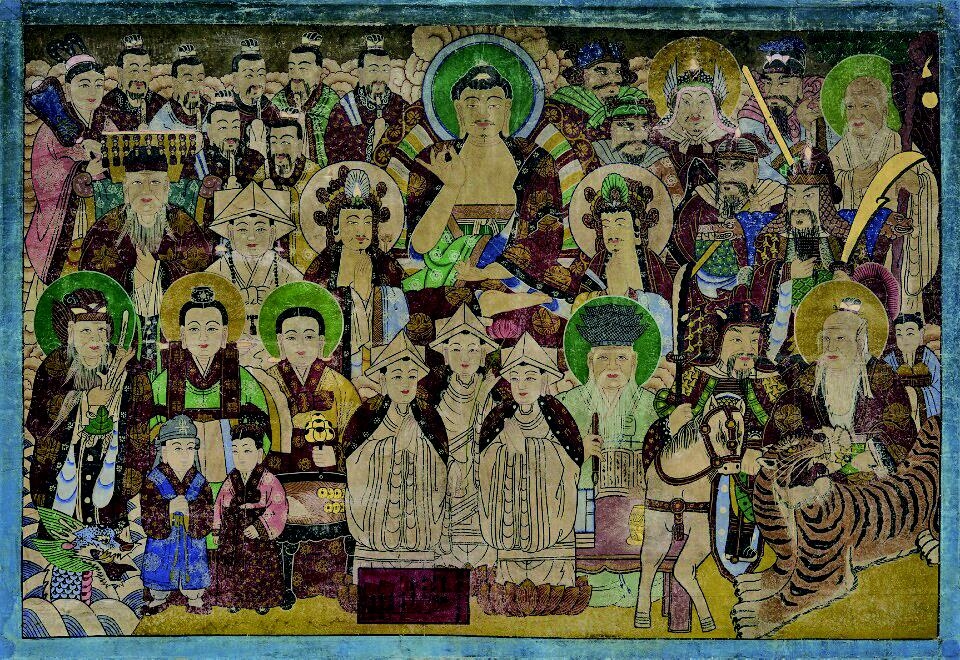
Korean mythology comprises two distinct corpora of literature: the literary mythology recorded in traditional histories such as the Samguk yusa, and the modern oral mythology consisting primarily of shamanic narratives sung by shamans during religious ceremonies. The literary myths are heavily historicized state-foundation myths, while the oral mythology is living sacred truth, far richer in quantity and diversity of themes.
- Field
- Mythology
- Nationality
- Korean
- Known for
- State-foundation myths and shamanic narratives
Lore & Background
Korean mythology is divided into two types: written literary mythology, mostly about founding monarchs of historical kingdoms, and oral mythology, mostly narratives sung by shamans (mansin) in rituals. The literary myths are preserved in Hanja works such as Samguk sagi and Samguk yusa, with the founding myth of Gojoseon by Dangun becoming the founding myth of the whole Korean nation. State-foundation myths are further divided into northern types, where the founder is the son of a celestial male and earthly female, and southern types, where the founder begins as an object descended from heaven and marries an earthly woman.
Reader's Guide
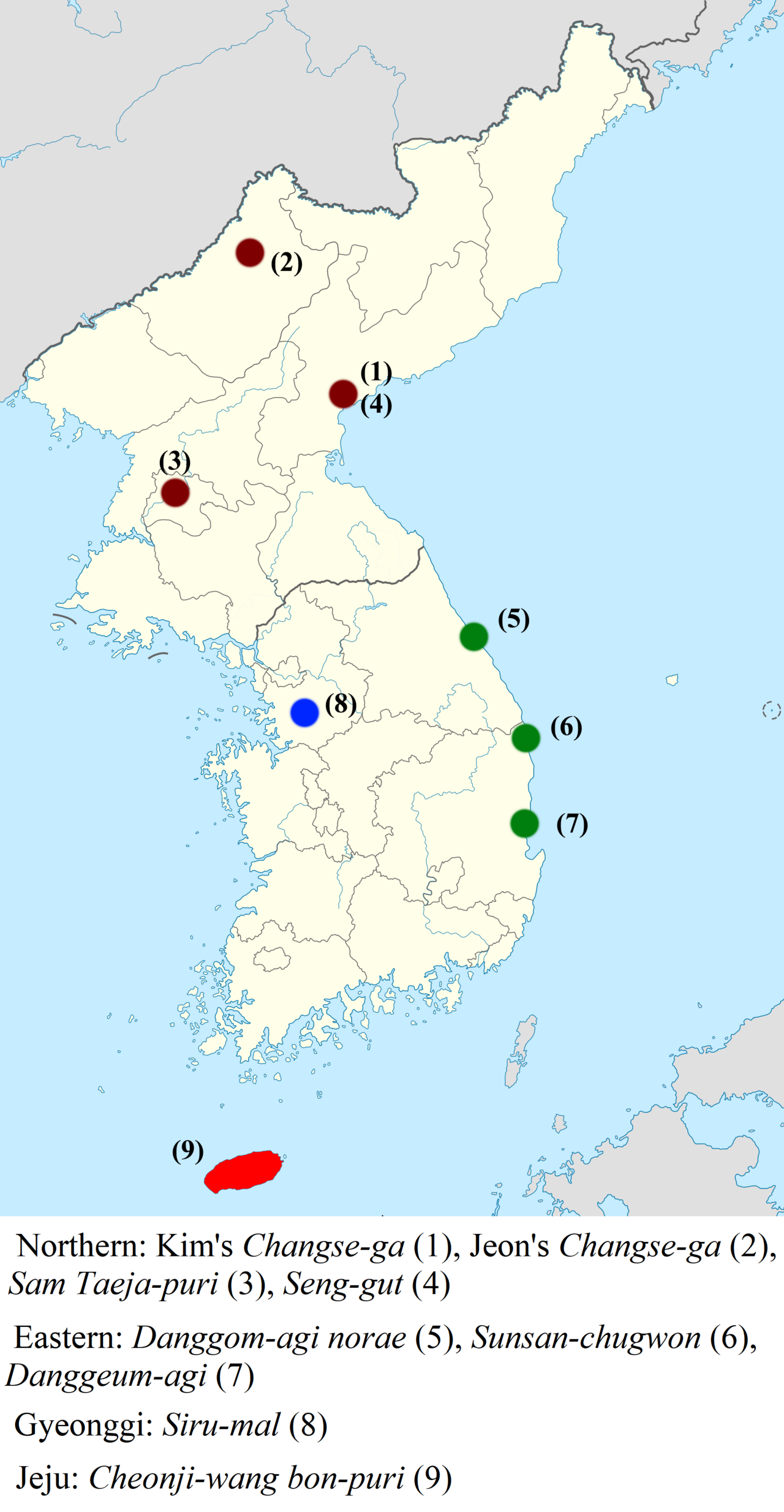
The shamanic mythology is divided into five regional traditions, with Jeju Island especially divergent. Two key narratives are the Jeseok bon-puri, about a girl impregnated by a supernaturally potent Buddhist priest who gives birth to triplet gods, and the Princess Bari, about a princess abandoned by her father who resurrects her parents with the flower of life. The oral mythology is always religious and must be distinguished from secular Korean folklore. Academic study began with literary myths, but research into oral corpus grew from the 1960s, with scholars like Kim Yeol-gyu, Hyeon Yong-jun, and Seo Daeseok. Recent trends include comparisons with neighboring mythologies, village-shrine myths, and feminist interpretations.
Did You Know?
- The shamanic narratives are sung by Korean shamans during gut ceremonies.
- The Princess Bari narrative involves a princess who resurrects her dead parents with the flower of life.
Supernatural Beings in the Korean Imagination
Korean folklore is populated by a rich pantheon of supernatural entities, collectively categorized under Imuldam. The most prominent among these are the Gwisin—spirits, ghosts, and divine presences that occupy a spectrum between deity and departed soul—and the Dokkaebi, often loosely translated as "Korean goblins." Unlike their European counterparts, Dokkaebi carry no inherent evil or demonic nature. Instead, they are powerful beings whose interactions with humans range from playful mischief to outright annoyance, bringing both delight and hardship into everyday life. Their presence is understood as woven into the fabric of human experience, a source of both pleasure and difficulty. These creatures populate stories told and retold across generations, forming a shared imaginative vocabulary for communities grappling with the mysteries of existence. The diversity of these beings reflects the layered religious and philosophical traditions—shamanic, Confucian, Buddhist, and even Christian—that have shaped Korean storytelling over millennia.
Sacred Spaces: Household and Village Deities
In Korean folk religion, the home is far more than a physical structure; it is a sacred space saturated with ancestral memory and divine presence. Every corner of a dwelling is believed to house a guardian deity: one god oversees the household and channels wealth, while a goddess in the master bedroom assists with childbirth and protects young children. These benevolent spirits stand in opposition to malevolent forces that lurk beyond the walls, and a whole set of customs—hanging thorn branches at gates, stretching ritual strings across thresholds—exists to keep those outside spirits at bay. The household cult naturally extends outward into the village, which functions as an enlarged family unit. Each village typically venerates a single principal god, often accompanied by a Jangseung totem pole or smaller subordinate deities. Village rituals, including communal farming ceremonies, can occasionally expand beyond a single settlement, binding neighboring communities together in shared worship. Korean shamans serve as the ritual specialists who mediate between these domestic and communal divine worlds.
Oral Tradition and the Princess Bari Narrative
For most of its history, Korean folk literature existed in the spoken word—shamanic songs, myths, and tales passed from voice to voice long before written records appeared. Fragmentary written traces date to the fifth century, but the first complete preserved stories emerged in the twelfth and thirteenth centuries through the Buddhist priest Iryeon's compendium, the Samguk yusa. Among the most celebrated of these narratives is the tale of Princess Bari, a shamanic song recited exclusively in funeral ceremonies. The story follows a Korean princess, the seventh daughter of a childless king's son, who is abandoned by her parents. When they later fall gravely ill, the only remedy is a medicinal water found in the Western Heaven. While her sisters refuse, the exiled princess journeys to the afterlife, marries its guardian, and bears him sons. She returns at her parents' funeral, revives them with resurrection flowers, and heals them with the sacred water, ultimately becoming a deity who bridges the living and the dead. Scholars note that the tale subtly inverts Confucian patriarchy and age hierarchy: it is the youngest daughter, not the eldest son, who fulfills the supreme duty of filial piety.
Synthesis of Beliefs and Social Cohesion
Korean folk religion is not a single, static system but a living synthesis. Rooted in indigenous shamanism, it absorbed and was absorbed by Buddhism, Confucianism, and more recently Christianity, producing a layered spiritual landscape. This blending is especially visible in the complementary relationship between shamanism and Confucianism: shamanic rituals addressed abnormal crises—releasing the rancor of bitter souls, expelling bad luck from a household—while Confucian practice governed the rhythms of everyday social order. Shamanism, long viewed with suspicion by adherents of other faiths, gradually adopted the organizational forms of Buddhism and Confucianism, and those traditions in turn incorporated shamanic elements. Beyond theology, these traditions served a profound social function. Folk customs, developed largely in rural villages, reinforced family bonds and communal solidarity. The performance of folk tales was not a passive spectacle; performers actively drew audiences into participation, turning storytelling into a collective act. Though many practices have modernized or faded, folklore remains deeply embedded in Korean life, continuing to shape religion, art, literature, and custom.
Gallery
Frequently Asked Questions
What is Korean mythology?
Korean mythology is not a single story but a dual corpus: literary state-foundation myths preserved in historical texts, and living oral traditions sung by shamans during religious ceremonies. Together they form the deepest layer of Korean cultural memory, bridging ancient cosmology and ongoing spiritual practice.
What are the two main corpora of Korean mythology?
The literary corpus, found in traditional histories such as the Samguk yusa, frames myths as historicized accounts of how the Korean states were founded. The oral corpus consists of shamanic narratives performed by mudang during rituals, and it is far richer in both volume and thematic diversity.
Where do Korean literary myths come from?
They are recorded primarily in traditional historical texts, with the Samguk yusa being the most well-known source. These narratives were deliberately shaped to serve as state-foundation stories, grounding political legitimacy in sacred origins.
How is shamanic oral mythology different from the literary myths?
Where the literary myths were edited and historicized for state purposes, shamanic narratives are treated by their practitioners as living sacred truth rather than history. They are performed vocally during ceremonies and cover a much wider range of themes and story types.
Why is Korean mythology important to Korean culture?
It supplies the foundational narratives for both political legitimacy through state-foundation myths and spiritual practice through shamanic ritual. The two corpora together represent a continuous thread of Korean identity stretching from ancient cosmological beliefs to living religious tradition.
More in Korean folklore 1-24
Spotted an error? Know more?
Reader corrections go straight into our review queue. Suggest an edit · How this site is sourced