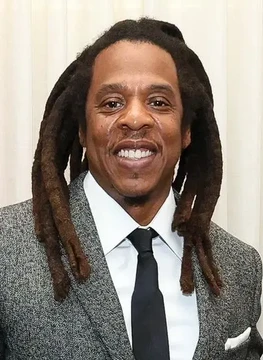
Timbaland
The architect who built Jay-Z a spaceship and called it a beat.

Timbaland—born Timothy Zachary Mosley in Norfolk, Virginia—is one of the most architecturally influential producers in modern hip-hop and R&B. Fans of the Roc-A-Fella catalog recognize Timbaland's fingerprints as the moments where the beat stops sounding like New York and starts sounding like a spaceship docking in a church. He is the collaborator who proved that Jay-Z's voice could float over a beat that had no traditional snare, no conventional kick pattern, and yet still made the whole room move.
Quick Facts
- Birth Name
- Timothy Zachery Mosley
- Birth Date
- 10 March 1972
- Birth Place
- Norfolk, Virginia, U.S.
- Other Names
- DJ Timmy Tim / Timbo / Timar / Emperor of Sound / Mozart Timadeas
- Occupation
- Record producer / rapper / singer / songwriter
- Years Active
- 1994–present
- Children
- 3
- Relatives
- Pharrell Williams (cousin)
- Works
- Discography · production
- Awards
- Full list
Facts from the source article.
Lore & Background
Timbaland's production language emerged from the Virginia scene in the mid-nineties, where he and his production partner Mag were flipping samples into something that felt less like hip-hop and more like a fever dream scored for a film that hadn't been made yet. His early work with Aaliyah and Missy Elliott established a template: take a vocal phrase, slice it into fragments, re-sequence it as a melodic hook, then build a skeletal drum pattern underneath that leaves enormous negative space. The effect is hypnotic, almost ceremonial, as if the beat is a ritual and the listener is the congregation. When that aesthetic entered the Jay-Z orbit, it created a fascinating tension. Jay-Z's identity was built on the concrete: the Bronx, the block, the pen, the punchline. Timbaland's identity was built on the abstract: the waveform, the frequency, the space between notes. Their intersection produced tracks where the lyricist sounds like he's narrating a heist while the beat sounds like it's narrating a dream. That duality—grounded and weightless simultaneously—became a signature of the early-2000s Roc-A-Fella sound, distinguishing it from both the gritty East Coast tradition and the polished West Coast G-funk lineage. In the broader culture, Timbaland's influence radiated outward. Producers who followed him absorbed his vocabulary of vocal manipulation, his willingness to let a beat breathe in silence, his insistence that a hi-hat could carry more emotion than a full drum break. He didn't just make records; he expanded the grammar of what a hip-hop beat could be, and Jay-Z's canvas was one of the most visible surfaces on which that new grammar was written.
Reader's Guide
The most defining Timbaland–Jay-Z moment lives in the early-2000s Roc-A-Fella catalog, where Timbaland's production handed Jay-Z a beat that refused to behave like a traditional hip-hop track. No four-on-the-floor. No predictable snare. Just a skeletal pulse, a chopped vocal ghost, and enough empty space for Jay-Z's cadence to become the rhythm section itself. The pairing mattered because it proved that the pen and the board could be equals: Jay-Z wasn't just riding a beat, he was completing it. Their intersection wasn't a long-term production deal so much as a series of creative conversations—Timbaland in the booth shaping the sonic architecture, Jay-Z filling the architecture with narrative weight. The cultural significance is that it expanded what fans expected from a 'Jay-Z track.' Listeners accustomed to the boom-bap thud or the swing-era bounce suddenly heard a record that felt like it was being assembled in real time, like watching a watchmaker snap gears into place. Why the pairing endures in fan memory: it represents the moment the Roc-A-Fella sound stopped being purely New York and started being a frequency. Timbaland brought the future; Jay-Z brought the present. Together they made the present sound inevitable.
Did You Know?
- Timbaland is a multi-instrumentalist who plays guitar, bass, and various keyboards, often sketching a track's melodic framework on guitar before touching a drum machine.
- His production style—built on vocal manipulation, sparse percussion, and negative space—became a foundational reference point for an entire generation of hip-hop and R&B producers in the 2000s.
- Timbaland and his production partner Mag were part of the Virginia scene that helped bridge the gap between late-90s R&B and the hip-hop production of the early 2000s.
- His work with Aaliyah and Missy Elliott in the late 1990s is widely cited as the template for the 'flip' era of production, where a sample is deconstructed and reassembled into something unrecognizable yet melodic.
More in Band Members & Collaborators
Elsewhere in Jay-Z
Spotted an error? Know more?
Reader corrections go straight into our review queue. Suggest an edit · How this site is sourced