Akita Prefecture
A northern Japanese prefecture known for rice, sake, and depopulation.

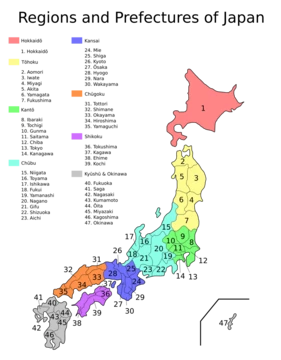
Akita Prefecture (秋田県, Akita-ken) sits in the Tōhoku region of Honshu, Japan. As of August 1, 2023, its population was estimated at 915,691, spread across 11,637 square kilometers (4,493 sq mi). It touches Aomori Prefecture to the north, Iwate to the east, Miyagi to the southeast, and Yamagata to the south. The capital and biggest city is Akita; other major urban centers include Yokote, Daisen, and Yurihonjō. The prefecture runs along the Sea of Japan coast and stretches east to the Ōu Mountains—Japan’s longest mountain range—which mark the border with Iwate. Historically, Akita made up the northern half of Dewa Province, with Yamagata forming the southern part.
The area now called Akita was carved from the ancient provinces of Dewa and Mutsu. For centuries, it stayed largely cut off from mainstream Japanese society, separated by hundreds of kilometers and the Ōu and Dewa mountain ranges. Before the year 600, the region was home to hunter-gatherers and mostly nomadic tribes. The first written mention of the area comes from 658, when Abe no Hirafu, governor of Koshi Province, subdued the native Ezo tribes near what are now Akita and Noshiro cities. He built a fort on the Mogami River, kickstarting Japanese settlement. In 733, a new military post—later called Akita Castle—went up in what is now the Takashimizu district of Akita, along with more permanent roads and buildings. The region served as a base for the Japanese empire as it pushed the Ezo people out of northern Honshu.
Control of the area changed hands several times. Under the Tokugawa shogunate, it was given to the Satake clan, who ruled for 260 years and built up the agriculture and mining industries that still dominate today. During that period, it remained part of Dewa Province. In 1871, during the Meiji Restoration, Dewa Province was reorganized, the old daimyō domains were abolished, and the modern borders of Akita were set. The famous Heian-era poet Ono no Komachi is said to have been born in Yuzawa City, in the Ogachi Town area of the prefecture’s southeast.
Geographically, Akita sits on the northwestern side of Honshu, with the Sea of Japan to the west. Its borders form a rough rectangle, 169 kilometers from north to south and 86 kilometers from west to east. The Oga Peninsula juts out prominently on the western coast, while the Ōu Mountains mark the eastern edge and the higher Dewa Mountains run parallel through the middle. Winters are cold, especially away from the sea, as is typical for much of northern Japan. As of March 31, 2019, 11% of the prefecture’s land was designated as Natural Parks: Towada-Hachimantai National Park; Chōkai, Kurikoma, and Oga Quasi-National Parks; and eight prefectural natural parks—Akita Shirakami, Hachimori Iwadate, Kimimachizaka, Magi Mahiru, Moriyoshizan, Taiheizan, Tashirodake, and Tazawako Dakigaeri.
Thirteen cities lie within Akita Prefecture, along with numerous towns and villages organized into districts. A list of mergers and governors since 1947 is also recorded.
Like much of Tōhoku, Akita’s economy still leans on traditional industries like farming, fishing, and forestry. This has pushed many young people to move to Tokyo and other big cities. Akita is one of four prefectures in Japan that has seen population declines since 1955, and it has the lowest percentage of children (under 15) in the country—9.3% in 2022, down from 11.2% in 2010. Meanwhile, 38.6% of residents are 65 or older, the highest share of any Japanese prefecture. As of October 1, 2022, the estimated population was 944,902. This depopulation has driven smaller communities to merge, and as numbers keep falling, schools and health facilities have closed in some areas, pushing families toward larger cities for better services and perpetuating the downward spiral. The combination of decline and an aging population has raised serious concerns for rural communities.
Culturally, Akita—whose name means “autumn rice paddy”—is known for rice farming and its sake breweries. It has the highest sake consumption in Japan and is thought to be the birthplace of the Akita dog breed, which shares the prefecture’s name. The region’s women, called Akita Bijin (“Beauties of Akita”), are famous for their fair skin, round faces, and high voices—traits long considered desirable. Ono no Komachi is a classic example of an Akita bijin.
Local food specialties include kiritanpo nabe, gakko, Akita komachi rice, and sake.
Sports teams based in the prefecture include the Akita Bank Red Arrows (women’s basketball), Akita Northern Bullets (rugby union), Akita Northern Happinets (men’s basketball), Blaublitz Akita (association football), and Prestige International Aranmare Akita (women’s basketball).
Recent efforts have focused on revitalizing rural communities hit by depopulation.
- Population (2023)
- 915,691
- Area
- 11,637 km² (4,493 sq mi)
- Capital
- Akita
- Region
- Tōhoku, Honshu, Japan
- Known for
- Rice farming, sake, Akita dog, Akita Bijin
Verified Timeline
Lore & Background
The region of Akita was created from the ancient provinces of Dewa and Mutsu. Separated from the principal Japanese centres of commerce, politics, and population by several hundred kilometres and by the Ōu and Dewa mountain ranges to the east, Akita remained largely isolated from Japanese society until after the year 600. Akita was a region of hunter-gatherers and principally nomadic tribes. The first historical record of what is now Akita Prefecture dates to 658, when Abe no Hirafu conquered the native Ezo tribes at what are now the cities of Akita and Noshiro. Abe, then governor of Koshi Province (the northwestern part of Honshū bordering the Sea of Japan), established a fort on the Mogami River, and thus began the Japanese settlement of the region. In 733, a new military settlement (later renamed Akita Castle) was built in what is now the Takashimizu area of Akita, and more permanent roads and structures were developed. The region was used as a base of operations for the Japanese empire as it drove the native Ezo people from northern Honshū. Governance of the region shifted hands several times. During the Tokugawa shogunate it was appropriated to the Satake clan, who ruled the region for 260 years and developed the agriculture and mining industries that are still predominant today. Throughout this period, it was classified as part of Dewa Province. In 1871, during the Meiji Restoration, Dewa Province was reshaped and the old daimyō domains were abolished and administratively reconstructed, resulting in the modern-day borders of Akita. The famous Heian period waka poet, Ono no Komachi, is said to have been born in Yuzawa City, Ogachi Town, located in the southeast of the prefecture.
Reader's Guide
Akita Prefecture's significance lies in its role as a frontier region in Japanese history, its traditional economy, and its demographic challenges. Like much of the Tōhoku Region, Akita's economy remains dominated by traditional industries such as agriculture, fishing, and forestry. This has led many young people to migrate to Tokyo and other large cities. Akita Prefecture has seen some of the most severe population decline in Japan: it is one of four prefectures in Japan registering declines in population since 1955. Its population also has the lowest percentage of children (defined as under the age of 15), at 9.3% in 2022, down from 11.2% in 2010. 38.6% of residents are 65 or older, the highest percentage of any Japanese prefecture. As of October 1, 2022, it has an estimated population of 944,902 people. The high rate of depopulation in Akita Prefecture has led smaller communities to merge with each other, which has affected the smallest of these merged communities. As depopulation in these communities continues, educational and health facilities have closed in some areas, encouraging families to migrate to larger cities for better access to health and educational opportunities and perpetuating the decline in population. Culturally, Akita is famous for rice farming and its sake breweries. It is well known for having the highest consumption of sake in Japan and is thought to be the origin of the Akita breed of dog which carries the prefecture's name. The women of the region, referred to as Akita Bijin (秋田美人, 'Beauties of Akita'), have also gained widespread renown for their white skin, rounded faces and high voices, all of which are considered highly desirable. Ono no Komachi is a famous example of an Akita bijin. Tourism efforts focus on green tourism and agritourism, advertising its pristine forests, sprawling rice fields, and range of cultures. The Namahage ritual in Oga on New Year's Eve draws a large number of tourists to Akita Prefecture every year. Near Lake Tazawa, there are a number of hot springs resorts (onsen). Famous festivals include the Akita Kantō, the Omagari Fireworks, Namahage Festival, and the Yokote Kamakura Festivals.
Did You Know?
- Akita Prefecture has the highest percentage of residents aged 65 or older (38.6%) and the lowest percentage of children under 15 (9.3%) of any Japanese prefecture as of 2022.
- Akita is one of only four prefectures in Japan that has registered a continuous population decline since 1955.
- The first historical record of Akita dates to 658, when Abe no Hirafu conquered the native Ezo tribes at what are now the cities of Akita and Noshiro.
- Akita Prefecture has the highest consumption of sake in Japan.
- The famous Heian period waka poet Ono no Komachi is said to have been born in Yuzawa City, Ogachi Town, in the southeast of the prefecture.
A Land Shaped by Distance and Conquest
For centuries, the territory that would become Akita Prefecture sat apart from the political and commercial heart of Japan, walled off by the Ōu and Dewa mountain ranges and separated by several hundred kilometres from the nation's centres of power. Before the seventh century, the land was home to nomadic hunter-gatherer tribes with little recorded contact to the wider Japanese world. The first documented Japanese incursion came in 658, when Abe no Hirafu, governor of Koshi Province, defeated the native Ezo tribes at what are now the cities of Akita and Noshiro and raised a fort along the Mogami River. A more permanent military settlement followed in 733 in what is now the Takashimizu area of Akita, later becoming Akita Castle, and the region served as a staging ground for the imperial push against the Ezo from northern Honshū. Governance changed hands repeatedly over the centuries, but the Satake clan's two-hundred-and-sixty-year tenure under the Tokugawa shogunate proved the most consequential, laying the agricultural and mining foundations that still anchor the local economy. The modern prefectural borders were finally drawn in 1871, when the Meiji government dismantled the old daimyō domains and reorganised the former Dewa Province into the administrative unit we recognise today.
Between Sea and Summit
Akita Prefecture occupies a roughly rectangular stretch of north-western Honshu, measuring approximately 169 kilometres from its northern tip to its southern border and 86 kilometres from the Sea of Japan coast to the eastern ridge. The western edge is punctuated by the dramatic Oga Peninsula, jutting into the cold waters of the Sea of Japan, while the eastern boundary is defined by the Ōu Mountains, the longest continuous range in the country. Running parallel through the centre, the higher Dewa Mountains create a layered topography that channels cold continental air deep into the interior, producing winters that grow increasingly severe the farther one travels from the sea. Despite its modest size, the prefecture is remarkably rich in protected landscapes: as of 31 March 2019, 11% of the total land area of the prefecture is designated as Natural Parks, namely the Towada-Hachimantai National Park; Chōkai, Kurikoma, and Oga Quasi-National Parks; and Akita Shirakami, Hachimori Iwadate, Kimimachizaka, Magi Mahiru, Moriyoshizan, Taiheizan, Tashirodake, and Tazawako Dakigaeri Prefectural Natural Parks. This concentration of wilderness, combined with the prefecture's position between open sea and towering peaks, gives Akita a landscape diversity that belies its compact footprint.
The Long Emptying
Akita Prefecture faces one of the most acute demographic challenges in all of Japan. It is among only four prefectures in the country that have registered a continuous population decline since 1955, and the trend has accelerated in recent decades. The root cause is economic: the local economy remains anchored in traditional agriculture, fishing, and forestry, industries that offer limited opportunity for young workers, who increasingly leave for Tokyo and other large cities. The result is a population structure that skews dramatically toward old age. As of 2022, 38.6 percent of residents were sixty-five or older, the highest such share of any Japanese prefecture, while the proportion of children under fifteen had fallen to just 9.3 percent, down from 11.2 percent in 2010. The practical consequences are visible in rural communities: as populations shrink, smaller municipalities have been forced to merge, and schools, clinics, and other essential services have closed in the thinnest-settled areas. Those closures, in turn, push remaining families toward larger cities, creating a self-reinforcing cycle of depopulation that has made the prefecture's future a matter of genuine concern for its residents and policymakers alike.
Rice, Sake, and the Beauty of the North
The very name Akita translates to 'autumn rice paddy,' a nod to the region's deep agricultural identity. The prefecture is renowned for its rice farming and for producing the highest per-capita sake consumption in Japan, with local breweries playing a central role in community life. Its culinary heritage includes distinctive dishes such as Kiritanpo Nabe and Gakko. Beyond the table, Akita is thought to be the origin of the Akita breed of dog which carries the prefecture's name. The region is also celebrated for its women, known as Akita Bijin (秋田美人, 'Beauties of Akita'), whose white skin, rounded faces and high voices have earned them a long-standing reputation in Japanese culture; the legendary Heian-era poet Ono no Komachi is said to have been born in Yuzawa City, Ogachi Town, located in the southeast of the prefecture. In recent years, local authorities have leaned into this cultural richness to counter depopulation, promoting green tourism and agritourism, home-stay programmes, farmers' markets for locally produced foods, and the integration of outsiders into local cultural practices. The famous Namahage ritual in Oga on New Year's Eve draws a large number of tourists to Akita Prefecture every year, and festivals like the Akita Kantō, the Omagari Fireworks, and the Yokote Kamakura Festivals offer a glimpse of rural or traditional Japan.
Frequently Asked Questions
Who is Akita Prefecture?
Akita Prefecture is a northern Honshu province in Japan's Tōhoku region, with the city of Akita serving as both its administrative seat and most populous municipality. It is bordered by Aomori to the north, Iwate to the east, and Yamagata to the south.
What are Akita Prefecture's signature abilities?
The prefecture is best recognized for its rice cultivation, its long tradition of sake brewing, and as the birthplace of the Akita dog breed. It also carries a cultural reputation for its 'Akita Bijin' and a strong regional identity.
What is Akita Prefecture's central conflict?
Akita's ongoing narrative struggle is severe and accelerating population loss, which has left many rural communities struggling to maintain basic services. As of 2023 its total population stands at roughly 915,000, a figure that continues to shrink year over year.
What is Akita Prefecture's backstory?
For centuries the region was largely cut off from the broader Japanese polity, only becoming meaningfully integrated after around 600 AD. It then served as a frontier base for the Yamato state's campaigns against the indigenous Ezo peoples of the north.
Why does Akita Prefecture matter in the larger Tōhoku story?
At roughly 11,637 km² it is one of the more spacious provinces in the region, and its agricultural output—especially rice and sake—has shaped northern Japan's food culture for generations. Its cultural exports, like the Akita dog, also give it a national profile well beyond its modest population.
More in Japanese Prefectures 1-24
Spotted an error? Know more?
This is a living reference — every entry is fact-audited, and reader corrections feed straight into our audit queue. Suggest an edit · See this site's audit record