Saga Prefecture
A Kyushu prefecture known for ceramics and porcelain production.

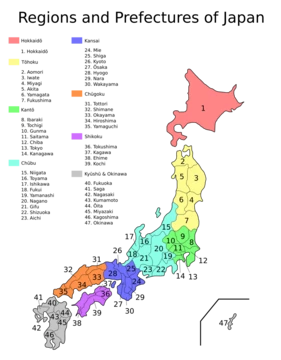
Saga Prefecture (佐賀県, Saga-ken) is a prefecture on the island of Kyushu, Japan. With a population of about 780,000 and an area of 2,439 square kilometers (942 sq mi), it is bordered by Fukuoka Prefecture to the northeast and Nagasaki Prefecture to the southwest. The capital and largest city is Saga, while other major cities include Karatsu, Tosu, and Imari. The prefecture occupies a narrow, isthmus-like stretch in northwestern Kyushu, sandwiched between the Sea of Japan and the Ariake Sea. Its western region is famous for ceramics and porcelain, especially in the towns of Karatsu, Imari, and Arita.
In ancient times, the area now comprising Saga and Nagasaki Prefectures was known as Hizen Province. The name "Saga" dates from the Meiji Restoration. Rice farming has thrived here since antiquity, with evidence found at the Nabatake ruins in Karatsu and the Yoshinogari site in Yoshinogari.
During the Kamakura and Muromachi periods, over 100 feudal clans are thought to have existed in the region. A powerful samurai clan called the Matsuratō operated along the Genkai Sea. In the Sengoku period, the Ryūzōji clan expanded to control all of Hizen and Chikugo Provinces, plus parts of Higo and Chikuzen. After daimyō Ryūzōji Takanobu died, Nabeshima Naoshige took charge, and by 1607 the entire Ryūzōji domain was under the Nabeshima clan. In the Edo period, the area was called Saga Domain (Saga-han), which included three sub-domains: Hasunoike, Ogi, and Kashima. Also within today’s prefectural borders were Karatsu Domain and two territories of the Tsushima-Fuchū Domain. The Nabeshima clan, its illegitimate branches, and former Ryūzōji members ruled Saga Domain and its sub-domains, keeping the region relatively stable. However, the cost of defending Nagasaki rose, and financial troubles worsened due to the Kyōhō famine and the 1828 Siebold Typhoon. Reclaimed land from the Ariake Sea greatly increased arable acreage, and by the 1840s Saga Domain’s annual koku reached about 670,000—double that of 200 years earlier. Around the mid-19th century, Naomasa Nabeshima worked to fix finances, reduce officials, and promote local industries like Arita porcelain, green tea, and coal. Proximity to the international port of Nagasaki also brought foreign technologies, such as reverberatory furnaces and steam locomotive models. After the Boshin War, many from Saga Domain aided the Meiji Restoration. In the Meiji era, coal mines in Kishima and Higashimatsuura districts modernized, boosted by railroad construction.
Key events in Saga’s timeline include: the Nabatake ruins (estimated 6th century BC, end of Jōmon period); the Yoshinogari site (1st century BC, middle Yayoi period); Kii Castle’s defenses for Dazaifu after the Battle of Baekgang (665); the Hizen Fudoki (733); the Mongol invasions (Bun’ei in 1274, Kōan in 1281); Nagoya Castle’s construction (1591) and fall (1598); Karatsu Castle and Saga Castle (1602); Nabeshima clan control of Saga Domain (1607); the Nijinomatsubara Uprising (1771); the Kōdōkan school (1781); the Siebold typhoon’s devastation (1828, over 10,000 deaths); the abolition of the han system (1871); the merger into Imari Prefecture (1871); renaming to Saga Prefecture (1872); the Saga Rebellion (1874); incorporation into Mizuma Prefecture (1876); transfers to Nagasaki Prefecture (1876); Mizuma’s abolition and absorption into Nagasaki (1876); Saga’s re-establishment as an independent prefecture (1883); the founding of Saga city (1889); the Kyushu Railroad Nagasaki Line opening from Tosu to Saga (1891); rail extensions to Takeo (1895), Haiki (1897), and Nishi-Karatsu (1903); Karatsu’s founding as a city (1932); the Japanese National Railways Saga Line (1935); the Great Showa Merger forming Tosu, Imari, Takeo, Kashima, and Taku (1954, leaving 7 cities, 8 districts, 18 towns, 35 villages); closure of all coal mines (1972, last being Nishiki); the Genkai Nuclear Power Plant (1975); the Saga Line’s closure (1987); the Yoshinogari History Park (1992); Saga Airport (1998); and the Great Heisei Merger reorganizing municipalities in 2005 (Karatsu and Shiroishi; Ogi and Miyaki; Saga) and 2006 (Karatsu and Ureshino; Takeo, Yoshinogari, and Arita; and further mergers on March 20).
- Capital
- Saga
- Population
- Roughly 780,000
- Area
- 2,439 square kilometres (942 sq mi)
- Region
- Kyushu, Japan
- Known for
- Ceramics and porcelain production, rice farming, Meiji Restoration contributions
Verified Timeline
Quick Facts
- Native Name
- ja · 佐賀県
- Settlement Type
- Prefecture
- Translit Lang1
- Japanese
- Translit Lang1 Type1
- Rōmaji
- Translit Lang1 Info1
- ja-Latn · Saga-ken
- Flag Size
- 100px
- Seal Size
- 80px
- Blank Emblem Type
- Emblem
- Subdivision Type
- Country
- Subdivision Name
- Japan
- Subdivision Type1
- Region
- Subdivision Name1
- Kyushu
Facts from the source article.
Lore & Background
In ancient times, the area composed by Nagasaki Prefecture and Saga Prefecture was called Hizen Province. Rice farming culture has prospered here since ancient times, and vestiges can be seen at the ruins of Nabatake in Karatsu and the Yoshinogari site in Yoshinogari. From the Kamakura period to the Muromachi period, it is thought that over 100 feudal clans existed. Also exerting great influence during this time was a samurai clan operating along the Genkai Sea called the Matsuratō. Upon entering the Sengoku period, the Ryūzōji clan expanded their control to include all of Hizen and Chikugo Provinces, and part of Higo and Chikuzen Provinces. After the death of daimyō Ryūzōji Takanobu, Nabeshima Naoshige took control of the political situation, and by 1607 all of the Ryūzōji clan's domain was under the control of the Nabeshima clan. In the Edo period this area was called the Saga Domain (佐賀藩 Saga-han), and it included three sub-domains: the Hasunoike, Ogi and Kashima Domains. Saga Domain and its sub-domains continued to be ruled by the Nabeshima clan, its various illegitimate family lineages and members of the former Ryūzōji clan, and politically the area was relatively stable. The cost of defending Nagasaki was increasing and, difficult from the start, the financial situation was worsened by the great Kyōhō famine and the Siebold Typhoon of 1828. Due to the large area of reclaimed land from the Ariake Sea, arable land was increased significantly and by the 1840s the annual koku of Saga Domain increased to about 670,000, twice that of 200 years before. Around the middle of the 19th century, Naomasa Nabeshima strove to set right the domain's financial affairs, reduce the number of government officials, and encourage local industry such as Arita porcelain, green tea, and coal. Also, thanks to the proximity of the international port of Nagasaki, new technologies were introduced from overseas, such as the reverberatory furnace and models of steam locomotives. After the Boshin War, many people from Saga Domain assisted in the Meiji Restoration.
Reader's Guide
Saga Prefecture's significance lies in its historical role as a center of ceramic production and its contributions to Japan's modernization. The region's ceramics, especially from Karatsu, Imari, and Arita, have been renowned for centuries. During the Edo period, Saga Domain achieved agricultural expansion through land reclamation from the Ariake Sea, doubling its annual koku output to about 670,000 by the 1840s. The domain's proximity to Nagasaki allowed early adoption of Western technology, including reverberatory furnaces and steam locomotives, which influenced Japan's industrial development. After the Meiji Restoration, Saga Prefecture was established in 1883 after several administrative changes, including being merged into Mizuma Prefecture and then Nagasaki Prefecture before being re-established. The prefecture's legacy includes the Yoshinogari History Park, which opened to the public in 1992 preserving Yayoi period village remains, and the Genkai Nuclear Power Plant, which began operation in 1975. Today, Saga remains largely rural, with agricultural and forested lands comprising over 68% of its total prefectural land area, and it continues to be known for its traditional crafts and historical sites.
Did You Know?
- The Siebold Typhoon of 1828 caused heavy damage in Saga, with deaths estimated at over 10,000.
- By the 1840s, the annual koku of Saga Domain had increased to about 670,000, twice that of 200 years before, due to reclaimed land from the Ariake Sea.
- The Yoshinogari History Park, which opened in 1992, preserves village remains from the Yayoi period (1st century BC).
- Saga Prefecture was re-established as an independent prefecture in 1883, after being merged into Mizuma Prefecture and then Nagasaki Prefecture.
- The Genkai Nuclear Power Plant began operation in 1975.
Frequently Asked Questions
Who is Saga Prefecture?
Saga is a small prefecture on the northwestern coast of Kyushu, governed from its capital city of Saga. It is home to roughly 780,000 residents spread across 2,439 square kilometres.
What are Saga Prefecture's powers or role?
Its most celebrated ability is ceramics: the towns of Karatsu, Imari, and Arita have produced world-renowned porcelain for centuries. It also plays a supporting role in Kyushu's rice agriculture.
How does Saga Prefecture's story end?
As a living, ongoing prefecture it has no fixed ending, but its modern arc centres on preserving its ceramic-craft heritage while sustaining a modest, stable population of around 780,000.
Why is Saga Prefecture important to the broader narrative?
It served as a key staging ground during the Meiji Restoration, giving it outsized historical weight despite its small footprint. Its porcelain traditions also shaped Japan's global trade identity for generations.
What is Saga Prefecture's territory like?
It occupies 2,439 square kilometres (about 942 sq mi) along the northwestern tip of Kyushu, making it one of the smaller prefectures in that region.
More in Japanese Prefectures 1-24
Spotted an error? Know more?
This is a living reference — every entry is fact-audited, and reader corrections feed straight into our audit queue. Suggest an edit · See this site's audit record