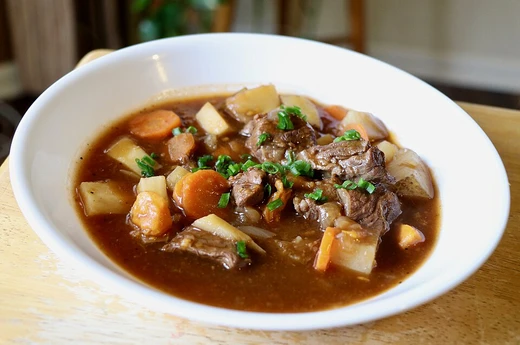
Coddle
An Irish dish of sausages, bacon, and potatoes.

Coddle, also called Dublin coddle (Irish: cadal), is an Irish dish traditionally prepared to repurpose leftovers. It typically features layers of roughly sliced pork sausages and rashers (thin, fatty back bacon) alongside chunky potatoes, sliced onion, salt, pepper, and herbs. Barley is a traditional optional ingredient. The dish is braised in the stock created by boiling the bacon and sausages, and it is cooked in a pot with a tight-fitting lid to steam any ingredients not fully submerged in the broth. Seasoning is usually limited to salt, pepper, and sometimes parsley.
The name derives from the verb "coddle," meaning to cook food in water below the boiling point (as in a coddled egg). This verb comes from "caudle," which traces back to a French term meaning "to boil gently, parboil, or stew."
Coddle is strongly associated with Dublin, Ireland's capital. It was reportedly a favorite dish of writers Seán O'Casey and Jonathan Swift, and appears in several references to Dublin, including the works of James Joyce. Because the dish is seen as uniquely Dublin and often looks unappetizing to newcomers, many Dubliners are defensive of it. Like other controversial national dishes—such as casu martzu, escargot, or hákarl—enthusiasts take pride in the revulsion of the uninitiated. In particular, many coddle fans consider browning the sausages beforehand an unacceptable shortcut.
Quick Facts
- Country
- Ireland
- Region
- Dublin
- Course
- Main course
- Main Ingredient
- Potatoes, pork sausage, rashers, onion
Facts from the source article.
Lore & Background
Coddle is particularly associated with Dublin, the capital of Ireland. It was reputedly a favourite dish of the writers Seán O'Casey and Jonathan Swift, and it appears in several references to Dublin, including the works of James Joyce. The name comes from the verb coddle, meaning to cook food in water below boiling, which in turn derives from caudle, from the French term meaning 'to boil gently, parboil or stew'.
Reader's Guide
Coddle holds significance in Irish popular culture as a dish particularly associated with Dublin. Because of its unappetising appearance to those who have not seen it before, many Dubliners are defensive of the dish. As with other controversial national dishes such as casu martzu, escargot or hákarl, enthusiasts take the revulsion of the uninitiated as a point of pride—in particular, many coddle enthusiasts see browning the sausages as an unacceptable cop-out. The dish is traditionally eaten with bread, and sometimes raw sliced or diced potato is added. Its legacy is tied to its working-class origins as a way to use leftovers, and its literary connections to notable Dublin writers.
Did You Know?
- Coddle is sometimes called Dublin coddle (Irish: cadal).
- Many coddle enthusiasts consider browning the sausages an unacceptable cop-out.
Composition & The Art of the Pot
Coddle is fundamentally a dish of resourcefulness, traditionally assembled to make use of whatever leftovers a household had on hand. The classic construction layers roughly sliced pork sausages alongside rashers—thinly cut, somewhat fatty slices of back bacon—over chunky potatoes and sliced onion. A handful of herbs, salt, and pepper round out the seasoning, and on occasion a measure of barley finds its way into the pot. The cooking method is deceptively simple yet specific: the bacon and sausages are first boiled to release their stock, and that liquid becomes the braising medium for the entire dish. Everything is sealed in a pot with a tightly fitting lid so that any ingredients sitting above the broth line are gently steamed rather than boiled. A few preparations call for raw sliced or diced potato to be added directly, but the traditional table companion is a plain slice of bread. Parsley may appear as a final garnish, yet the seasoning palette remains deliberately restrained—salt, pepper, and perhaps that single herb.
A Name with a French Root
The word coddle carries a small linguistic journey embedded in its syllables. It descends from the English verb meaning to cook food in water held just below the boiling point—the same gentle technique that produces a coddled egg. That verb, in turn, traces back to the older English word caudle, which itself was borrowed from a French term carrying the sense of boiling gently, parboiling, or stewing. So the very name of the dish encodes its method: a slow, low-heat, liquid-based cooking rather than a sear or a roast. In Irish the dish is called cadal, and in everyday English it is frequently specified as the Dublin coddle to distinguish it from other regional preparations. The etymology reinforces what the preparation itself communicates—this is not a dish that demands aggressive heat or complex technique. It asks only for patience, a well-fitting lid, and the quiet release of flavour from meat into a simple broth. The French root, the English verb, and the Irish cadal together form a small trilingual fingerprint on what is, at its core, a humble pot of meat, potato, and onion.
Dublin's Literary Stomach
Coddle occupies a distinctive place in the cultural geography of Ireland, anchored firmly to Dublin rather than spread evenly across the country. Its association with the capital is so strong that the dish is routinely qualified as a Dublin specialty. The connection to the city's literary tradition is particularly vivid: the dish is reputedly a favourite of both Seán O'Casey and Jonathan Swift, two writers separated by centuries yet linked by their love of the capital's food. James Joyce, too, wove references to coddle into his depictions of Dublin life, embedding the dish within the sensory texture of the city he wrote about. This literary pedigree has cemented coddle's status as something more than mere sustenance—it has become a symbol of Dublin's culinary identity. For residents of the capital, the dish carries a sense of local ownership and pride. When outsiders express surprise or discomfort at the sight of a pot of braised sausages, bacon, and potatoes, Dubliners often respond with a defensive protectiveness, as though the dish's very ordinariness is a point of honour.
Pride in the Unappetising
Coddle occupies a curious position in the global landscape of controversial foods. To those who have never encountered it, the visual presentation—a pot of braised sausages, fatty bacon, and chunky potatoes in a pale broth—can provoke genuine revulsion. Yet this very reaction is embraced by enthusiasts as a badge of authenticity. The dish is frequently compared to other polarising national specialities such as Sardinia's casu martzu, French escargot, or Icelandic hákarl, all of which share the quality of repelling the uninitiated while being fiercely defended by locals. Within the coddle community, this defensiveness takes on a specific culinary dimension: browning the sausages before adding them to the pot is regarded by many traditionalists as an unacceptable shortcut, a cop-out that betrays the dish's identity as a slow, gentle braise. The philosophy underpinning coddle is one of simplicity and patience—salt, pepper, perhaps a sprinkle of parsley, and the quiet work of steam and stock. To alter that process, even in a way that might make the dish more palatable to a wider audience, is to many Dubliners a small act of culinary betrayal.
Frequently Asked Questions
Who is Coddle?
Coddle (Irish: cadal) is a classic Dublin braise built around pork sausages, rashers, chunky potatoes, and sliced onion. It's a one-pot comfort dish that layers those ingredients and cooks them together in their own savory stock.
What are Coddle's powers/role?
Coddle's signature technique is a two-stage braise-and-steam: the bacon and sausages are boiled to release a rich stock, then everything is simmered in that liquid while a tight-fitting lid traps steam to finish any pieces sitting above the broth. Seasoning stays deliberately simple—salt, pepper, and at most a sprinkle of parsley.
Why is Coddle important?
Coddle is deeply tied to Dublin's food identity and has been referenced by major Irish writers including Seán O'Casey, Jonathan Swift, and James Joyce. It also embodies a frugal tradition of stretching leftover meats and potatoes into a hearty, satisfying meal for the whole family.
What's Coddle's origin story?
The dish grew out of a practical need to repurpose leftover sausages, bacon, and potatoes rather than waste them, making it a staple of Irish kitchen economy. Barley is a traditional optional addition that lends the braise a heartier, more substantial texture.
More in Irish cuisine 1-24
Spotted an error? Know more?
Reader corrections go straight into our review queue. Suggest an edit · How this site is sourced