
Interactive cinema
Where audience becomes participant.

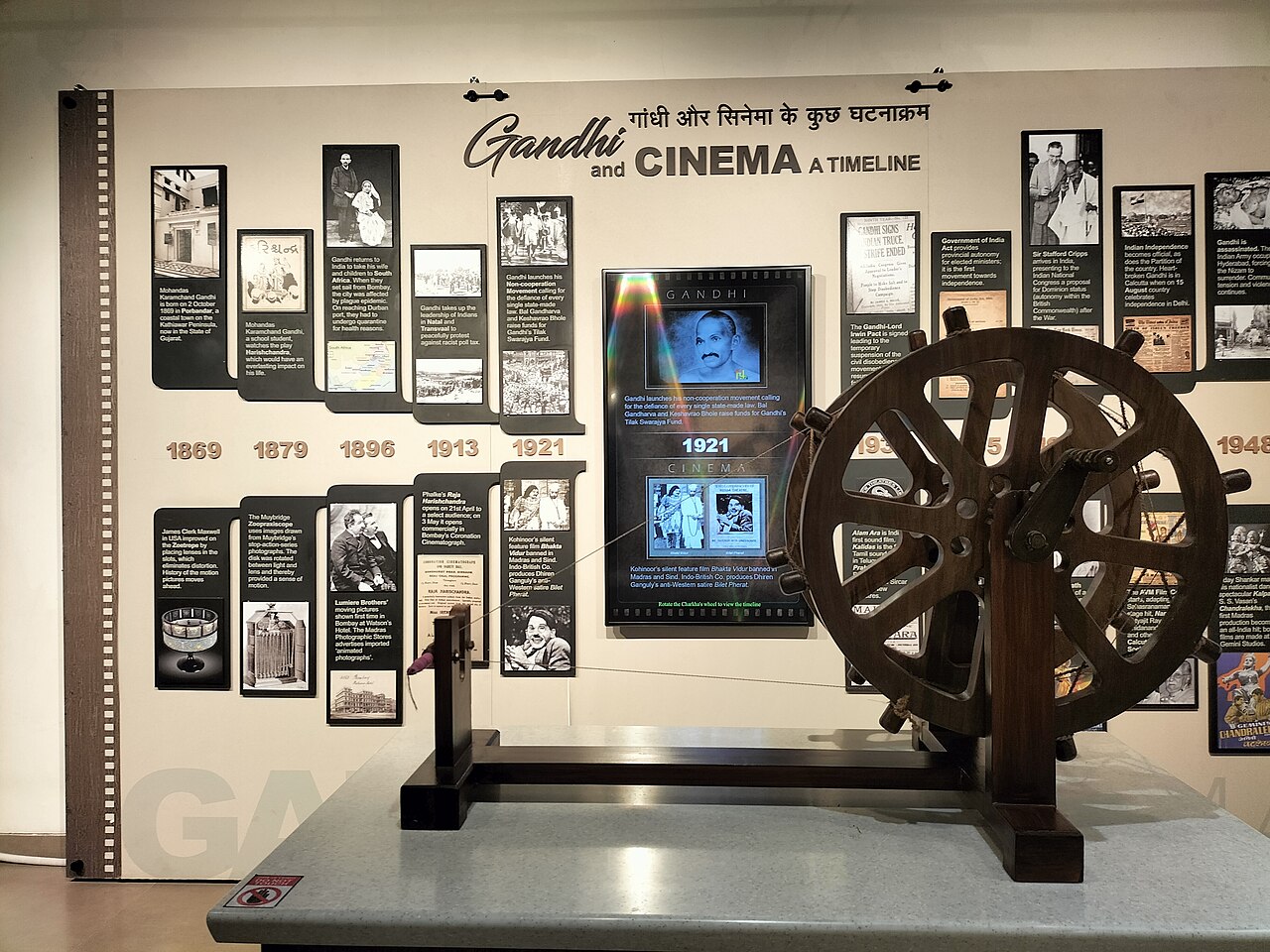
Khushi Vaishya · CC BY-SA 4.0
Interactive cinema tries to give an audience an active role in the showing of movies. Another newer definition of interactive cinema is a video game which is a hybrid between participation and viewing, giving the player – or viewer, as it were – a strong amount of control in the characters' decisions. It is compared to interactive film.
- Earliest example
- 1967 (Kinoautomat by Radúz Činčera)
Lore & Background
The earliest rudimentary examples of interactive cinema date back to the early 20th century, with 'cinematic shooting gallery' games. The first successful example of such a game was Life Targets, released in the United Kingdom in 1912. The 1967 Czechoslovak film Kinoautomat by the Czech director Radúz Činčera (presented in the Czech Pavilion at Expo 67 in Montreal) is the first cinema-like interactive movie. The first theatrical interactive film to receive a wide release was I'm Your Man, produced by Interfilm in 1992. A successor film titled Mr. Payback was produced in collaboration with Sony Pictures for the same voting system in 1995. A third film, Ride For Your Life, followed later the same year. After those two films were met with mixed reviews, the format was abandoned.
Reader's Guide
Interactive cinema includes early cinematic shooting gallery games, films like Kinoautomat and I'm Your Man, and video games such as Policenauts (1994), Shenmue (1999), and Fahrenheit (2005). Companies like Netflix used to release this form of media until it was removed on December 1st, 2024 for people not using it.
Did You Know?
- Kinoautomat (1967) is considered the first cinema-like interactive movie.
- I'm Your Man (1992) was the first theatrical interactive film to receive a wide release.
- Hideo Kojima's 1994 game Policenauts has a subtitle reading 'Interactive cinema' on its cover art.
Early Pioneers & Mechanical Origins
The roots of interactive cinema stretch back further than most gamers realize. In 1912, a British arcade game called Life Targets let players fire at a cinema screen showing film footage of targets; hitting the right moment would pause the film and register a point. These cinematic shooting gallery games, often featuring safari animals filmed in British imperial colonies, enjoyed brief popularity across Britain in the 1910s before fading. Decades later, Capitol Projector's 1954 Auto Test used a film reel projector to display pre-recorded driving footage, awarding points for correct decisions—an educational simulation rather than entertainment. In 1967, Czech filmmaker Radúz Činčera directed Kinoautomat, screened at Expo '67 in Montreal, where a live moderator on stage asked audiences to vote between two scenes, a workaround before random-access video existed. Nintendo's 1974 Wild Gunman paired 16mm film projectors with a light gun for Wild West shooting, while 1975's EVR Race let players bet on horse races played from videotape, becoming Japan's top-grossing medal game for three consecutive years.
The LaserDisc Revolution & Dragon's Lair
The invention of LaserDisc players transformed interactive cinema from electro-mechanical novelty into a viable genre. Unlike linear videotape, a LaserDisc could jump to any chapter instantaneously, enabling branching narratives assembled from out-of-order video segments—much like a Choose Your Own Adventure book built from shuffled pages. This capability powered the 1983 arcade hit Dragon's Lair, where ex-Disney animator Don Bluth crafted full-motion animated video and players guided the protagonist through a single correct sequence of moves. Choosing wrong triggered a lose-a-life scene; choosing right advanced the story. Despite offering only one successful path, the game's spectacle made it enormously popular. The hardware paired a LaserDisc player with a processor running interface software that mapped controller buttons to specific chapter jumps. The discs themselves were standard, nothing special beyond chapter ordering. However, the players proved fragile under constant arcade use, demanding frequent replacement—a practical cost of the format's arcade dominance.
Design Architecture: Branching, Choice, and the Illusion of Agency
Interactive films were constructed with a clear architectural logic. A main storyline formed the backbone, while alternative scenes—death sequences, Game Over moments, or permissible alternate paths—were filmed separately and triggered by specific player inputs. The design mirrored Choose Your Own Adventure books: a controller button at each decision point was programmed to jump to the next chapter in the successful narrative or to a death chapter if the wrong input was made. In Dragon's Lair, for instance, the player's only real agency was guessing the single move the designers intended; there was no genuine branching. Yet this constraint did not diminish the experience. Later technological advances allowed designers to overlay multiple fields of full-motion video, called vites, on top of one another, paralleling how polygonal models and sprites layer over backgrounds in traditional game graphics. This layering expanded visual complexity without abandoning the cinematic, scripted presentation that defined the genre.
From Arcade to Beyond: Technological Evolution & Industry Impact
The trajectory of interactive cinema reveals a continuous dialogue between film and gaming industries. In the video game world, the term typically denotes a movie game—titles that present gameplay in a cinematic, scripted manner through full-motion video of animated or live-action footage. In the film industry, the same phrase describes interactive cinema, where one or more viewers can influence the events unfolding on screen. Early examples like 1979's The Driver, a hit arcade game featuring live-action 16mm film of a Toei-shot car chase, and Electro-Sport's 1982 Quarter Horse, the first arcade game to use a LaserDisc player for non-interactive horse race footage, illustrate how the format straddled both worlds. An early software experiment, Rollercoaster, written in BASIC for the Apple II by David Lubar, attempted to combine a text adventure with a LaserDisc player playing portions of the 1977 American feature film of the same name. These experiments foreshadowed the genre's eventual evolution toward 3D-rendered models and the broader convergence of cinema and interactive media.
Gallery





Frequently Asked Questions
What is interactive cinema?
Interactive cinema is a storytelling format in which the audience actively shapes the narrative by making choices on behalf of the characters, rather than passively watching a fixed sequence of events. It occupies a hybrid space between a traditional film and a video game, blending cinematic presentation with player-driven decision-making.
When did interactive cinema first appear?
The earliest known example traces back to 1912 with Life Targets, exhibited in the United Kingdom. The first work that more closely mirrors a modern interactive movie is Kinoautomat, created by Radúz Činčera in 1967.
What is the first interactive film shown in a theater?
I'm Your Man, produced by Interfilm in 1992, is recognized as the first theatrical interactive film to reach a broad audience. Prior to that, interactive experiences were largely confined to arcade-style or experimental formats.
Who is a key pioneer in interactive cinema?
Hideo Kojima, born in 1963, is widely regarded as a major figure in pushing the boundaries of interactive storytelling. His 1994 title Policenauts is frequently cited as a landmark work that explicitly adopted the 'interactive cinema' label.
Did Netflix end its interactive film program?
Yes, Netflix stepped back from producing new interactive titles in November 2024 as part of a broader shift in its technology priorities. A small number of existing titles, including Black Mirror: Bandersnatch, remain available on the platform.
More in Interactive films 1-24
Spotted an error? Know more?
Reader corrections go straight into our review queue. Suggest an edit · How this site is sourced