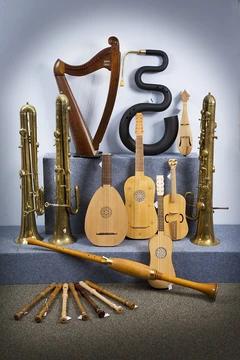
Bagpipes
A woodwind instrument with enclosed reeds fed from a bag.

A bagpipe is a woodwind instrument that produces sound when air from a sealed bag is forced through enclosed reeds. While the Scottish Great Highland bagpipe is the most famous, bagpipes have been played for centuries across much of Europe, North Africa, West Asia, the Persian Gulf region, and northern South Asia. Pipers often call their instrument "the pipes," "a set of pipes," or "a stand of pipes." Because playing requires blowing air into the instrument to create sound, bagpipes belong to the aerophone family.
A basic set of pipes includes an air supply, a bag, a chanter, and usually at least one drone. Many sets have multiple drones or chanters, held in place by stocks—sockets that attach the pipes to the bag.
The most common way to fill the bag is by blowing into a blowpipe. Some pipes require the player to cover the blowpipe tip with the tongue while inhaling to prevent the bag from deflating, but most blowpipes have a non-return valve that makes this unnecessary. Modern instruments often include devices to create a cleaner airflow and collect condensation. Using bellows to supply air dates from the 16th or 17th century. In these "cauld wind pipes," the air is not warmed or moistened by the player's breath, allowing for more delicate reeds. Examples include the Irish uilleann pipes; the border or Lowland pipes, Scottish smallpipes, Northumbrian smallpipe, and pastoral pipe in Britain; the musette de cour, musette bechonnet, and cabrette in France; and the dudy, koziol bialy, and koziol czarny in Poland.
The bag is an airtight reservoir that holds air and regulates its flow through arm pressure, letting the player produce a continuous, even sound. The player keeps the bag inflated by blowing or pumping. Bags are often made from the skins of local animals like goats, dogs, sheep, or cows. Synthetic materials such as Gore-Tex have become more common; some synthetic bags have zips for fitting moisture traps inside. However, synthetic bags can still harbor fungal spores and risk lung infection if not kept clean, though they generally need less cleaning than natural bags. Bags cut from larger materials are usually saddle-stitched, with an extra strip folded over the seam and stitched (for skin) or glued (for synthetic) to reduce leaks. Holes are then cut for the stocks. When made from whole animal skins, stocks are often tied where the limbs and head joined the body, a technique common in Central Europe. Hide treatments vary: some use only salt, while others involve milk, flour, and removing the fur. The hide is typically turned inside out so the fur lines the bag’s interior, reducing moisture buildup.
The chanter is the melody pipe, played with both hands. Every bagpipe has at least one chanter; some, especially in North Africa, the Balkans, and Southwest Asia, have two. The chanter’s bore may be cylindrical or conical. Popular woods include boxwood, cornel, plum, and other fruit woods. Most chanters are open-ended, so the pipe cannot be easily silenced. This forces a constant legato sound with no rests. To create the illusion of articulation and accents, players use technical movements called embellishments or ornaments, which are often highly specific to each type of pipe and require years of study. A few bagpipes—such as the musette de cour, uilleann pipes, Northumbrian smallpipes, piva, and the left chanter of the surdelina—have closed ends or stop against the player’s leg, allowing the chanter to go silent when all holes are covered. A practice chanter is just the chanter without the bag or drones, using a quieter reed for silent practice. The word "chanter" comes from the Latin *cantare*, meaning "to sing," like the modern French *chanter*. A distinctive feature of the gaida’s chanter is the "flea-hole," a small tube often made of metal or a chicken or duck feather, covered by the left index finger. Uncovering it raises any note by a half step and is used for ornamentation in Balkan music. Some gaida types have a double-bored chanter, such as the Serbian three-voiced gajde, which has eight fingerholes: the top four covered by the left thumb and first three fingers, and the remaining four by the right hand’s fingers. The chanter’s note is produced by a reed at its top, which may be a single reed with one vibrating tongue.
- classification
- Aerophone
- air_supply_methods
- Blowpipe or bellows
- minimum_components
- Air supply, bag, chanter, and usually at least one drone
- common_materials_for_bag
- Animal skins (goat, dog, sheep, cow) or synthetic materials like Gore-Tex
- chanter_reed_types
- Single or double reed
- historical_evidence_earliest
- Uncertain prior to 13th century; possible Hittite slab from circa 1000 BCE
Lore & Background
A set of bagpipes minimally consists of an air supply, a bag, a chanter, and usually at least one drone. Many bagpipes have more than one drone in various combinations, held in place in stocks—sockets that fasten the various pipes to the bag. The most common method of supplying air to the bag is through blowing into a blowpipe or blowstick, though the use of a bellows to supply air is an innovation dating from the 16th or 17th century. The bag is an airtight reservoir that holds air and regulates its flow via arm pressure, allowing the player to maintain continuous, even sound. Materials used for bags vary widely, but the most common are the skins of local animals such as goats, dogs, sheep, and cows; more recently, synthetic materials including Gore-Tex have become much more common.
Reader's Guide
The chanter is the melody pipe, played with two hands. All bagpipes have at least one chanter; some pipes have two chanters, particularly those in North Africa, in the Balkans, and in Southwest Asia. The chanter is usually open-ended, so most bagpipes share a constant legato sound with no rests in the music. Because of this inability to stop playing, technical movements are made to break up notes and to create the illusion of articulation and accents. Most bagpipes have at least one drone, a pipe that generally is not fingered but rather produces a constant harmonizing note throughout play. The evidence for bagpipes prior to the 13th century is still uncertain, but several textual and visual clues have been suggested, including a possible Hittite slab from circa 1000 BCE and references by ancient Greek and Roman authors. Modern scholarship suggests that such instruments were understood as variants on mouth-blown instruments that used a bag as an alternative blowing aid, and that it was not until drones were added in the European Medieval era that bagpipes were seen as a distinct class.
Did You Know?
- The term 'chanter' is derived from the Latin cantare, or 'to sing'.
- Some bagpipes have a 'flea-hole' (also known as a mumbler or voicer) that raises any note played by a half step.
- Bellows-driven bagpipes are sometimes called 'cauld wind pipes' because the air is not heated or moistened by the player's breathing.
- A practice chanter is a chanter without bag or drones and has a much quieter reed.
Common Misconceptions (Editorial)
A common misconception is that bagpipes are exclusively Scottish. In fact, bagpipes have been played for centuries throughout large parts of Europe, North Africa, West Asia, around the Persian Gulf, and northern parts of South Asia. Another misconception is that all bagpipes are blown by mouth; however, the use of bellows to supply air is an innovation dating from the 16th or 17th century.
Why It Matters (Editorial)
Bagpipes endure because their distinctive, drone-driven sound creates an immediate emotional connection, whether in celebration or mourning. They also represent a remarkable example of human ingenuity in instrument design, using a simple airtight bag to produce a continuous, steady tone that no other wind instrument can replicate.
Frequently Asked Questions
What exactly is a bagpipe?
A bagpipe is a woodwind instrument in which enclosed reeds are fed air from a constant reservoir stored in a bag. It belongs to the aerophone family because sound is produced by blowing air through the instrument.
What are the minimum parts a bagpipe must have?
At minimum, a bagpipe requires an air supply mechanism, the bag itself, a chanter, and usually at least one drone. The air can be fed via a blowpipe or bellows depending on the design.
What is the bag made of?
Traditionally the bag is crafted from animal skins such as goat, dog, sheep, or cow. Modern versions often use synthetic materials like Gore-Tex instead.
How old are bagpipes and where is the earliest evidence?
Concrete historical evidence for bagpipes is uncertain before the 13th century, though a possible Hittite slab dating to roughly 1000 BCE has been suggested as an early depiction. The instrument has been played across Europe, North Africa, West Asia, the Persian Gulf region, and northern South Asia for centuries.
What type of reed does the chanter use?
The chanter can be fitted with either a single reed or a double reed. This is one of the key design choices that shapes the instrument's tonal character.
More in Musical Instruments 1-22
Spotted an error? Know more?
This is a living reference — every entry is fact-audited, and reader corrections feed straight into our audit queue. Suggest an edit · See this site's audit record