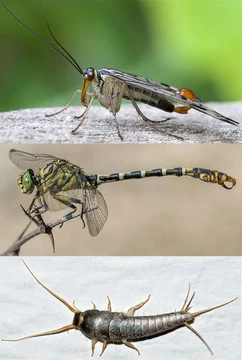
Springtail
Small hexapods that jump using a tail-like furcula.

Springtails (class Collembola) are the largest of the three lineages of modern hexapods no longer considered insects, the others being Protura and Diplura. They are omnivorous, free-living organisms that prefer moist conditions and contribute indirectly to decomposition through fragmentation of organic matter and control of soil microbial communities. With over 9,000 species worldwide, they are found in a wide range of terrestrial habitats.
Quick Facts
- Taxon
- Collembola
Facts from the source article.
Lore & Background
Springtails are distinguished by a tubular appendage called the collophore on the first abdominal segment, which secretes sticky vesicles and aids in adhesion, fluid uptake, excretion, and orientation during jumps. Most species also have a furcula, a tail-like appendage folded under the body and held by a retinaculum; when released, it snaps against the substrate, flinging the animal into the air in milliseconds. Their body form varies: Poduromorpha and Entomobryomorpha have elongated bodies, while Symphypleona and Neelipleona are globular. They lack tracheae except for two families that have a single pair of spiracles, and they respire through a porous cuticle.
Reader's Guide
Springtails are significant as one of the three hexapod lineages no longer classified as insects, highlighting the ongoing refinement of arthropod taxonomy based on molecular phylogenetics. Their internal mouthparts place them in the group Entognatha, but DNA studies show they are not more closely related to each other than to insects. The classification of springtails has shifted from order to subclass to full class depending on the taxonomic framework. Their ancient lineage is attested by the Early Devonian fossil Rhyniella praecursor, one of the oldest known terrestrial arthropods. Ecologically, they play a key role in soil health by fragmenting organic matter and regulating microbial communities, though they do not directly decompose material. Their ability to shrink body size under heat or contamination is a unique adaptive response. Despite their abundance, springtails have been neglected in genomic studies; the first high-quality genome, of Orchesella flavescens, was assembled in 2025.
Did You Know?
- Springtails can reduce their body size by up to 30% through moulting if temperatures rise high enough.
- The collophore was once thought to stick to surfaces to stabilize the creature; its name comes from Greek words for 'glue' and 'peg'.
- Most springtails lack a tracheal system and respire through a porous cuticle, except for two families with a single pair of spiracles.
- The oldest known springtail fossil, Rhyniella praecursor, dates from the Early Devonian, about 400 million years ago.
Taxonomic Identity and Evolutionary Debates
Springtails occupy a contested position in the arthropod family tree. As the class Collembola, they represent the largest of three hexapod lineages no longer classified as insects, the others being Protura and Diplura. These three are sometimes grouped under the class Entognatha on the basis of shared internal mouthparts, yet molecular data indicate they are no more closely related to one another than to true insects, which bear external mouthparts. Early DNA sequencing studies suggested Collembola diverged as a separate evolutionary line from other hexapods, a conclusion other researchers challenged. The disagreement appears rooted in widely divergent molecular evolutionary rates across arthropod groups, complicating any clean reconstruction of their relationships. This ambiguity carries practical taxonomic consequences: included with insects, springtails rank as an order; nested within Entognatha, they become a subclass; placed directly under Hexapoda, they are elevated to full class status. With more than 9,000 described species worldwide, resolving their exact position continues to shape how scientists interpret the broader architecture of land-dwelling arthropods.
The Jumping Machine and Body Architecture
The furcula is the springtail's signature structure: a tail-like appendage on the ventral side of the fourth abdominal segment, folded beneath the body and locked under tension by a small structure called the retinaculum. When the lock releases, the furcula snaps against the substrate in a few milliseconds, flinging the animal into the air for rapid evasion or short-distance travel. The collophore, a tubular tube projecting ventrally from the first abdominal segment, was long thought to be a simple adhesive for clinging to surfaces. Modern understanding reveals a far broader toolkit: fastening the body on smooth substrates, fluid uptake and excretion, cleaning the cuticle, and aiding orientation mid-jump. Body plans diverge sharply across the group. Poduromorpha and Entomobryomorpha display elongated, conspicuously segmented bodies, while Symphypleona and Neelipleona are compact and globular. Most species stay under 6 millimeters, though atmobiotic forms can reach 8 to 10 millimeters. Remarkably, springtails can genetically shrink by up to 30 percent through successive moults when temperatures rise, a metabolic adaptation that curbs energy expenditure in warmer conditions.
Ecological Niche and Habitat Stratification
Springtails are omnivorous, free-living organisms that favor moist conditions, yet their ecological role is more nuanced than simple decomposition. They do not chemically break down organic matter themselves; instead, they fragment it and regulate the soil microbial communities that perform the heavy biochemical work, making them critical intermediaries in nutrient cycling. Their morphology is tightly coupled to vertical position in a terrestrial ecosystem. Atmobiotic species perch on vegetation and litter surfaces, reaching 8 to 10 millimeters with dark pigmentation, long limbs, and a full set of up to eight ocelli. Epedaphic forms occupy upper litter layers and fallen logs, slightly smaller with less pigment and less developed limbs and photoreceptors. Hemiedaphic species, just 1 to 2 millimeters long, inhabit lower decomposing layers with shortened limbs and a reduced number of ocelli. Euedaphic springtails live in the humus horizon of mineral soil; they are the smallest, soft-bodied, unpigmented, eyeless, and often lack a functional furcula. This gradient from canopy to deep soil mirrors a progressive loss of light-sensing organs and locomotor complexity.
Breathing, Digesting, and Sensing Without an Insect's Toolkit
Most springtails lack a tracheal respiration system entirely, exchanging gases through a porous cuticle—a constraint that anchors them to moist microhabitats. Two families, Sminthuridae and Actaletidae, are exceptions, possessing a single pair of spiracles between head and thorax that feeds a rudimentary but fully functional tracheal network. Their digestive tract divides into foregut, midgut, and hindgut. The midgut, lined with a monolayer of columnar or cuboidal cells and wrapped in a muscular network, mixes and propels food toward the hindgut. Its lumen hosts a diverse microbiome of syntrophic bacteria, archaea, and fungi, supported by a pH gradient: the anterior midgut and hindgut sit near 6.0 while the posterior midgut reaches about 8.0, each zone tuned for distinct enzymatic and microbial activity. A muscular pyloric sphincter separates midgut from hindgut. Springtails have no Malpighian tubules; excretion and osmoregulation are handled by the eversible vesicles of the collophore. Sensory perception relies on tactile hairs and sensilla across dorsal surfaces and legs, plus chemoreceptive vesicles concentrated on the antennae. Most species exhibit negative phototaxis, actively fleeing from light.
More in Insects And Their Relatives 1-21
Spotted an error? Know more?
Reader corrections go straight into our review queue. Suggest an edit · How this site is sourced